
Beyond The 90-Crore Milestone: How ABHA Is Reshaping India's Digital Health Ecosystem
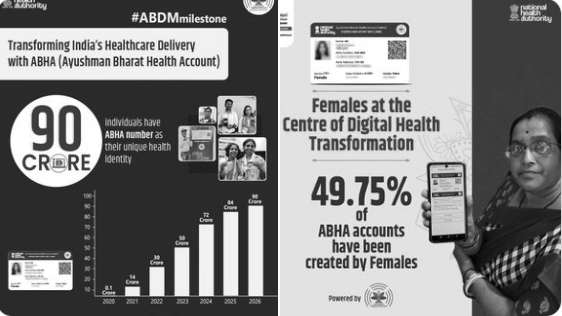
India's ambitious push to build a nationwide digital healthcare network has crossed a major milestone, with more than 90 crore Ayushman Bharat Health Accounts (ABHAs) now created under the Ayushman Bharat Digital Mission (ABDM) . The achievement marks one of the world's largest digital health initiatives and signals the rapid expansion of a healthcare ecosystem designed to connect patients, hospitals, doctors, laboratories and insurers through a common digital platform.
Launched under the Ministry of Health and Family Welfare and implemented by the National Health Authority (NHA) , the mission aims to create a secure, interoperable and citizen-centric healthcare framework. At the centre of this effort is the ABHA number , a unique 14-digit digital health identity that allows individuals to link, access and share their medical records across healthcare providers with their consent.
The scale of growth has been remarkable. Cumulative ABHA creation rose from 14.7 crore accounts in 2021 to 30.4 crore in 2022 , 50.6 crore in 2023 , 72.2 crore in 2024 , and 84.5 crore in 2025 , before crossing the 90-crore mark in 2026. The steady increase reflects growing adoption of digital health services by citizens as well as healthcare institutions across the country.
According to Dr. Sunil Kumar Barnwal , Chief Executive Officer of the National Health Authority, the milestone demonstrates the increasing participation of citizens, states, Union Territories and ecosystem partners in the mission. He said ABHA represents an important step towards giving individuals secure, consent-based access to their health information while reducing dependence on physical records and enabling continuity of care.
The achievement also highlights the emergence of healthcare as India's next major Digital Public Infrastructure (DPI) success story. After the widespread adoption of systems such as Aadhaar and UPI , the government is attempting to create a similar digital backbone for healthcare through ABDM.
Beyond ABHA, the mission includes several interconnected digital platforms, including the Healthcare Professionals Registry (HPR) , Health Facility Registry (HFR) , Health Information Exchange and Consent Manager (HIE-CM) , Unified Health Interface (UHI) and the National Health Claims Exchange (NHCX) . Together, these systems are intended to enable secure exchange of health information and streamline healthcare delivery across public and private sectors.
The state-wise distribution of ABHA accounts reflects widespread adoption across the country. Uttar Pradesh leads with more than 15.3 crore ABHAs , followed by Rajasthan and Maharashtra with over 7.1 crore accounts each . Bihar has crossed 6.3 crore , while West Bengal has recorded nearly 5.9 crore ABHAs . Significant contributions have also come from Madhya Pradesh, Gujarat, Andhra Pradesh, Odisha and Karnataka .
However, the success story is not limited to absolute numbers. Several states and Union Territories have achieved exceptionally high levels of coverage relative to their populations. Andaman and Nicobar Islands, Ladakh, Lakshadweep, Dadra and Nagar Haveli and Daman and Diu have reported full ABHA saturation. Among larger states, Andhra Pradesh has emerged as a standout performer with 98.5 per cent saturation , followed by Odisha (91.9 per cent) , Chandigarh (90.8 per cent) , Rajasthan (89.7 per cent) and Himachal Pradesh (88.9 per cent) .
The near-universal coverage achieved by Andhra Pradesh demonstrates how digital health initiatives are increasingly reaching citizens beyond metropolitan centres and into rural and semi-urban regions. Health officials view such penetration as critical to ensuring equitable access to digital healthcare services.
Another notable aspect of the milestone is the growing participation of women. According to official data, women account for 49.75 per cent of all ABHA holders , indicating that digital health adoption is becoming increasingly inclusive. The government believes that easier access to digital records can strengthen maternal healthcare, child immunisation tracking and long-term health management for women, particularly in underserved areas.
For patients, the practical benefits of ABHA extend beyond account creation. Digital health records can help reduce the need to carry physical prescriptions, laboratory reports and medical files. Individuals can securely share their medical history with healthcare providers when required, potentially reducing duplication of tests and improving treatment continuity.
Experts believe such interoperability could prove particularly valuable for patients with chronic illnesses who often receive treatment from multiple hospitals or specialists. A connected health ecosystem could help healthcare providers access relevant medical histories more efficiently while improving transparency and convenience for patients.
At the same time, the rapid expansion of digital health infrastructure raises important questions about data privacy, cybersecurity and informed consent . As more health records move online, ensuring robust safeguards against misuse and unauthorised access will remain essential to maintaining public trust in the system.
The crossing of the 90-crore mark therefore represents more than just a numerical achievement. It signals the growing foundation of a national digital health network that could transform how healthcare is delivered, accessed and managed in India. The next challenge will be ensuring that these accounts translate into meaningful usage, seamless record-sharing and better health outcomes for millions of citizens across the country.