
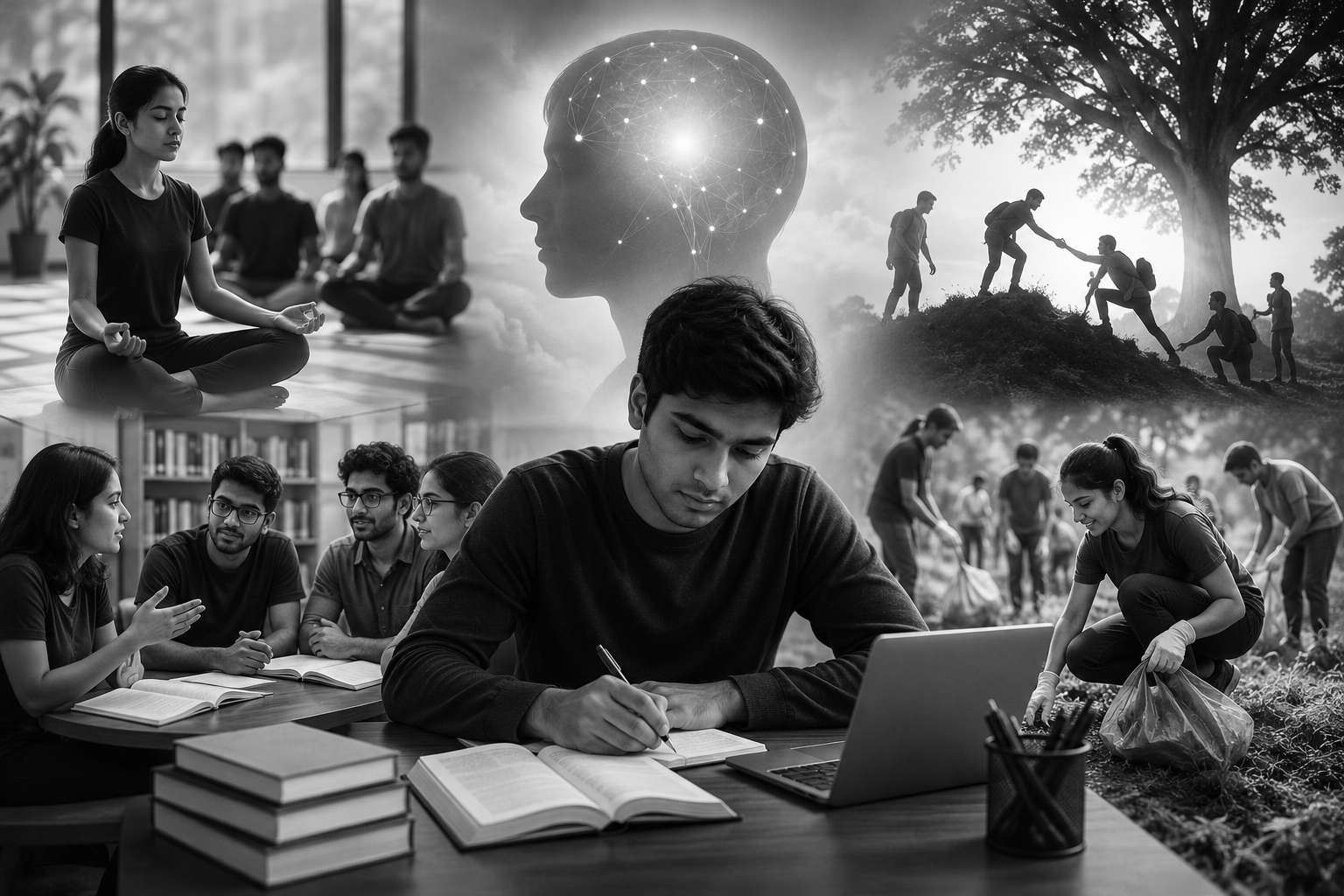
Beyond Degrees: How Holistic Education Can Build Stronger Students and Communities
Higher education has traditionally focused on building knowledge, professional skills and career opportunities. Universities teach students how to solve scientific problems, develop technology, conduct research and prepare for increasingly competitive workplaces. But as the demands of modern life become more complex, a larger question is gaining importance: Can education also help students build the inner strength needed to manage themselves and contribute meaningfully to society?
Across India and other parts of the world, universities are increasingly exploring partnerships and programmes centred on student well-being, personal development, mindfulness, human values, communication and community engagement. These collaborations are based on a simple idea: a degree can prepare a student for a profession, but a broader educational experience can help prepare that student for life.
The recent IIT Kanpur initiative involving ISKCON, which proposes voluntary programmes in areas including self-management, wellness, personal development, stress management and self-esteem, has brought renewed attention to this wider model of education. The proposed courses are designed as short structured programmes, with participation left entirely to interested students. More importantly, the idea fits into a broader effort by educational institutions to recognise that student development extends beyond academic performance.
A Broader Role for Higher Education
A university can teach mathematics, engineering, science and technology. It can train students to analyse problems and develop specialised expertise. But students also need to learn how to organise their time, manage attention, communicate effectively and respond to setbacks.
A highly talented student may still struggle with concentration. Someone with strong academic ability may find it difficult to maintain consistency. Another student may need greater confidence while speaking, working in a team or facing an unfamiliar situation.
These are not shortcomings unique to young people today. They are human challenges. But the modern environment has made some of them more complex. Students now navigate a world of constant information, digital engagement, intense competition and rapidly changing opportunities.
This is where personal-development programmes can add another dimension to education. Their purpose is not to replace academic learning. Instead, they can complement it by helping students develop self-awareness, discipline, focus and emotional resilience.
Building Habits That Strengthen the Mind
One of the most valuable outcomes of structured self-development is the creation of positive habits.
Students are often told to concentrate, manage their time and remain disciplined. But knowing what to do and consistently doing it are two different things. Regular practice can help bridge that gap.
Planning the day, setting priorities, reducing unnecessary distractions, reflecting on mistakes and pausing before reacting can gradually become part of a student's normal behaviour.
In simple terms, practice becomes habit, and habit shapes behaviour.
This is why structured programmes can be useful. They provide students with time and space to practise skills that may otherwise remain only good intentions. Over time, greater self-management can help students bring more consistency to their academic work and personal lives.
Learning How to Think More Clearly
A good educational experience should not simply fill a student's mind with information. It should also strengthen the ability to examine information.
Critical thinking begins with asking questions. What is the evidence? What assumptions am I making? Is there another perspective? What could be the consequences of my decision?
These skills are increasingly important in a world where students encounter enormous amounts of information every day.
Personal-development and value-based programmes can encourage reflection, discussion and thoughtful decision-making. Their real value lies not in telling students what to think, but in helping them learn how to think.
Students who develop the habit of questioning assumptions can become more thoughtful learners and more responsible professionals. They can learn to approach problems with curiosity rather than fear and to consider different perspectives before reaching conclusions.
The Human Skills Beyond the Syllabus
Some of the most important skills in life cannot always be measured through examinations.
Effective listening is one of them. Listening requires attention, patience and genuine interest in understanding another person's perspective. These qualities are valuable in friendships, families, workplaces and leadership.
Communication and teamwork are equally important. A student may have a brilliant idea, but the ability to explain it clearly and work with others often determines whether that idea can become reality.
Students can also benefit from developing healthy spontaneity, the confidence to respond when situations do not go according to plan. This does not mean acting without thinking. It means developing trust in one's ability to handle uncertainty.
Group discussions, public speaking, volunteering and collaborative activities can help students develop this confidence. Gradually, the fear of asking “What if I make a mistake?” can give way to a more constructive mindset: “I can learn from the experience and handle what comes next.”
A Model Already Taking Shape in India
While there is no single nationwide database that counts every Indian university involved in partnerships related to well-being, mindfulness or value-based education, several documented examples show that the model already exists across different institutions.
IIT Kanpur partnered with The Art of Living Foundation in 2025 for a holistic student well-being programme focused on areas including mental resilience, stress management and personal growth. The programme included meditation, breathing techniques, mindfulness practices, interactive sessions and group activities.
At IIIT Sri City in Andhra Pradesh, a formal collaboration with The Art of Living was designed to promote a value-based and socially responsible campus environment. Its objectives included decision-making, time management, communication, leadership, interpersonal relationships, ethics and integrity, while a credited course titled “Foundation in Human Values” formed part of the initiative.
Dr Babasaheb Ambedkar Technological University in Maharashtra also entered into a partnership with The Art of Living Trust focused on holistic education, mental well-being and human values. Suryadatta Institutes in Pune have similarly documented programmes connected with holistic student development and value-based education.
These examples demonstrate that Indian institutions are increasingly exploring ways to bring personal development alongside professional education.
From Personal Growth to Community Impact
The potential impact of such programmes does not stop when students leave the classroom.
Students carry their habits into families, friendships, workplaces and communities. A student who becomes more disciplined can become a more dependable teammate. Someone who develops stronger listening skills can build better relationships. A student who learns responsibility may be more willing to mentor others and participate in community initiatives.
This creates a positive multiplier effect:
Individual growth → stronger relationships → healthier communities.
The impact becomes even greater when personal development is connected with service and social responsibility.
Students can apply their skills through mentoring, volunteering, educational outreach, environmental programmes and other forms of community engagement. In this way, the educational journey moves beyond the question, “How can I succeed?” and towards another equally important question: “How can my knowledge and abilities benefit others?”
Well-Being as a Complement to Academic Excellence
The strongest approach is not to view academic excellence and personal development as competing priorities. They can strengthen one another.
A student who learns to manage time effectively may study with greater consistency. A student who develops better communication skills may perform more effectively in teams. Someone with greater self-awareness may make better decisions under pressure.
Personal-development programmes can also encourage students to develop a sense of purpose and direction. That sense of purpose can come from different sources—spirituality, philosophy, ethics, science, family values or service to society.
The important principle is that students should have the freedom to choose their own path.
Measuring the Real Impact
As more universities explore such partnerships, the next important step is to understand their long-term impact.
Institutions can examine student participation, feedback and engagement, while also studying whether programmes contribute to stronger self-management, communication, resilience and community participation.
The goal should be continuous improvement. Universities can identify what works, strengthen effective programmes and adapt those that do not meet students' needs.
A meaningful partnership should ultimately be judged by one question: Does it help students become stronger, more capable and more responsible individuals?
Education for Life
The future of higher education may increasingly depend on finding the right balance between professional knowledge and personal capability.
Universities will continue to teach students how to design technology, conduct research and solve complex problems. But students will also face challenges that no textbook alone can solve.
They will need to manage attention, work with people who think differently, recover from failure, make responsible choices and remain confident during uncertainty.
These are the qualities that shape not only careers but lives.
That is why partnerships focused on well-being, values, self-management and human development can offer an important addition to the university experience.
A university can help a student build professional capability.
A broader education can help the student build the character, confidence and inner strength to use that capability wisely for personal growth, professional success and the betterment of the community.