
Beyond 50%? Telangana’s Quota gamble faces legal reality
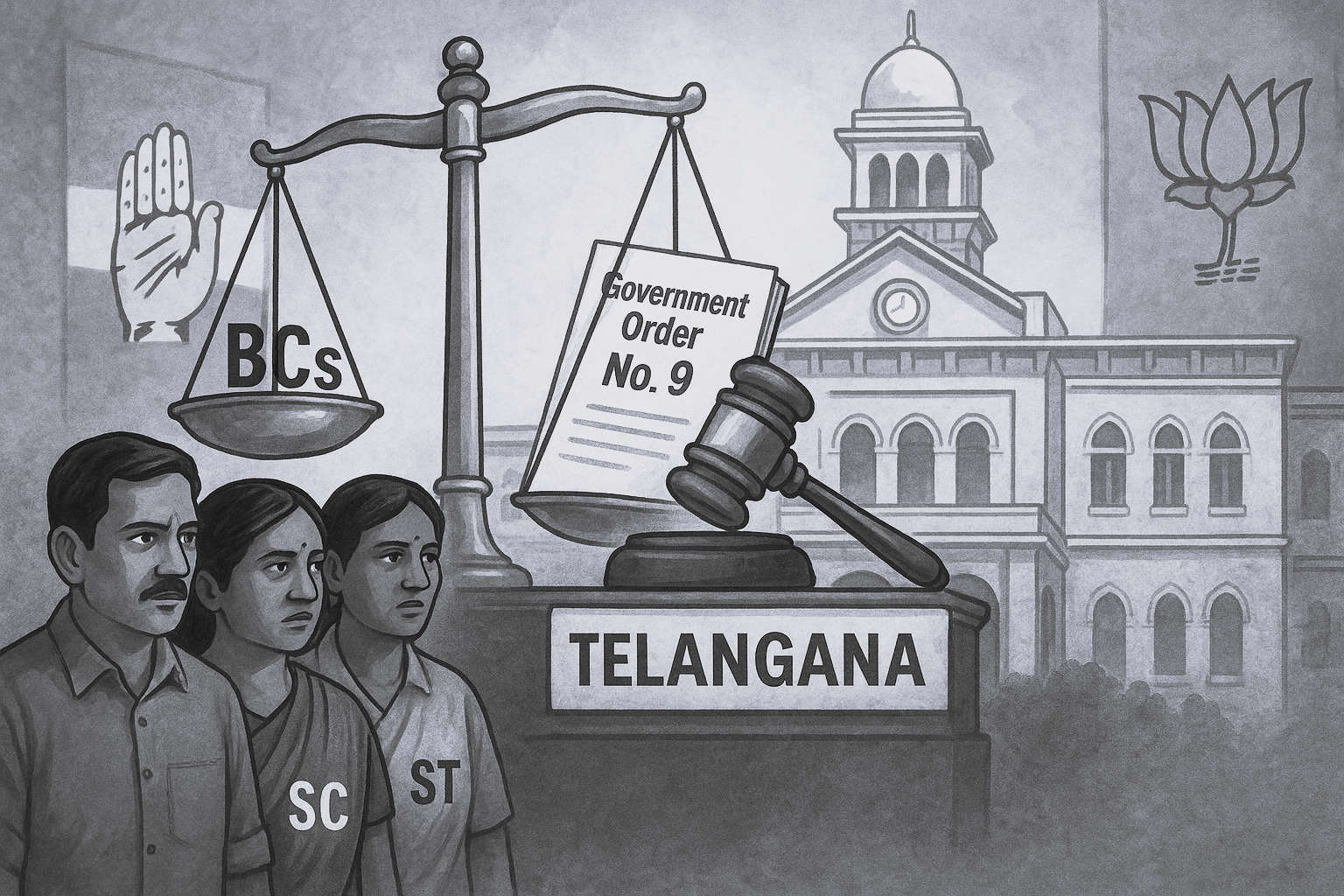
In a major setback to the Telangana government, the High Court on Thursday struck down the state’s attempt to increase caste-based reservations in local bodies beyond the 50 percent ceiling. The court stayed Government Order No. 9, observing that raising Backward Classes’ share to 42%, alongside 15% for Scheduled Castes and 10% for Scheduled Tribes, violates the constitutional limit established in the Indra Sawhney (Mandal) case. The verdict rekindles India’s long-running debate over how far affirmative action can go before it begins to erode the principle of equality.
Equality and affirmative action - What the constitution allows
The Indian Constitution carefully balances two powerful ideas: equality before law (Article 14) and special provisions for disadvantaged groups (Articles 15(4) and 16(4)).
While Article 14 ensures equal treatment, Articles 15(4) and 16(4) empower the State to provide reservations for socially and educationally backward classes, SCs, and STs. This dual mandate equality versus social justice has shaped decades of litigation and legislation.
From Mandal to Indra Sawhney - How the 50% rule was born
The Mandal Commission (1980) identified multiple backward classes and recommended 27% OBC reservations, triggering protests when implemented in 1990. In Indra Sawhney v. Union of India (1992), the Supreme Court upheld OBC quotas but introduced a vital restraint total reservations should not exceed 50%, except in extraordinary circumstances supported by data. The Court reasoned that unchecked quotas would “virtually obliterate equality of opportunity” under Article 16. Thus, the 50% ceiling became a judicially entrenched benchmark, a product of what jurists call “harmonious construction” between equality and affirmative action.
Nagaraj and later cases - data, not declarations
In M. Nagaraj (2006) , the Supreme Court clarified that any deviation from established limits must rest on quantifiable data proving three things:
• The backwardness of the community,
• Its inadequate representation, and
• That administrative efficiency will not be impaired.
Subsequent cases have reaffirmed that empirical evidence , not political will, must drive policy expansion.
Tamil Nadu’s 69% exception - a political route through the Ninth Schedule
Tamil Nadu remains the only state with total reservations above 50%, fixed at 69%.
It achieved this by enacting a special law and placing it in the Ninth Schedule of the Constitution (Article 31B), which shields certain laws from ordinary judicial review.
However, in I.R. Coelho v. State of Tamil Nadu (2007), the Supreme Court ruled that even Ninth Schedule laws can be tested if they violate the basic structure of the Constitution including the equality principle. Thus, Tamil Nadu’s path, though bold, is legally fragile and difficult for others to imitate.
Telangana’s legal and political tangle
The Telangana Congress government defended its move by citing a door-to-door socio-economic survey, claiming it shows exceptional backwardness among BCs in rural areas. Petitioners countered that the government failed to meet the Indra Sawhney standards and that the move breached both constitutional and statutory limits.
The High Court, siding with judicial caution, stayed the order and directed the state to produce data-backed justification. The ruling halts the local body election process for now and sets up a high-stakes constitutional test.
The political calculus
The Congress government’s decision to expand BC quotas had clear electoral motives, appealing to large backward communities that form its voter base. However, the gamble risks backfiring if courts strike it down, making it look like symbolic politics rather than structural reform.
At the national level, the BJP-led Central Government is unlikely to endorse Telangana’s move to push the law into the Ninth Schedule, which would require Parliament’s approval. For the BJP, doing so would be “poking a honey bee nest” reopening the quota debate nationally without any political benefit. Supporting a Congress-led initiative would only allow the rival party to claim credit among backward classes, while the BJP would bear the cost of defending a legally risky expansion.
Moreover, the BJP’s ideological preference has been to shift from caste-based quotas to economic criteria and welfare-based inclusion, avoiding the political minefield of expanding caste reservations.
Why other states failed to cross the line
Several states, including Maharashtra, Rajasthan, and Haryana, have tried to exceed the 50% limit through special quotas for Marathas, Jats, and Gujjars. Each attempt was struck down by courts citing the Indra Sawhney precedent and lack of extraordinary data-based justification. These consistent rulings show that courts will not tolerate blanket breaches of the ceiling.
The way forward for Telangana
To succeed where others failed, Telangana must shift from political signalling to evidence-based policy .
It should:
• Publish complete socio-economic data proving exceptional backwardness among BCs.
• Demonstrate “extraordinary circumstances” unique to local bodies, not a statewide claim.
• Adopt legislative backing , ensuring parliamentary debate and a clear rationale.
• Avoid relying solely on the Ninth Schedule , which offers no absolute immunity.
Conclusion: Proof, not politics, will decide the future
The Telangana government’s intent to expand representation for backward communities aligns with the spirit of social justice but method matters. With the BJP-led Centre unwilling to back a Ninth Schedule route both because it’s politically explosive and electorally unrewarding the Congress government cannot expect Delhi’s cooperation.
Therefore, Telangana’s only viable path is through hard evidence and constitutional discipline.It must produce foolproof, quantifiable data proving that its backward communities are exceptionally disadvantaged socially, economically, and politically. Only such a transparent, data-driven approach can withstand judicial scrutiny and transform a political gamble into a lasting constitutional achievement.