
Bengaluru Proposes Paid Residential Parking, Fees Up to ₹25,000
Greater Bengaluru Authority (Parking) Rules, 2026 proposing annual residential parking permits of up to ₹25,000 for SUVs, could soon change how residents park vehicles on public roads outside their homes. The draft rules seek to introduce a permit-based system for residential roadside parking, with fees varying according to vehicle type and stricter conditions on where and how vehicles can be parked.
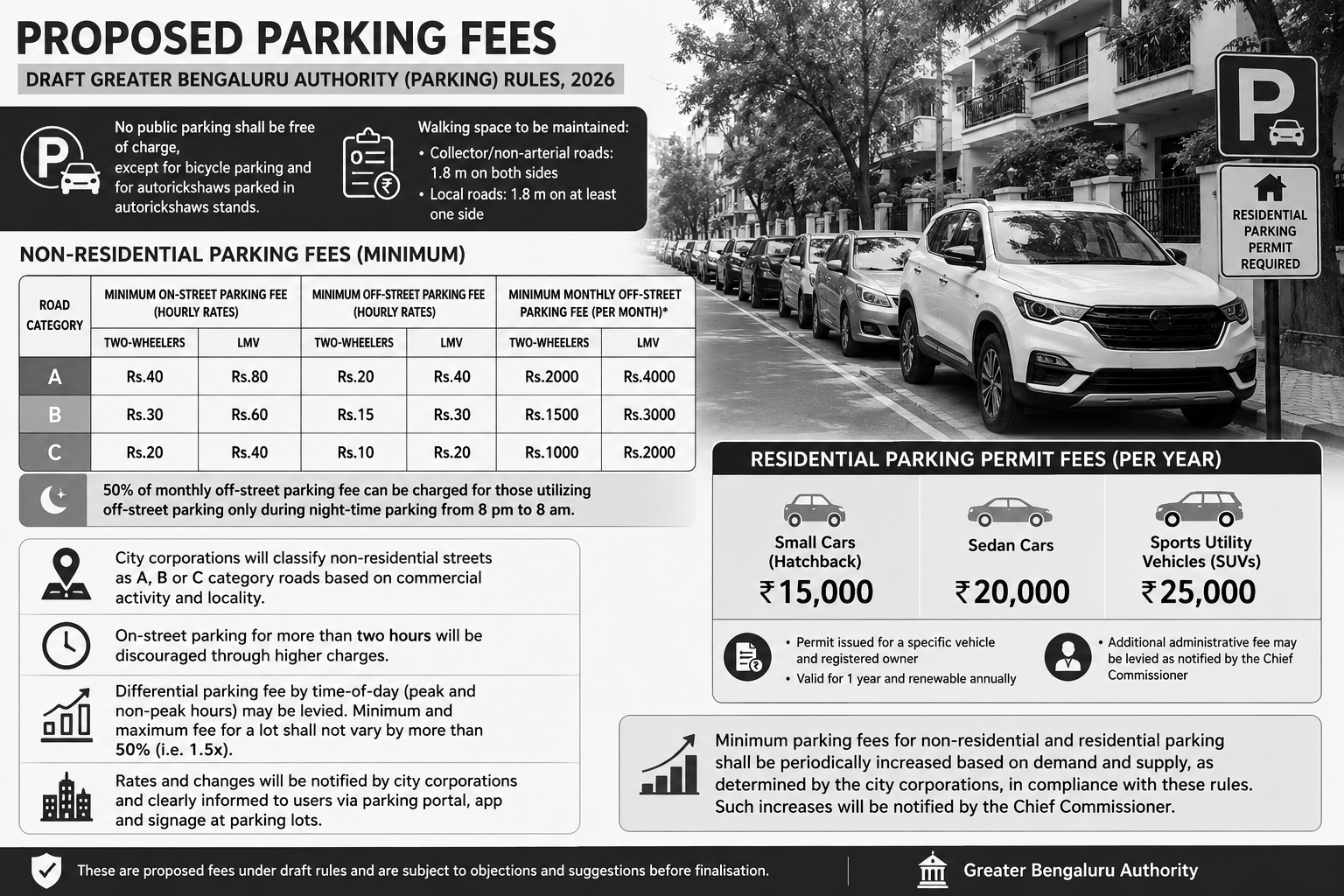
Under the proposal, annual residential parking permits would cost ₹15,000 for hatchbacks, ₹20,000 for sedans and ₹25,000 for SUVs. An additional administrative fee may also be imposed, with the amount to be determined by the Greater Bengaluru Authority’s chief commissioner.
The permit would be issued for a specific vehicle and its registered owner, remain valid for one year and require annual renewal after verification that the applicant continues to reside in the area. It would be valid only on roads designated for residential parking and located within walking distance of the resident’s home.
Importantly, paying the fee would not give residents ownership or exclusive rights over the road outside their homes. It would only permit the registered vehicle to use designated public road space under the prescribed conditions.
Eligibility could become a contentious aspect of the proposal. Residential permits would be issued only to residents of buildings that comply with the minimum parking requirements under building bye-laws. Residents of houses or buildings without the prescribed on-site parking may therefore face difficulties obtaining a permit.
The rules are part of a wider attempt to transform Bengaluru’s parking system from largely informal roadside parking to a managed and paid model. Proposed on-street parking charges for light motor vehicles could range from ₹40 to ₹80 an hour, depending on the road category, while off-street parking is envisaged as a comparatively cheaper option.
The proposed framework also seeks to encourage alternatives, including private parking facilities, multi-level parking and vacant private land. Earlier this year, the GBA floated tenders for pay-and-park facilities across 23 corridors, potentially giving private operators a larger role in managing parking and collecting fees.
The draft lays down specific road-space requirements for residential parking. On collector or non-arterial roads, at least six metres of road space must remain available for traffic, while 1.8 metres of clear walking space must be maintained on both sides. On local roads, four metres must remain available for traffic, with 1.8 metres of pedestrian space maintained on at least one side.
Parking marshals and designated city officials may verify residential permits and report violations, while the Bengaluru Traffic Police would enforce no-parking provisions. Parking outside authorised areas or without a valid permit could attract penalties.
The proposal comes as Bengaluru struggles with rising vehicle numbers, congestion and the growing use of public roads for long-term vehicle storage. By making roadside parking more expensive and promoting organised off-street facilities, authorities hope to improve traffic movement and protect pedestrian space.
However, implementation could prove challenging in older neighbourhoods where homes lack adequate parking and affordable alternatives may not be readily available. The effectiveness of the policy will therefore depend heavily on whether the city can expand convenient and reasonably priced off-street parking alongside stricter enforcement.
The ₹15,000–₹25,000 residential parking fees are currently only proposals and are not yet payable. The Karnataka government has invited objections and suggestions on the draft rules, meaning the proposed charges, eligibility conditions and enforcement mechanisms could change before the framework is finalised.