
Bengal’s First BJP Budget: Rs 4.39 Lakh Cr Record Outlay, DA Up 20 Points, Women’s Welfare Halved
The headline number says it all. West Bengal West Bengal’s first-ever BJP Bharatiya Janata Party government has presented a budget of Rs 4,38,775 crore for 2026-27 , and that figure alone is the story. It marks roughly a 13 per cent jump over the Rs 3.89 lakh crore budget the outgoing TMC All India Trinamool Congress government had presented for 2025-26, and is even larger than the Rs 4.06 lakh crore interim "vote-on-account" budget TMC had tabled just months earlier ahead of the assembly elections. For a state whose finances have been under constant scrutiny, a budget that crosses Rs 4.38 lakh crore for the first time is, by itself, the biggest takeaway of the day, before a single scheme is even discussed.
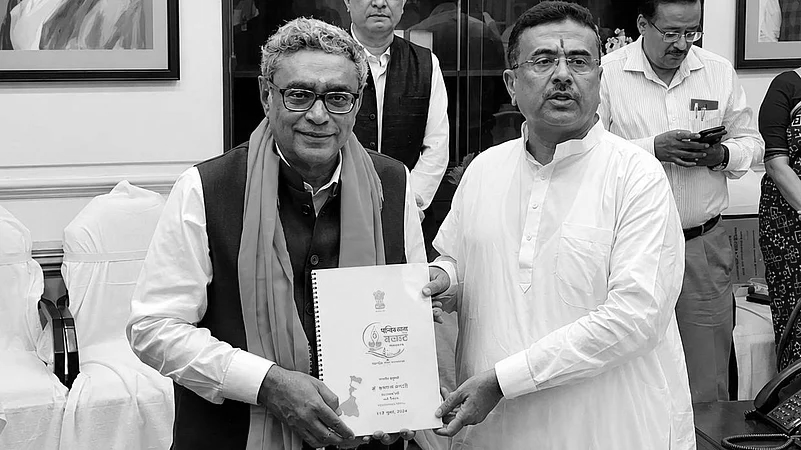
Finance Minister Swapan Dasgupta Swapan Dasgupta used that scale to frame a larger narrative: that the government inherited an accumulated debt of Rs 8.15 lakh crore from the previous regime, notably higher than the Rs 7.71-7.77 lakh crore debt trajectory the TMC government itself had projected for the end of 2025-26 in its last full budget. Dasgupta repeatedly invoked this number to justify why fiscal discipline and administrative reform needed to take precedence this year.
The DA hike is the most direct comparison point with last year. In the 2025-26 budget, the TMC government had raised DA by just 4 percentage points , taking it to 18 per cent from April 2025, a hike widely criticised as inadequate against the central government's DA rates. The new BJP government has gone five times further, announcing a 20 percentage point hike , taking DA to 38 per cent effective October 2026 . It's the kind of number that instantly resets the political conversation around the long-standing DA agitation by state employees.
This is where the budget's two headline numbers, the topline figure and the welfare allocation, start to tell different stories. The flagship Annapurna Yojana , the BJP's rebrand of Lakshmir Bhandar , gets Rs 36,000 crore . But unlike DA, this isn't simply "more than before." The previous scheme covered 2.4 crore women ; budget estimates suggest Annapurna Yojana will reach roughly 1 crore , fewer than half. The government says 30 lakh names removed through a verification drive, framing the shrinkage as targeting, not a cut. The new monthly rate, Rs 3,000 for women aged 25-60 , sits in roughly the same band, but the recipient base has been sharply reduced.
A similar swap-out is visible in youth support: the TMC interim budget had introduced Banglar Yuva Sathi , offering Rs 1,500 a month to unemployed youth aged 21-40. The new government's Bhorsa scheme replaces it with Rs 3,000 for unemployed graduates and Rs 2,000 for others , income-conditional, a richer per-person payout, but with tighter eligibility gates.
Beyond the comparison points, the budget carries several announcements that didn't exist in any prior version: 1 lakh vacant government posts , including 33 per cent women reservation , 20,000 in police , and 50,000 in school education , a 10 per cent Agniveer quota , a proposed greenfield airport near Kalyani, a Durgapur semiconductor unit, a deep-sea port at Dadanpatrabar, and a Tribal University in Jhargram. The MLA area development fund has also been raised from Rs 70 lakh to Rs 1 crore.
Every budget invites a debate about priorities, but this one is unusual in how openly its own arithmetic does the talking: a topline number that dwarfs anything Bengal has seen before , a DA hike five times the previous year's , and a flagship welfare scheme that, even with more money behind it, now reaches fewer than half the women it once did. Whether voters read that as fiscal repair or welfare rollback may end up being the real story behind the Rs 4,38,775 crore figure everyone is talking about today.