
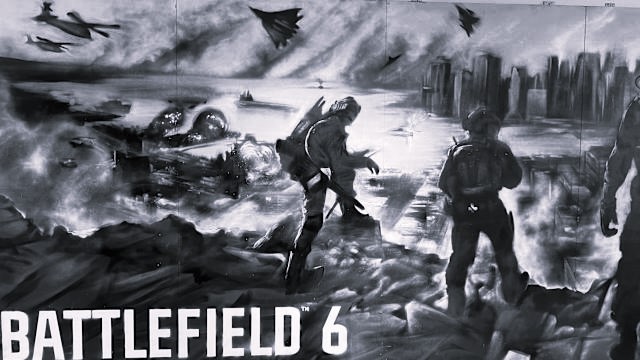
Battlefield 6 marks EA’s most ambitious shooter yet
Electronic Arts (EA) is preparing to re-enter the competitive first-person shooter arena with Battlefield 6, a game the company hopes will redefine large-scale warfare in gaming. Developed collaboratively by four EA-owned studios Battlefield 6 DICE in Sweden, Motive Studios in Canada, Ripple Effect Studios in Los Angeles, and Criterion in the UK Battlefield 6 the project represents one of the most ambitious undertakings in the series’ history. Designed to compete directly with Call of Duty, Battlefield 6 aims to deliver a more realistic, tactical, and immersive military experience through technical innovation and global collaboration.
After the disappointing reception of Battlefield 2042, the new installment builds upon critical lessons learned from its predecessor. Rebecka Coutaz, Vice President and General Manager of DICE and Criterion, noted that Battlefield 6 could not have been made without understanding what went wrong last time. The team focused on reconnecting with players early in the development process, launching closed community playtests that provided valuable feedback. Coutaz described the early responses as “explosively positive,” emphasizing the team’s renewed commitment to player-driven design and performance stability.
Technically, Battlefield 6 marks a major leap forward for the franchise. The game leverages next-generation graphics technologies, large-scale physics simulations, and advanced environmental lighting systems designed to deliver cinematic realism. Criterion’s design director, Fasahat “Fas” Salim, who leads the single-player campaign’s creative direction, highlighted the return of a story-driven experience as a key innovation. The campaign combines dynamic mission structures, real-time weather effects, and interactive environments to make each battle feel unpredictable and grounded.
Lighting artist Vlad Kokhan, one of the youngest members of the team, plays a crucial role in defining the visual tone. His atmospheric effects contribute to the mood and realism of the campaign, demonstrating how sophisticated lighting technologies have become central to modern game storytelling. Kokhan’s work integrates adaptive illumination and environmental shading Battlefield 6 techniques that react to gameplay choices and environmental shifts Battlefield 6 creating a world that feels alive and responsive to player actions.
Behind the scenes, Battlefield 6 represents one of EA’s most complex production efforts to date. Coordinating multiple studios across continents required building advanced real-time collaboration systems, enabling artists, designers, and engineers to co-develop assets seamlessly. Fas Salim described this global development approach as “a really interesting environment,” blending diverse cultural and technical perspectives. This distributed model has allowed EA to scale up production without compromising creativity or efficiency, though it has also added significant logistical challenges.
From a player perspective, Battlefield 6 aims to merge technical precision with accessibility. The new Frostbite engine iteration powers enhanced destruction mechanics, improved AI behavior, and expanded multiplayer systems capable of supporting larger player counts and deeper tactical coordination. Developers have also integrated more robust anti-cheat and netcode systems to ensure smoother, fairer online experiences Battlefield 6, a key differentiator as competitive shooters become increasingly connected across platforms.
EA has also addressed industry concerns about the use of generative AI in development. While the company is experimenting with GenAI tools to streamline creative workflows, Coutaz confirmed that none of the game’s content was generated using AI. Instead, these tools were employed in early design phases to automate repetitive tasks and “allow more time and more space to be creative.” Both Coutaz and Salim view generative AI as a powerful but evolving asset, not a threat. “If we can break the magic with AI, it will help us be more innovative and more creative,” Coutaz said, adding that true human artistry remains at the core of game design.
However, Battlefield 6 launches amid significant corporate turbulence. EA’s $55 billion acquisition by a Saudi Arabia–led group and its accompanying $20 billion debt burden have raised questions about long-term investment stability. Despite these financial shifts, EA has reassured employees and players that development plans will continue uninterrupted. Coutaz emphasized that her focus remains on ensuring the teams deliver their “best work in their careers” and that the game’s roadmap of post-launch content and monthly updates remains intact.
The stakes are high: analysts predict Battlefield 6 could sell up to five million copies in its first week. Yet in a market dominated by Call of Duty, Fortnite, and Roblox, sustained success depends on keeping players engaged beyond launch. EA’s approach Battlefield 6 fusing technical excellence, transparent communication, and community participation Battlefield 6 could finally position Battlefield as a true rival in the shooter genre.
For players, Battlefield 6 promises a blend of large-scale realism, emotional storytelling, and technical brilliance. For EA, it represents both a test of technological innovation and a defining moment for the company’s future direction in a rapidly evolving industry. If successful, it could mark the beginning of a new era not just for the Battlefield series, but for how modern shooters are developed, powered, and experienced.