
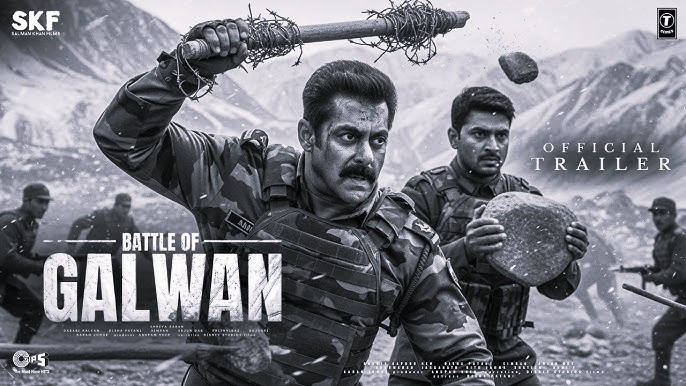
‘Battle of Galwan’ Teaser Sparks China’s Ire as Global Times Questions Film’s Intent
Salman Khan’s upcoming film Battle of Galwan has sparked an international media debate even before its release, after China’s state-run newspaper Global Times accused the film of “distorting facts” related to the 2020 Galwan Valley clash between Indian and Chinese troops. The controversy emerged following the release of the film’s teaser on December 27, coinciding with Salman Khan’s 60th birthday. While the teaser was received with patriotic enthusiasm by Indian audiences, it drew criticism from Chinese media, highlighting how popular cinema continues to intersect with unresolved geopolitical tensions.
In its commentary, Global Times claimed that the film presents an exaggerated and one-sided depiction of the Galwan incident, arguing that no matter how dramatic a movie may be, it cannot alter territorial realities or historical truths. Although the publication did not point to specific scenes, it broadly accused the film of portraying the Chinese military negatively while glorifying Indian soldiers. Analysts note that Global Times, though not an official government mouthpiece, is often seen as reflecting hawkish opinion within China and signalling Beijing’s discomfort without formal diplomatic escalation.
The film is inspired by the violent face-off that took place on June 16, 2020, in the Galwan Valley along the Line of Actual Control in eastern Ladakh. In that clash, 20 Indian soldiers were killed in action, while China also reportedly suffered casualties, though it did not officially disclose figures. The incident marked the most serious military confrontation between the two countries in decades and led to a prolonged standoff along multiple points on the border.
Following the clash, India strengthened troop deployments and surveillance along the Line of Actual Control to prevent further incursions. Over time, both sides agreed to disengage from certain friction points and establish buffer zones, though the broader boundary dispute remains unresolved. The Galwan incident continues to shape diplomatic and military engagements between the two neighbours.
Directed by Apoorva Lakhia, Battle of Galwan reportedly features Salman Khan in the role of martyr Colonel B. Santosh Babu, the commanding officer of the 16 Bihar Regiment who was killed during the clash. The teaser shows Salman Khan as a stern and determined Indian Army officer operating in extreme cold and rugged terrain, with visuals highlighting high-altitude conditions, hand-to-hand combat, and the physical and emotional challenges faced by soldiers stationed at the border.
Actress Chitrangada Singh plays a key role in the film, which the makers say will blend intense military drama with mainstream cinematic elements. The film is scheduled for theatrical release on April 17, 2026. While Indian audiences have largely viewed the teaser as a tribute to the bravery and sacrifice of Indian soldiers, some commentators have raised questions about balancing realism with mass-hero treatment when portraying real-life military events.
Chinese media, however, has characterised the film as a propaganda exercise, arguing that the powerful and cinematic portrayal of the protagonist unfairly undermines the image of the Chinese military and could fuel public sentiment against China. Indian film industry voices have dismissed the criticism as predictable, stating that the film reflects India’s perspective on a widely acknowledged episode.
The renewed attention on the Galwan clash also coincides with India’s efforts to commemorate the fallen soldiers. Earlier this month, Defence Minister Rajnath Singh virtually inaugurated the Galwan War Memorial at the Leh Army Base. Built at an altitude of 14,500 feet by the Border Roads Organisation within a short span, the memorial honours the soldiers who laid down their lives in the service of the nation, with the Defence Minister describing their courage and sacrifice as a lasting inspiration.
The reaction to Battle of Galwan underscores how cinema can influence national memory and provoke international responses when it engages with sensitive historical events. As the film moves closer to release, it is likely to remain under close scrutiny—not only as a cinematic project, but also as a cultural narrative linked to one of the most consequential episodes in recent India–China relations.