
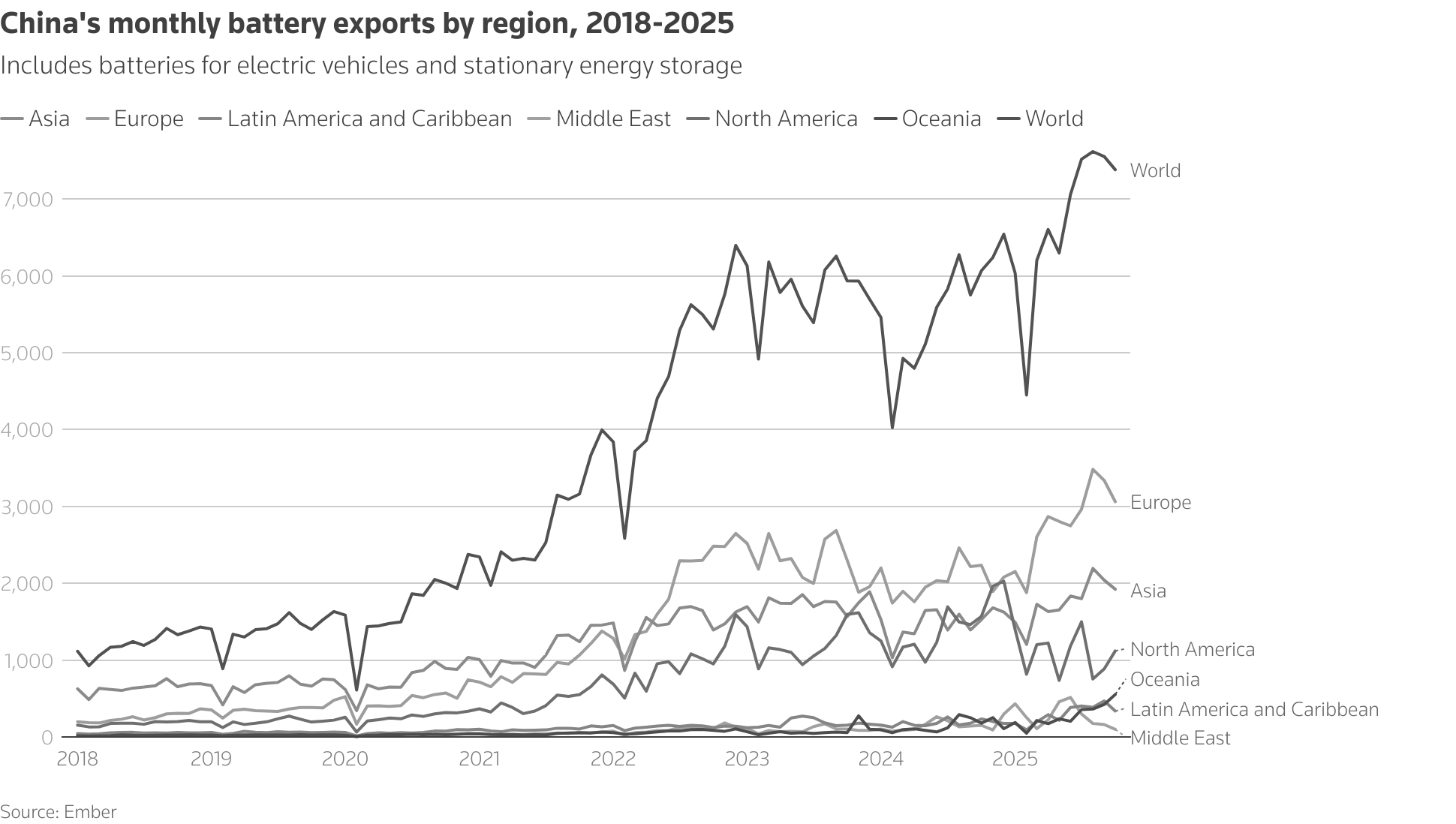
Battery exports surge as China leads global energy storage market
China’s dominance in energy storage is set to reach new heights, with global shipments of lithium-ion battery cells for energy storage expected to surge by 75% this year, driven by domestic reforms, renewable energy expansion, and rising international demand.
Chinese manufacturers have already exported over $65 billion worth of storage and electric-vehicle (EV) batteries in 2025, cementing their position as global leaders in a sector critical for wind and solar power integration and powering AI data centres.
The boom is fueled by a combination of domestic and international factors. Locally, the expansion of renewable energy projects and increased reliance on storage to balance the grid are driving demand. Globally, data centres’ growing energy needs, Europe’s aging power infrastructure, and China’s renewable energy initiatives in the Middle East are spurring exports.
“Leading energy storage cell makers are fully booked and working double shifts to meet demand,” said Cosimo Ries, analyst at Trivium China. “This is one of the biggest surprises in China’s energy sector this year.”
UBS recently raised its 2026 forecast for global battery energy storage installations by 25%, while the International Energy Agency projects a 16% rise in global investment in battery storage facilities this year, reaching $66 billion. Most of this market is expected to be captured by Chinese firms, which dominate the production of the cells used in storage systems, even though Tesla leads in system integration.
All six of the world’s top energy storage cell suppliers CATL, HiTHIUM, EVE Energy, BYD, CALB, and REPT BATTERO-are Chinese, according to consultancy Infolink’s January–September ranking. Of the top 10, only Japan’s AESC is non-Chinese. Companies like EVE Energy have reported a 35.5% rise in storage sales in the first three quarters, while REPT BATTERO set record high shipments in Q3.
The pairing of solar energy with storage is becoming critical, particularly for U.S. AI data centres, which face constraints from limited baseload power growth over the next five years, UBS analyst Yishu Yan said. However, Chinese manufacturers face challenges from U.S. restrictions on foreign entities receiving investment tax credits, which includes Chinese firms.
China’s battery exports including EV and storage batteries hit a record $66.76 billion in the first 10 months of 2025, making them the country’s most lucrative clean-technology export since 2022, surpassing solar photovoltaics. Exports of energy storage and non-automotive batteries grew 51.4% in the first 11 months, outpacing the 40.6% growth in EV battery exports, according to the China Electric Vehicle Industry Technology Innovation Strategic Alliance.
Domestically, China’s battery storage fleet, already the largest in the world with around 40% of global capacity, has benefited from government mandates requiring storage for wind and solar projects. Until recently, much of this storage capacity remained idle due to low profitability. Reforms introduced in June now require new projects to sell power via market-based auctions, allowing storage plants to profit by charging during low prices and discharging during high prices. As a result, average daily operating hours for energy storage plants increased to 3.08 hours in Q3, up 0.78 hours from last year.
Government support remains strong, with a $35 billion plan to nearly double battery storage capacity by 2027, along with new provincial subsidies and capacity tariffs in 10 provinces to incentivize standby storage. According to Jefferies, a global investment banking and financial services firm known for research and market analysis, these measures are expected to further boost China’s energy storage sector.