
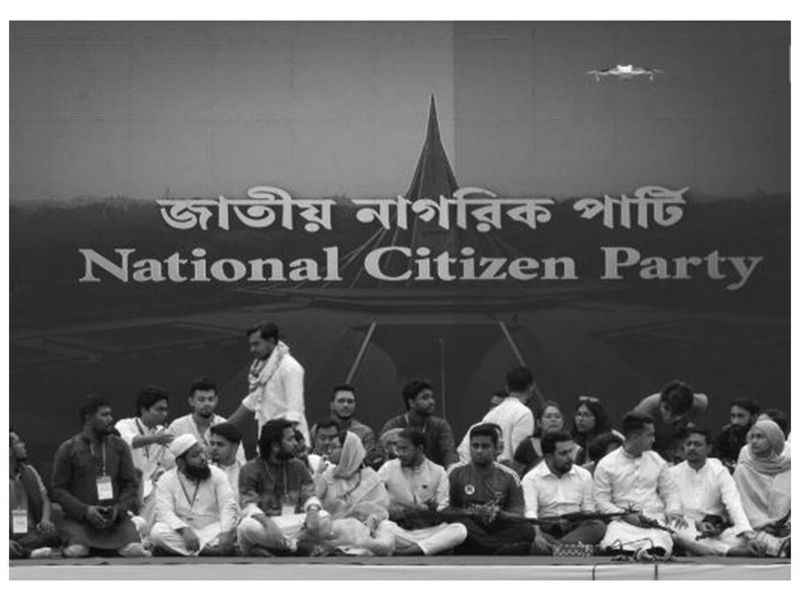
Bangladesh’s National Citizen Party rejects ‘July National Charter 2025’, calls It a ‘Drama’
The National Citizen Party (NCP), a student-led political party formed in 2024 after the anti-Hasina uprising, has announced that it will not sign the “July National Charter 2025”, a document outlining post-uprising reform agendas prepared by the interim government under Nobel laureate Muhammad Yunus.
The signing ceremony, scheduled for Friday, October 17, 2025, at the south plaza of the Bangladesh Parliament building, is expected to be attended by Yunus, who heads the interim government following the ousting of former Prime Minister Sheikh Hasina on August 5, 2024. Sheikh Hasina fled to India after the student-led movement that led to her removal.
In a news conference on Thursday, Nahid Islam, convenor of the NCP, said, “We will not participate in a drama to sign the July Charter.” The party cited the absence of a clear implementation roadmap as the primary reason for its refusal.
The July National Charter 2025 was prepared by the National Consensus Commission, established under Yunus’s leadership to formulate state reform proposals in line with the July Movement’s objectives. The commission engaged with participating parties, including the Bangladesh Nationalist Party (BNP), Jamaat-e-Islami, and the NCP. The interim government excluded Sheikh Hasina’s Awami League and its coalition partners, including the Jatio Party.
The Charter contains 151 reform points, of which 84 have been agreed upon and 67 remain disputed. The agreed points are categorized into 47 requiring constitutional amendments and 37 to be implemented through laws, ordinances, rules, or executive orders. Covering 17 areas of state reform, the Charter addresses the constitution, electoral system, judiciary, public administration, police system, anti-corruption mechanisms, political party regulations, legislative reforms, governance structures, media and information freedom, education and youth engagement, economic governance, social justice, law enforcement, public accountability mechanisms, national security frameworks, and implementation mechanisms.
Alongside the NCP, four leftist parties have refused to sign: the Communist Party of Bangladesh, Bangladesher Samajtantrik Dal (Basod), Bangladesh Jatiya Samajtantrik Dal (JSD), and Bangladesher Samajtantrik Dal (Marxist). They argued that the Charter omits the four basic principles of the constitution. The political party Gonoforum has also stated it will not sign unless the telegram of the Declaration of Independence issued by Sheikh Mujibur Rahman on March 26, 1971, and the Proclamation of Independence of the Mujibnagar Government on April 10, 1971, are incorporated.
If these dissenting parties ultimately refuse to sign, the Charter is still expected to be adopted by the remaining parties who have agreed to the points, including the BNP and Jamaat-e-Islami. The interim government has indicated that the document can be formally endorsed despite partial non-participation, though unresolved issues may remain open for future discussion.
The Charter aims to reform Bangladesh’s governance system and ensure smooth functioning until the next national elections, scheduled for February 2026. It proposes structural, legal, and institutional changes across multiple sectors, including constitutional reforms, electoral processes, judiciary, public administration, law enforcement, and anti-corruption mechanisms. The absence of a clear implementation plan has been cited as the main reason for the dissent from youth-led and leftist parties.
As the signing ceremony proceeds, it remains uncertain whether NCP and other dissenting parties will propose alternative reforms or amendments. The interim government has made preparations to accommodate the participation of the remaining political parties, while leaving space for ongoing discussions on disputed points.