
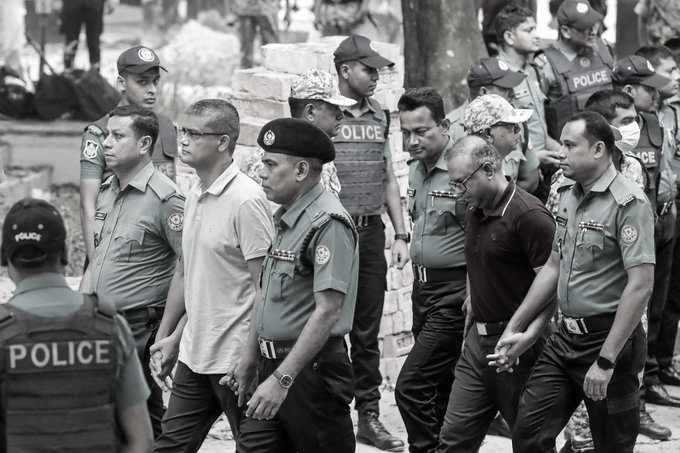
Bangladeshi civil tribunal sends 15 serving army officers to jail in enforced disappearance case
Bangladesh's International Crimes Tribunal (ICT) has ordered the detention of 15 serving army officers, including five generals, on charges of enforced disappearances, custodial torture, and murder, marking a landmark development in the country’s efforts to address human rights violations. The case traces back to incidents during former Prime Minister Sheikh Hasina’s tenure, particularly during the 2024 student-led uprising that led to her eventual ousting. During the protests, numerous students and activists went missing, and allegations emerged of secret detention centers and extrajudicial killings carried out by elements within the army and intelligence agencies.
This marks the first time in Bangladesh’s history that such a large number of senior military officials have been formally charged in a civilian court for crimes against humanity. Military courts, which traditionally handle internal disciplinary matters, were bypassed because these offenses involve serious human rights violations against civilians. The ICT, a civilian tribunal established to prosecute war crimes and crimes against humanity, provides the proper jurisdiction to ensure transparency, accountability, and adherence to both domestic and international law. By bringing the case to the ICT, the interim government is signaling that even top military officials are not above the law.
Following the 2024 protests, Sheikh Hasina fled to India amid escalating demonstrations and has described the tribunal’s proceedings as a "kangaroo court." She has refused to return to Bangladesh to face trial, and no legal representation has been appointed on her behalf. The prosecution has demanded the death penalty for Hasina, citing her alleged role in orchestrating the violent crackdown that resulted in numerous deaths and injuries.
After Hasina’s resignation, Nobel laureate Muhammad Yunus assumed the role of Chief Adviser of the interim government. Under his leadership, the government has initiated steps to investigate enforced disappearances and other human rights abuses, including establishing a commission and signing the UN Convention on Enforced Disappearances. Yunus has consistently emphasized justice and accountability, while also noting that India may continue to host Hasina if given a free choice, reflecting the sensitive diplomatic situation.
The tribunal’s actions have provoked political reactions, with Hasina’s supporters organizing protests both domestically and internationally, including at the United Nations, accusing Yunus of bias and mismanagement. These developments underscore the deep political divisions in Bangladesh and the challenges facing the interim government in pursuing accountability.
The trial of these 15 army officers, along with the ongoing legal proceedings against Sheikh Hasina, represents a pivotal moment in Bangladesh’s pursuit of justice for human rights violations. The outcome could have profound implications for the country’s legal and political landscape, shaping future governance, military accountability, and the protection of civilians against state-sponsored abuses.