
Bangladesh elections: Campaigning wraps up ahead of Feb 12 polls
Campaigning for Bangladesh’s parliamentary elections officially ended on February 10, as the country prepares for the crucial February 12 polls that could redefine its political landscape. This election marks the first major national vote since the August 2024 uprising , which led to the exile of former prime minister Sheikh Hasina and the collapse of the Awami League , the country’s historically dominant party.
In a final push, Bangladesh Nationalist Party (BNP) Chairperson Tarique Rahman wrapped up his nationwide campaign, calling on citizens to support his vision of a “self-reliant and democratic Bangladesh.” Returning from nearly two decades in exile, Rahman appealed to workers, farmers, students, professionals, women, and all citizens to vote for the BNP’s symbol, the Sheaf of Paddy . He promised job creation, economic reforms, merit-based governance, and women’s empowerment , stressing that no segment of society would be left out. The BNP is contesting 292 of 300 parliamentary seats and heads a coalition of nearly ten allied parties , aiming to restore trust in democratic institutions and implement financial support for the poor, investment-friendly economic policies, and anti-corruption measures .
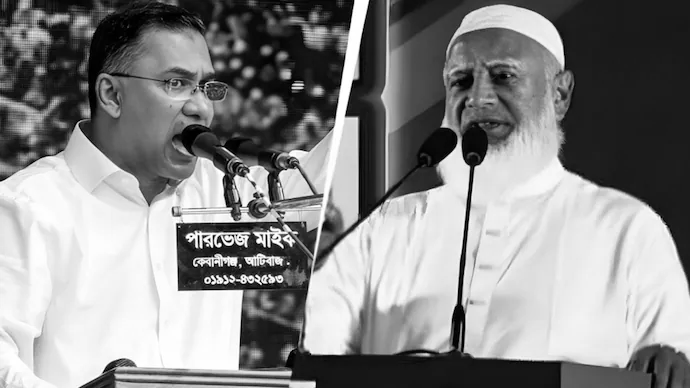
The BNP faces a formidable challenge from an 11-party Islamist coalition led by Jamaat-e-Islami , whose leader, Shafiqur Rahman , has risen from relative obscurity to become a serious contender for prime minister. This coalition draws support from Islamic constituencies and younger voters aligned with the National Citizen Party (NCP) , a group born from the 2024 student-led uprising . Jamaat campaigns on promises of anti-corruption, economic diversification, moral governance, and community development . Surveys indicate a closely contested race , although mainstream polling favors the BNP. A recent survey by Eminence Associates (EASD) shows the BNP-led alliance at 66.3 % support , compared with 11.9 % for the Jamaat-led bloc , projecting BNP could secure roughly 208 seats , while Jamaat may take about 46, with the rest going to minor parties and independents. Some other polls suggest a tighter contest, with BNP at 44.1 % and Jamaat at 43.9 % , highlighting how fluid voter sentiment remains.
The historically dominant Awami League remains barred from participating , and Sheikh Hasina is still in exile in India. Reports indicate that most loyal Awami League supporters are expected to boycott the election , though a small portion may shift to BNP or Jamaat. Analysts estimate the former AL vote now accounts for roughly 10–15 % of the electorate , with about half potentially supporting BNP and 30 % going to Jamaat , while the rest abstain.
A decisive factor in this election is the youth vote , with citizens under 35 making up around 25 % of all voters . Analysts suggest this younger demographic could swing the balance of power and play a pivotal role in determining whether Bangladesh sees a change in leadership . Voters are also focused on corruption, inflation, unemployment, economic growth, and governance reforms , alongside a referendum on the July National Charter 2025 , a constitutional and governance reform package aimed at resetting the nation’s democratic framework.
Most analysts predict the BNP-led alliance is likely to emerge as the largest party , potentially securing a parliamentary majority, though some credible polls show a much tighter contest in select constituencies. The outcome will not only shape domestic policy and economic reform but also influence Bangladesh’s regional relations and the future trajectory of its democratic institutions .