
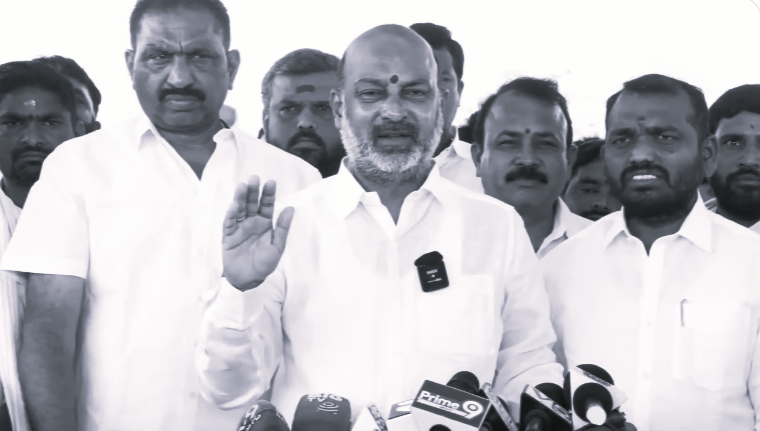
Bandi Sanjay Targets Congress, INDIA Bloc Over Women’s Bill and Delimitation Debate
Union Minister Bandi Sanjay Kumar on Tuesday launched a sharp attack on the Congress , the INDIA bloc , and several regional parties, accusing them of functioning as family-run parties that resist genuine women’s empowerment . Speaking in Karimnagar, he said the opposition’s resistance to the Women’s Reservation Bill reflects a deeper intent to protect dynastic politics , rather than expand opportunities for women from ordinary backgrounds . According to him, projecting a few leaders from influential political families as symbols of empowerment does not translate into broader representation for women at the grassroots level.
His remarks come amid an intensified national debate over the proposed 33% reservation for women in legislatures, which has been linked to delimitation and the expansion of parliamentary seats. Sanjay argued that while the Centre is attempting structural reforms to ensure fair representation, opposition parties are obstructing the process for political reasons. He maintained that India’s population growth from about 52 crore to over 140 crore necessitates an increase in Lok Sabha seats , though he acknowledged concerns that a purely population-based approach could impact southern states .
Turning to Telangana politics, Sanjay strongly criticised Chief Minister Revanth Reddy and BRS chief K. Chandrashekar Rao , describing them as political “Rahu and Ketu” who, he alleged, have hindered the rise of new leadership. He also revisited the controversy surrounding the Kaleshwaram project , questioning why earlier allegations of a massive scam were later narrowed down, and demanded clarity from the state government. Further, he accused Revanth Reddy of attempting to expand his influence within the Congress and positioning himself in national politics.
Overall, Sanjay framed the ongoing debate as a larger battle between merit-based leadership and entrenched political families, asserting that true democratic progress depends on opening doors for grassroots leaders rather than reinforcing inherited power structures.