
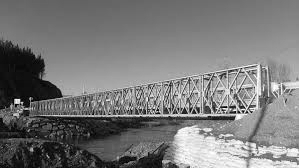
Bailey Bridge boost: India steps up aid to Sri Lanka
India has expanded its humanitarian assistance to Sri Lanka after Cyclone Ditwah caused catastrophic destruction across multiple districts, leaving communities cut off and essential infrastructure severely damaged. Under Operation Sagar Bandhu, the Indian Air Force on Wednesday transported a prefabricated Bailey bridge and 500 water-purification units to the island nation aboard a C-17 aircraft. The Indian High Commission in Colombo said the deployment aims to restore connectivity to isolated regions and ensure access to safe drinking water, noting on social media that the effort is “bridging gaps and restoring hope” in the aftermath of the disaster. As part of the relief effort, officials also highlighted the practical impact of these water-purification units each typically capable of providing several hundred litres of safe water per day and raised questions about how much water they can realistically supply in crisis conditions and how many such units would be needed to support a community of 1,000 people. India also continued disaster-management cooperation digitally, with Bhaskar Katamneni, Secretary of Real Time Governance, Andhra Pradesh, sharing a disaster-preparedness “digital toolkit” during a virtual meeting with Hans Wijayasuriya, Chief Advisor to the Sri Lankan President on Digital Economy, and the GovTech team, showcasing India’s best practices in emergency response.
Sri Lanka is reeling under widespread flooding, landslides, and extensive infrastructure collapse triggered by the cyclone since November 16. More than 479 people have died and 350 remain missing, according to official figures as of Wednesday evening. The economic loss is estimated between USD 6 billion and 7 billion, representing roughly 3–5% of Sri Lanka’s GDP. President Anura Kumara Dissanayake expressed gratitude to Indian Prime Minister Narendra Modi, noting that India’s support under the SAGAR-BANDHU initiative reflects the longstanding partnership and goodwill between the two nations. As relief operations continue, questions have also emerged about the financial scale of India’s assistance, including whether any official figures exist on how much New Delhi has spent so far on disaster relief for Sri Lanka information that has not yet been publicly detailed despite multiple consignments of aid and personnel deployments.
A key element of India’s assistance is the deployment of the Bailey bridge, a portable, pre-fabricated steel truss bridge known for its ability to be assembled rapidly without heavy machinery. Originally designed during World War II for quick military mobility, the Bailey bridge’s modular structure allows individual panels and components to be transported easily by air and put together on-site with basic tools. This makes it ideal for disaster-affected areas where normal infrastructure has collapsed and where heavy construction equipment cannot be moved in. Sri Lanka’s floods washed away several roads and bridges, leaving communities unreachable, and the Bailey bridge’s strength, speed of construction, and capacity to carry heavy relief vehicles made it the most suitable solution to immediately reconnect affected regions.
Although alternatives such as pontoon bridges, ferries, modular systems like Acrow and Mabey bridges, helicopters, and temporary causeways were available, these options either require more time, cost more, or cannot sustain heavy logistical movement in a disaster zone. The decision to send a Bailey bridge was therefore driven by its proven reliability, its rapid deployability, and India’s extensive experience using it in flood-hit, mountainous, and remote areas where urgent connectivity is critical.
India’s delivery of the bridge, along with water-purification systems and digital coordination support, underscores a comprehensive response shaped by urgency, practicality, and longstanding cooperation between New Delhi and Colombo. The operation addresses immediate humanitarian needs while restoring vital lifelines for Sri Lanka’s recovery from one of its most devastating natural disasters in recent years, drawing comparisons to the island’s last major calamity of similar scale, the severe floods of 2017, which also displaced hundreds of thousands and required extensive international assistance.