
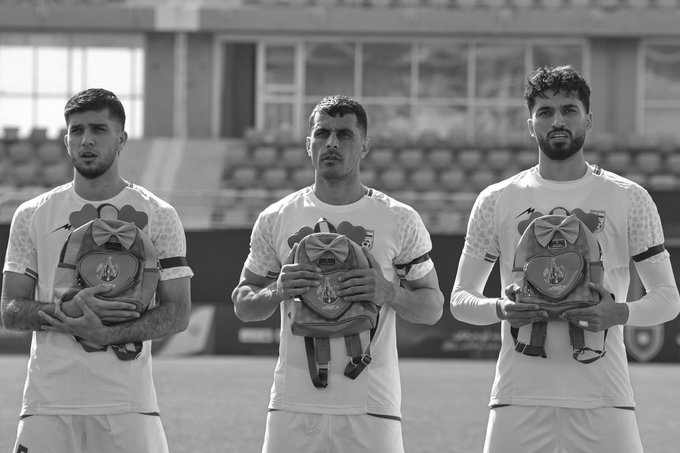
Backpacks and black armbands: Iran footballers honor victims of deadly elementary school strike
Iran’s national football team paid a moving tribute to victims of a deadly missile strike on an elementary school before their friendly match against Nigeria in Antalya, Turkey.
During the national anthem, the players placed small pink and purple school backpacks in front of them, symbolising the children who lost their lives in the attack. The team also wore black armbands in remembrance of those killed since the conflict began.
More than 165 people were killed in the February 28 strike on a school in southern Iran, with most of the victims believed to be children. The attack has drawn sharp criticism from the United Nations and several human rights organisations.
The strike is widely believed to have been launched by the United States, although neither Washington nor Israel has officially accepted responsibility . The U.S. military has said it would never deliberately target civilians and has launched an investigation into the incident.
Friday’s match in Antalya ended in a 2–1 win for Nigeria . The game served as a preparation fixture for Iran ahead of the FIFA World Cup , which will be co-hosted by the United States, Mexico and Canada.
However, Iran’s participation in the U.S. leg of the tournament has become uncertain. Iranian officials have asked FIFA to shift their three group-stage matches to Mexico , citing safety concerns after U.S. President Donald Trump discouraged the team from travelling to the country.
Iranian authorities have said they do not intend to boycott the tournament, but argue that travelling to the United States may be difficult amid ongoing military tensions involving the U.S. and Israel.
FIFA President Gianni Infantino has indicated that the schedule is unlikely to change, saying the global football body wants the World Cup “to go ahead as scheduled.”
In a separate development, Iran’s judiciary reportedly threatened to seize the property of national team forward Sardar Azmoun , following warnings that authorities could act against celebrities considered critical of the government.