
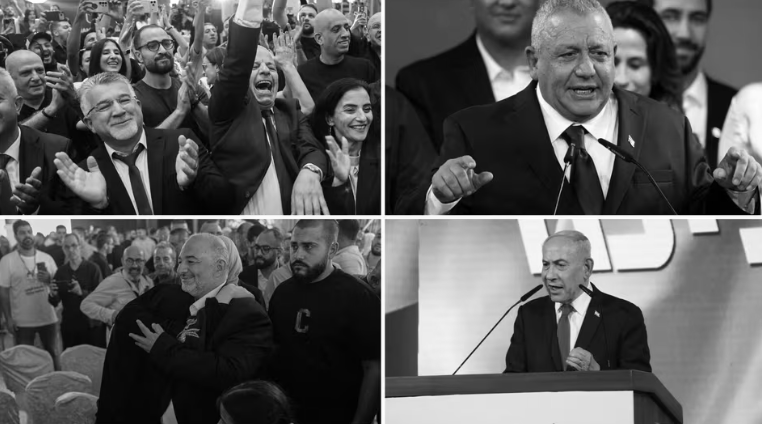
Back To The Ballot Box? Why Israel Could Face Another Election
Israel faces political uncertainty after the election left Prime Minister Benjamin Netanyahu's right-wing bloc short of a parliamentary majority, while opposition leader Gadi Eisenkot also struggles to secure enough support to form a government.
Preliminary results show Netanyahu's bloc projected to win 53 seats in the 120-member Knesset, against 48 seats for Eisenkot's opposition alliance. Both fall short of the 61 seats required for a majority. Arab-led parties, the Joint List and Ra'am, are projected to win a combined 19 seats, potentially giving them decisive influence over government formation.
The results reflect record-high turnout among Arab voters, who account for about 21% of Israel's population. Their increased participation has strengthened Arab representation in parliament and intensified debate over whether parties representing Palestinian citizens of Israel should help determine the country's next government.
The current situation has historical significance. Arab parties have previously supported Israeli governments from outside governing coalitions, including during Yitzhak Rabin's premiership. However, Ra'am made history in 2021 by joining the governing coalition led by Naftali Bennett and Yair Lapid, becoming the first independent Arab party to participate in an Israeli government. That coalition collapsed after approximately 18 months.
Ra'am has since sought to establish itself as a potential coalition partner. Its leader, Mansour Abbas, has signalled a willingness to cooperate with other parties, while the Joint List's Yousef Jabareen has said his party is prepared to help remove Netanyahu's government. Ra'am has also placed Jewish politician Yoav Segalovitz second on its electoral list, a move intended to broaden its appeal.
However, cooperation remains contentious. Eisenkot and several opposition partners have resisted relying on Arab parties, while far-right factions oppose a government dependent on their support. Opposition leader Yair Golan has urged his allies to reconsider, arguing that the combined numbers could provide a parliamentary majority.
Netanyahu, meanwhile, has alleged electoral fraud involving Arab parties, prompting calls for investigations. The allegations remain unproven, and election officials have found no basis for claims that the vote was systematically compromised.
President Isaac Herzog has urged political leaders to approach coalition negotiations with open minds and avoid another election. If neither bloc can form a viable government, Israel could return to the ballot box after weeks of negotiations.
The outcome will depend on whether political rivals overcome their differences or leave voters facing another election.