
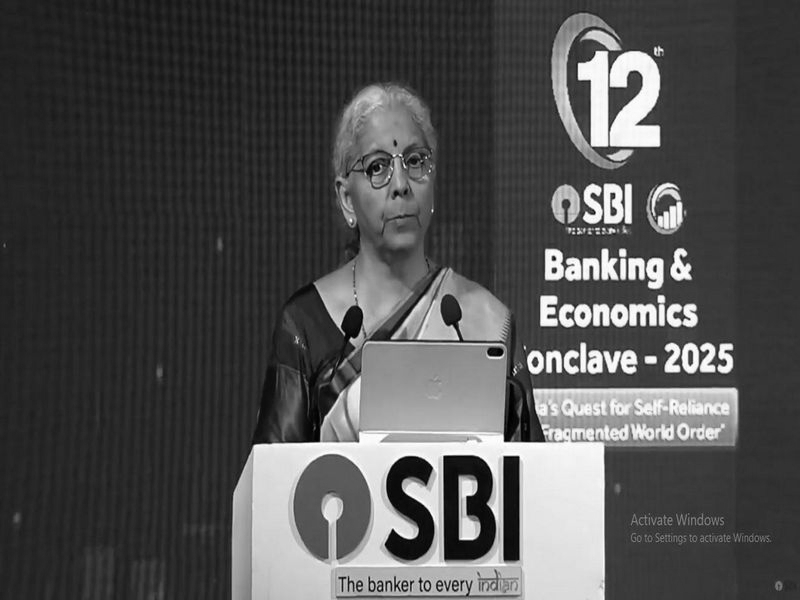
“Atmanirbhar Bharat” means Resilient Interdependence, not Isolationism : FM Sitharaman
Union Finance Minister Nirmala Sitharaman on Thursday emphasised that the vision of Atmanirbhar Bharat is not isolationist but represents “Resilient Interdependence”, allowing India to meet domestic needs while actively engaging with global value chains. Speaking at the State Bank of India’s conclave on “Realising the Vision of Atmanirbhar Bharat,” she outlined how India’s path to self-reliance is rooted in strengthening domestic capacity without disconnecting from the global economy.
Sitharaman described Atmanirbhar Bharat as a multi-dimensional approach, anchored on economic, social, technological, strategic, and environmental self-reliance. “It envisions an India that designs, produces, and innovates for itself and for the world,” she said, highlighting that self-confidence, enterprise, and compassion guide the country’s economic and social policies.
Economic and trade reforms:
India’s pursuit of self-reliance has been supported by extensive reforms and infrastructure development since 2014. Capital expenditure has grown nearly fivefold, from ₹2.3 lakh crore to ₹11.21 lakh crore, funding roads, metro networks, and urban infrastructure. National highways now expand at 34 km per day, compared with 11.6 km daily in 2014, while metro connectivity covers 23 cities with 1,000 km in operation. Port capacity has doubled to 2,762 MMTPA, and vessel turnaround time has improved from 93 to 49 hours, enabling faster and more efficient trade.
Regulatory reforms
Regulatory reforms have also been significant. The government has repealed 1,500 outdated laws and eliminated 45,000 compliance requirements, simplifying the business environment. Additionally, the introduction of GST as a “next-generation” reform has reduced tax rates and streamlined processes. These initiatives strengthen India’s engagement with international markets, promoting resilient interdependence rather than isolation.
Financial inclusion and social empowerment:
Financial inclusion remains central to India’s self-reliance agenda. Over 56 crore Jan Dhan accounts, 52 lakh Mudra loans, and 70 lakh PM Swanidhi loans have empowered citizens to participate in the formal economy and pursue entrepreneurship. Sitharaman emphasised the importance of social self-reliance, noting the shift from patronage-based support to irreversible empowerment, lifting millions out of multidimensional poverty.
Government welfare programs, supported by digital public infrastructure, have reached millions directly through Direct Benefit Transfer (DBT), amounting to ₹47 lakh crore since 2014 and saving ₹4.31 lakh crore by reducing leakages. Major initiatives include four crore PM Awas Yojana homes, 15 crore tap water connections, 12 crore toilets, 10 crore LPG cylinders, and free ration for 81 crore people.
Technological innovation and future growth:
Sitharaman highlighted the role of technology in enhancing efficiency and transparency, ensuring welfare delivery reaches beneficiaries directly while supporting entrepreneurship. Technological self-reliance also positions India to innovate in strategic sectors and participate in high-value global industries.
Looking ahead:
While the call for Viksit Bharat 2047 is recent, Sitharaman noted that foundational work toward self-reliance began in 2014 and will guide India’s progress over the next two decades. By combining financial inclusion, infrastructure expansion, governance reforms, and technological innovation, India aims to create a self-reliant, empowered, and sustainable economy, fully integrated with the global market yet resilient in the face of external shocks.