
Astronomers Decode Black Hole “Heartbeats” Through Oscillating Accretion Shocks
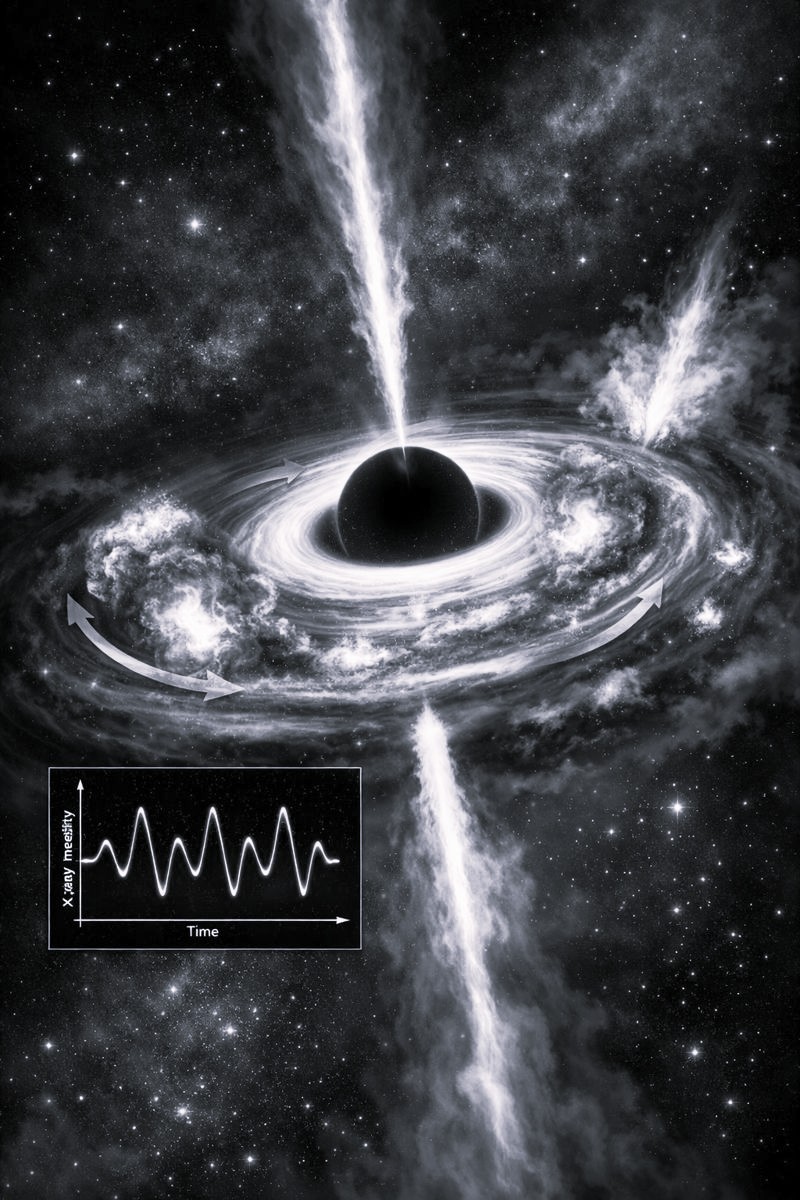
Astronomers have unraveled the mystery behind rhythmic flickers , known as quasi-periodic oscillations (QPOs) , in black hole systems using advanced numerical simulations. These flickers, observed as variations in high-energy radiation, have puzzled scientists for decades because they reveal the dynamic behavior of matter very close to black holes.
Black holes, among the most compact and gravitationally intense objects in the Universe, cannot be observed directly. Instead, researchers study the radiation emitted by the surrounding accretion disc , a temporary structure formed as matter spirals inward under the black hole’s strong gravity. When the motion of matter in the disc is primarily rotational, it emits thermal radiation. However, if the infalling matter has a significant inward velocity, non-thermal radiation dominates, producing the QPOs that appear as beats or flickers in the observed light. These oscillations typically range from less than one Hertz to tens of Hertz, depending on the mass and dynamics of the black hole system.
Scientists from the Aryabhatta Research Institute of Observational Sciences (ARIES) , in collaboration with researchers from MJPRU Bareilly, the Nicolaus Copernicus Astronomical Center in Poland, and IRFU France, used a 2D numerical simulation with a relativistic equation of state to track viscous accretion flows over time. Their models showed that, rather than falling smoothly, the inflowing gas forms shocks , regions where the flow slows, heats up, and becomes denser, similar to shock waves in supersonic jets. When the disc has sufficient viscosity (α ≥ 0.05) and cools via radiation, these shocks become unstable and begin to oscillate , producing the flickering patterns observed as QPOs.
The simulations also revealed that turbulent, bubble-like regions form behind the shocks in the inner disc. These regions can oscillate and sometimes erupt as bipolar jets or outflows , perpendicular to the disc, with speeds exceeding 25% of the speed of light under high-viscosity conditions. By analyzing density, temperature, and angular momentum distributions in the disc, the researchers replicated the time-dependent variations in radiation, offering a direct physical explanation for the QPOs .
This study is significant because it is likely the first 2D simulation of viscous transonic accretion flows onto black holes using a relativistic equation of state for electron-proton plasma. It provides a natural explanation for low-frequency QPOs around stellar-mass black holes, showing that these oscillations arise from the fluid-like behavior of post-shock accretion discs rather than from solid structures. By connecting simulations with real observations, the research marks a major step in understanding the dynamic, high-energy environment near black holes .