
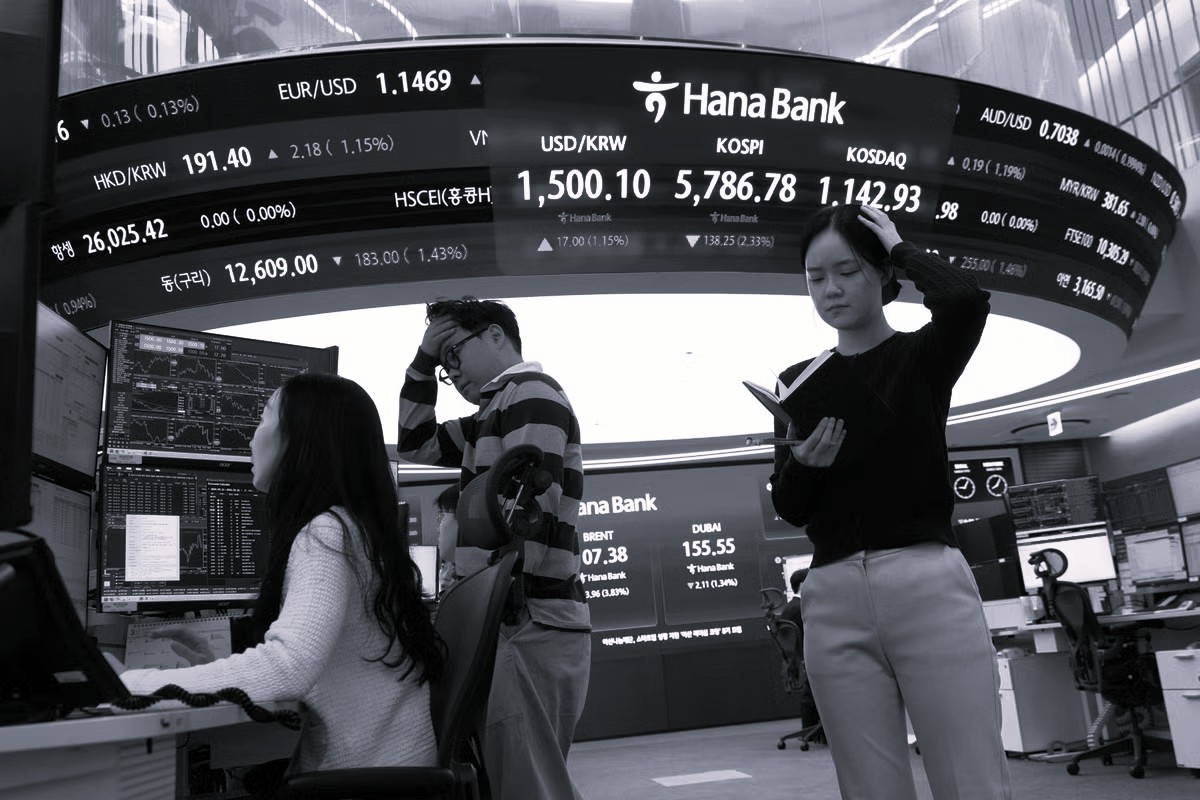
Asian Markets Slip as Oil Crosses $100 Even as Wall Street Hits Highs
Indian equity benchmark indices extended their sharp decline for the second consecutive session, as surging crude oil prices , escalating geopolitical tensions in West Asia, and sustained foreign fund outflows continued to weigh heavily on investor sentiment.
The BSE Sensex tumbled 852.49 points to settle at 77,664 after falling over 900 points during intraday trade, while the NSE Nifty 50 dropped 205.05 points to close at 24,173.05. The back-to-back losses reflect a clear shift in market tone from resilience to heightened risk aversion amid growing global uncertainty .
The primary trigger behind the downturn remains the sharp rise in crude oil prices. Brent crude continues to trade above the critical $100 per barrel mark, currently hovering in the $102–105 range after touching highs of $103–106. The surge has been driven by stalled negotiations between the United States and Iran and a rapidly worsening situation in the strategically crucial Strait of Hormuz .
Recent developments indicate that the crisis has intensified further. Iran has tightened its control over the Strait of Hormuz, reportedly seizing cargo vessels and restricting maritime traffic. The waterway, which carries nearly one-fifth of the world’s oil supply, remains partially disrupted, raising serious concerns about prolonged supply constraints . Iranian authorities have also indicated that normal operations in the strait may not resume under current conditions, deepening fears of an extended crisis.
Military tensions have also escalated, with increased naval presence and reports of aggressive actions in the region. The absence of any breakthrough in US–Iran talks has further added to uncertainty, with negotiations remaining deadlocked and no immediate resolution in sight.
Despite a slight stabilization in crude prices after the initial spike, they continue to remain elevated, keeping pressure on global markets. Analysts warn that if tensions persist, oil prices could rise further, posing significant risks to global economic growth and financial stability.
For India, a major oil-importing nation, the sustained rise in crude prices presents multiple macroeconomic challenges. Higher energy costs are likely to fuel inflation , widen the current account deficit , and exert additional pressure on the rupee . The domestic currency has already weakened against the US dollar in recent sessions, reflecting rising import bills and capital outflows.
Foreign Institutional Investors (FIIs) remained net sellers, offloading equities worth Rs 2,078.36 crore in the previous session, further dampening investor sentiment. Persistent FII outflows, combined with a weak rupee and elevated global risk, have contributed to increased market volatility .
Sector-wise, heavyweights such as Trent, Bajaj Finserv, Tech Mahindra, Mahindra & Mahindra, Infosys, and HDFC Bank were among the major laggards. However, selective buying in stocks like Adani Ports, Larsen & Toubro, Sun Pharma, Bharti Airtel, and Bharat Electronics provided limited support.
Global cues remained mixed but largely cautious. Asian markets, including Japan’s Nikkei 225, Hong Kong’s Hang Seng, and China’s Shanghai Composite, ended lower after early gains faded. Notably, the Nikkei briefly crossed the historic 60,000 mark before reversing, highlighting fragile investor confidence.
South Korea’s Kospi showed some resilience, supported by strong economic data, but broader regional sentiment remained subdued. European markets were also trading lower in mid-session deals, reflecting global unease.
This comes even as Wall Street recently touched record highs, with the S&P 500, Nasdaq Composite, and Dow Jones Industrial Average supported by strong corporate earnings. However, global markets remain highly sensitive to geopolitical developments, limiting the impact of positive US cues.
Additionally, disruptions in crude supply are beginning to affect refining activity across Asia, raising concerns about potential shortages of key fuels such as diesel and aviation fuel. This has intensified worries about inflationary pressures and slowing economic growth across the region.
The latest decline follows a sharp fall in the previous session, when the Sensex dropped 756.84 points and the Nifty fell 198.50 points, indicating a continuing bearish trend .
Overall, the combination of elevated oil prices, deepening geopolitical tensions, disrupted energy supply chains, weak global cues, and sustained foreign fund outflows is expected to keep markets volatile in the near term.
Investors are likely to closely monitor developments in the US–Iran situation, movements in crude oil prices, currency trends, and foreign investment flows for further direction, as uncertainty continues to dominate the global and domestic investment landscape.