
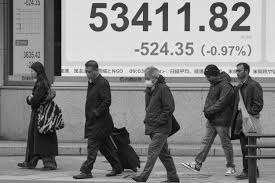
Asian markets slip as Global Trade tensions rattle investor sentiment
Asian markets mostly declined on Tuesday , tracking weakness in global cues after U.S. markets were shut for the Martin Luther King Jr. Day holiday, while sharp losses in Europe and falling U.S. futures weighed on sentiment.
Market nerves were heightened after U.S. President Donald Trump threatened to impose a 10% additional tariff on imports from eight European countries , escalating trade tensions with key U.S. allies. The move sparked a strong backlash from Europe and raised fresh concerns about a widening global trade conflict, pressuring equities worldwide.
Japan led regional losses , with the Nikkei 225 sliding 1.1% after Prime Minister Sanae Takaichi called a snap election for February 8. Investors grew cautious as expectations of increased government spending revived concerns over Japan’s fiscal outlook. Yields on long-term Japanese government bonds surged to multi-decade highs, with the 40-year bond yield touching a record 4%, dragging bond prices lower and unsettling equity markets.
Elsewhere in Asia, Chinese markets weakened , with the Shanghai Composite slipping 0.3%, while Hong Kong’s Hang Seng edged marginally lower. South Korea’s Kospi bucked the trend with modest gains, while Australia’s benchmark index fell. Indian markets were flat, reflecting cautious global sentiment.
European equities closed sharply lower on Monday, and U.S. stock futures fell early Tuesday , underscoring investors’ growing unease over geopolitical risks, trade policy uncertainty, and tighter financial conditions. Oil prices were largely flat, while the U.S. dollar eased slightly against the yen and the euro.
Global markets remain highly sensitive to political developments, trade disputes, and central bank policy signals , with investors bracing for key U.S. earnings, inflation data, and upcoming policy meetings by the Federal Reserve and the Bank of Japan later this week.