
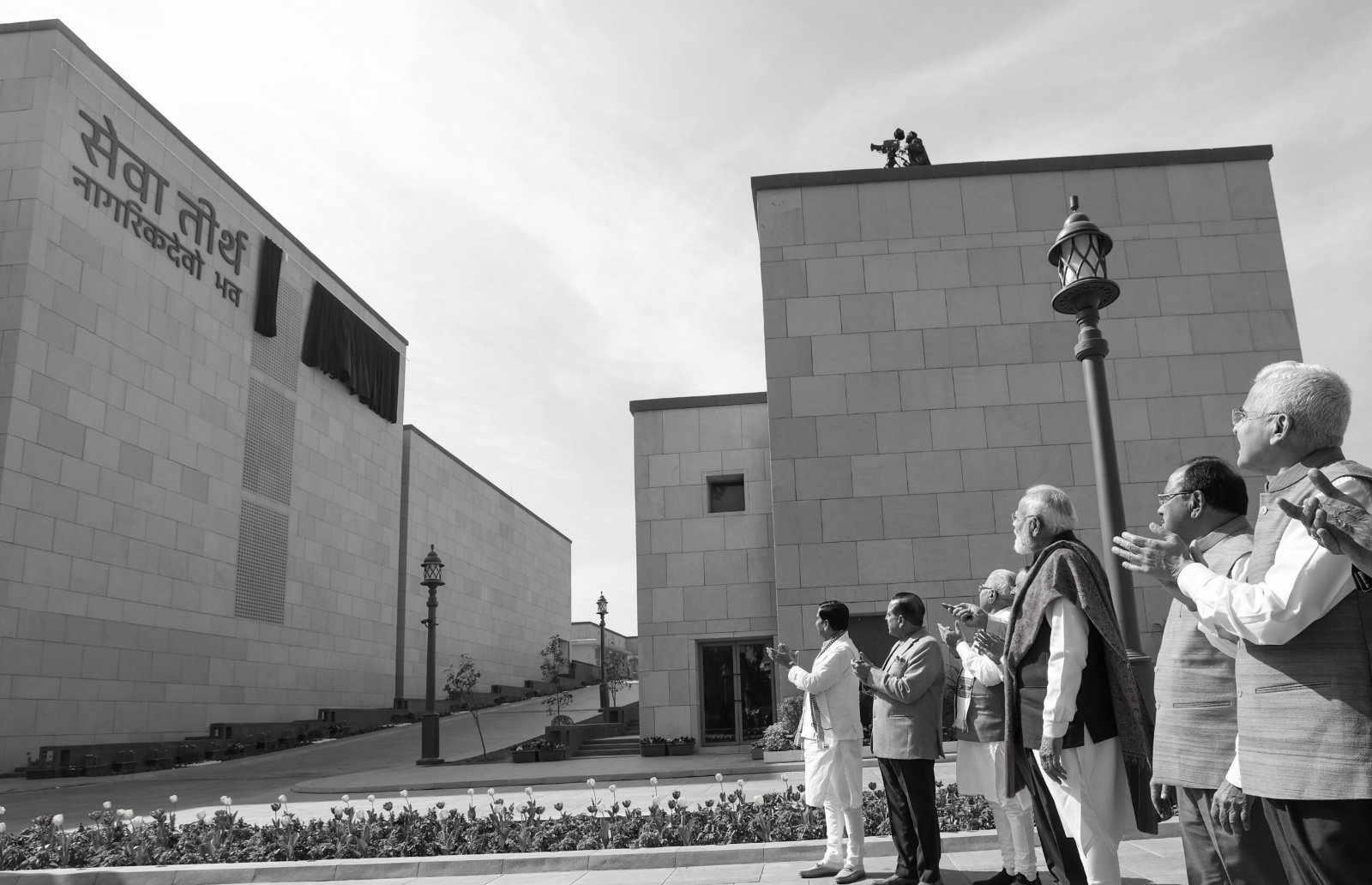
As New Delhi turns 95, Modi unveils Seva Teerth, signals shift in India’s governance architecture
Prime Minister Narendra Modi on Friday inaugurated Seva Teerth , the newly designated complex housing the Prime Minister’s Office (PMO), the National Security Council Secretariat and the Cabinet Secretariat, marking a major milestone in India’s administrative governance on the 95th anniversary of New Delhi ’s formal inauguration as the nation’s capital. The name Seva Teerth derived from Seva (service) and Teerth (a sacred place or pilgrimage) literally translates to “a sacred place of service”, reflecting the idea that governance is rooted not in authority or privilege but in duty to citizens. The symbolic naming also signals a conscious move away from colonial-era imagery of power towards a civilisationally grounded, people-centric vision of public service, aligned with the Prime Minister’s long-articulated emphasis on leadership as service to the nation.
The inauguration of the new PMO building, along with Kartavya Bhavan 1 and Kartavya Bhavan 2, brings together key institutions and ministries that were earlier spread across different locations in the Central Vista. Seva Teerth now houses the PMO, the National Security Council Secretariat and the Cabinet Secretariat, while the two Kartavya Bhavans will accommodate major ministries including law, defence, finance, health and agriculture.
“The inauguration marks a transformative milestone in India’s administrative governance architecture and reflects the Prime Minister’s commitment to building a modern, efficient, accessible and citizen-centric governance ecosystem,” the PMO said in a statement.
The occasion is also symbolic as it coincides with the gradual vacating of the historic North Block and South Block, which have served as the seat of power since 1931. The North Block earlier housed the home and finance ministries, while the South Block accommodated the defence and external affairs ministries along with the PMO. As per government plans, both buildings will be repurposed to house the proposed Yuge Yugeen Bharat National Museum.
During the inauguration, the Prime Minister’s first decisions from the new complex reflected the ethos behind the name Seva Teerth, underscoring governance as a form of public service. These included the launch of the PM RAHAT Scheme providing cashless treatment up to ₹1.5 lakh for road accident victims, expansion of the Lakhpati Didi initiative with a target of six crore beneficiaries by 2029, doubling of the Agriculture Infrastructure Fund to ₹2 lakh crore, and approval of a ₹10,000 crore Startup India Fund of Funds 2.0 to support innovation and entrepreneurship.
New Delhi’s emergence as the capital dates back to the 1911 Delhi Durbar, when the British announced the shift of the imperial capital from Calcutta to Delhi. The decision was driven by the city’s central location, administrative convenience and its long-standing association with power. Designed by architects Edwin Lutyens and Herbert Baker, the new imperial city was built south of Shahjahanabad and formally inaugurated on February 13, 1931, with the Raisina Hill complex forming the nucleus of governance.
Delhi’s association with political authority, however, extends far beyond the colonial period. Ancient texts refer to Indraprastha , believed to have existed near present-day Purana Qila, as an early centre of power. Over centuries, the region witnessed the rise and fall of multiple capitals under successive rulers, including the Delhi Sultanate and the Mughal Empire, reinforcing its status as the political heart of northern India.
After Independence, India retained New Delhi as its capital, ensuring continuity in administration while transforming the city into the seat of democratic governance. As New Delhi completes 95 years as the nation’s capital, the inauguration of Seva Teerth reflects both continuity and change linking the city’s journey from ancient Indraprastha to imperial capital and, finally, to the administrative centre of a modern republic.