

Artemis II Rewrites Space History, Breaks Apollo 13 Record in Epic Moon Flyby
In a defining moment for modern spaceflight, Artemis II has carried astronauts farther from Earth than ever before, surpassing the long-standing record set during Apollo 13 and marking a major step toward sustained human exploration beyond the Moon.
The Orion spacecraft, carrying Commander Reid Wiseman , Pilot Victor Glover , Mission Specialist Christina Koch , and Canadian astronaut Jeremy Hansen , reached a maximum distance of 252,756 miles (406,771 km) from Earth about 4,100 miles farther than Apollo 13. The achievement not only set a new benchmark but also demonstrated the capability of modern spacecraft to safely operate deeper in space , a prerequisite for future missions to Mars.
The mission’s highlight was a seven-hour lunar flyby , during which the crew came within approximately 4,067 miles (6,545 km) of the Moon’s surface. Travelling at speeds exceeding 3,100 mph at closest approach, the astronauts observed the Moon’s far side directly , capturing high-resolution images of craters and geological formations. Among the key scientific targets was the vast Orientale Basin , a multi-ring impact structure stretching nearly 950 km across.
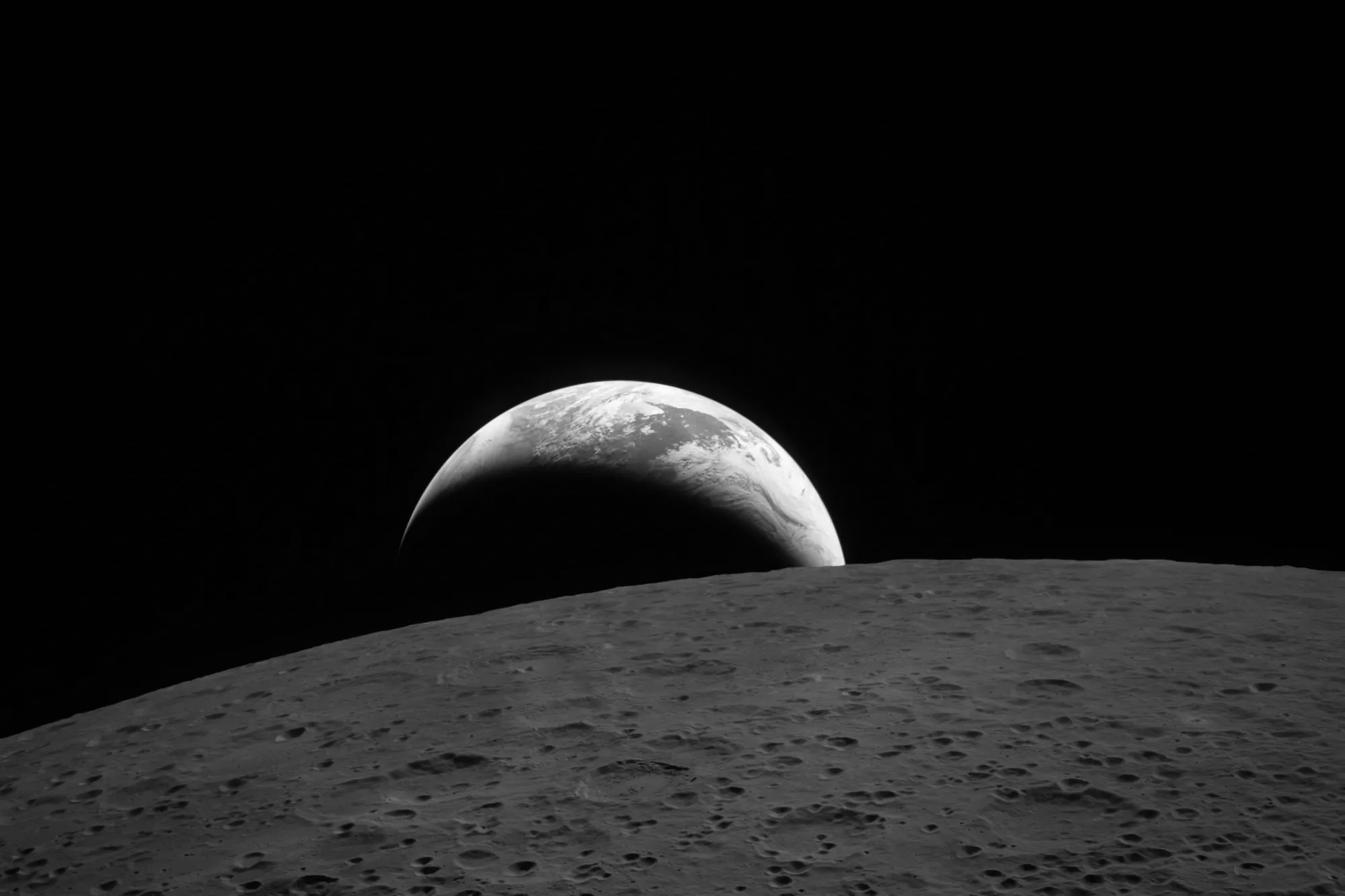
During the flyby, the crew also captured a striking view of Earth setting beyond the lunar horizon , documenting terrain features such as impact craters, ancient lava flows, surface cracks, and ridges formed over billions of years. Variations in colour, brightness, and texture provided valuable clues about the Moon’s composition and geological evolution, offering scientists deeper insight into its history.
The image drew comparisons with the iconic “Earthrise” photograph taken during Apollo 8 in 1968, when astronauts first orbited the Moon. That historic mission marked humanity’s first journey around the lunar body, making Artemis II’s imagery a powerful reminder of how far space exploration has progressed across generations.
Astronauts provided continuous real-time observations to scientists on Earth, describing surface features and documenting newly formed craters. They also identified historic landing sites from earlier missions, creating a strong link between the Apollo era and the present. The crew even proposed names for two prominent craters, adding a personal dimension to the scientific exploration.
A rare and striking moment occurred when the astronauts witnessed a total solar eclipse from behind the Moon , as the lunar body completely blocked the Sun from their vantage point. The phenomenon revealed the Sun’s corona and allowed visibility of planets including Mercury, Venus, Mars, and Saturn in the darkened sky. Scientists consider such observations valuable for studying solar radiation and light behaviour in deep space, free from Earth’s atmospheric interference.
The mission followed a free-return trajectory , a fuel-efficient path that uses the gravitational pull of the Earth and Moon to guide the spacecraft safely back home the same technique used during the Apollo 13 emergency. This approach underscores the reliability of mission design for long-duration human spaceflight.
About Apollo 13:
The Apollo 13 mission, launched in April 1970, was intended to be NASA’s third Moon landing but turned into a dramatic survival story after an oxygen tank explosion crippled the spacecraft mid-flight. Commander Jim Lovell and his crew were forced to abandon the landing and rely on a free-return trajectory to loop around the Moon and safely return to Earth. The mission set a distance record for human space travel and became a landmark example of crisis management and engineering ingenuity.
In a poignant tribute, a recorded message from Lovell, who passed away last year, was played to the Artemis II crew before the flyby, linking two generations of explorers and highlighting the continuity of human ambition in space.
Artemis II, the first crewed lunar mission since Apollo 17 , represents a transition from short-term exploration to long-term presence. By proving that astronauts can travel farther and operate effectively in deep space, the mission lays the groundwork for establishing lunar infrastructure and using the Moon as a launch hub for future planetary missions .
As the spacecraft now heads back toward Earth for a planned Pacific splashdown, Artemis II stands as a milestone that not only breaks records but also signals humanity’s readiness to move beyond the achievements of Apollo and into a new era of sustained and collaborative space exploration.