
Artemis II Moves Closer to Moon After Precision Tests and Orbital Milestones
In a landmark moment for human spaceflight , NASA’s Artemis II mission has rapidly progressed from a symbolic return to the Moon into a high-precision operational test of deep space capabilities . Launched aboard the Space Launch System , the mission is now demonstrating, in real time, the technologies, human skills, and system reliability required to push beyond Earth orbit for the first time in over five decades.
Carrying astronauts Reid Wiseman, Victor Glover, Christina Koch, and Jeremy Hansen , Artemis II represents a new era of inclusive exploration , bringing together the first woman, first person of colour, and first non-American on a lunar trajectory. But beyond its historic composition, the mission’s true significance lies in its role as a critical proving ground for future lunar landings and sustained human presence on the Moon.
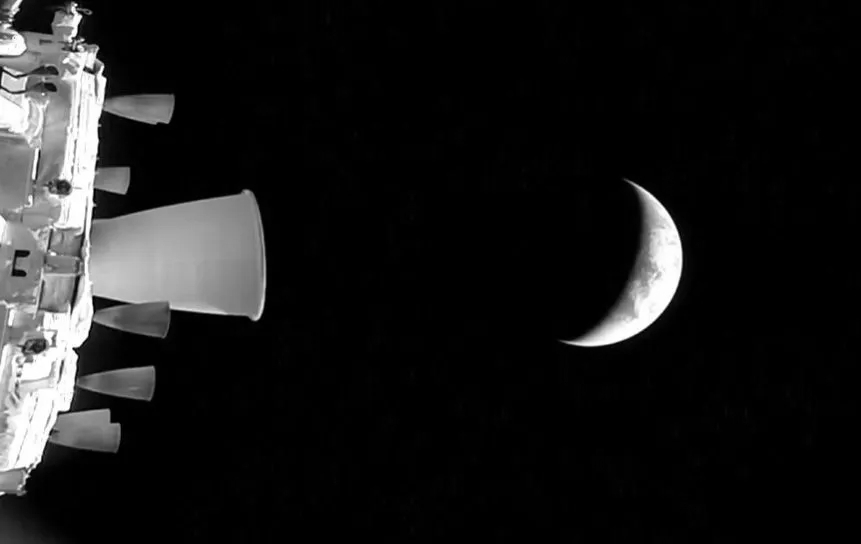
At the heart of this phase is the Orion spacecraft, Integrity , now undergoing rigorous testing in high Earth orbit . The crew successfully completed a proximity operations demonstration , manually guiding the spacecraft through a series of precise approach and retreat maneuvers around the detached Interim Cryogenic Propulsion Stage (ICPS) . This 70-minute exercise validated the astronauts’ ability to control Orion in close-range scenarios , a skill essential for future missions involving docking, lunar orbit operations, and spacecraft assembly.
Following the maneuver, Orion executed an automated departure burn , safely distancing itself from the ICPS, which is now set for a controlled re-entry over the Pacific Ocean . This sequence not only showcased navigational accuracy but also highlighted NASA’s focus on safe and sustainable space operations .
Parallel to crewed activities, Artemis II has also expanded scientific exploration through the deployment of four international CubeSats . These compact satellites are conducting experiments on space radiation, solar activity, advanced onboard systems, and biological effects in extreme environments . Contributions from Argentina, Saudi Arabia, Germany, and South Korea reflect the mission’s global collaborative framework , reinforcing that the future of space exploration is increasingly shared.
Meanwhile, the mission has not been without its minor challenges. A fault indication in the spacecraft’s toilet system prompted ongoing troubleshooting between the crew and ground teams. While not mission-critical, such issues underscore the importance of system reliability in long-duration human spaceflight , where even small components play a vital role.
Crucially, Artemis II has now completed both apogee and perigee raise burns , key maneuvers that have refined Orion’s orbit and aligned it with its planned trajectory toward the Moon . In the latest burn, the spacecraft’s engine fired for 43 seconds , raising the lowest point of its orbit and placing it into a stable high Earth orbit . These carefully calculated adjustments ensure that Orion is positioned with extraordinary precision for its next major step.
That step the translunar injection (TLI) burn will mark the mission’s defining transition. Expected to last nearly six minutes , this powerful maneuver will accelerate the spacecraft by over 1,200 feet per second , sending it beyond Earth’s gravitational influence and onto a path toward the Moon, approximately 400,000 kilometres away . Before execution, mission managers will conduct a comprehensive review to confirm that all systems are operating flawlessly .
Once on its lunar trajectory, Orion will follow a free-return path , looping around the Moon and venturing thousands of kilometres beyond it before naturally returning to Earth. This approach enhances safety by allowing the spacecraft to return even in the event of limited propulsion capability. Throughout the journey, astronauts will continue to test life-support systems, navigation accuracy, radiation exposure limits, and manual control functions in the harsh environment of deep space.
The mission is expected to conclude with a Pacific Ocean splashdown around the tenth day , a critical test of Orion’s ability to withstand extreme re-entry temperatures and forces . Success here will confirm the spacecraft’s readiness for future missions, including planned landings near the lunar south pole later this decade .
Artemis II is unfolding against a backdrop of renewed global interest in the Moon, with multiple nations advancing their own lunar ambitions. Yet, what sets this mission apart is its methodical, step-by-step approach , prioritising safety, sustainability, and long-term presence over short-term achievement.
Ultimately, Artemis II is no longer just a return it is a transition . Each maneuver, each test, and each challenge overcome is shaping a future where humans do not merely visit the Moon, but live, work, and explore beyond Earth on a continuous basis .