
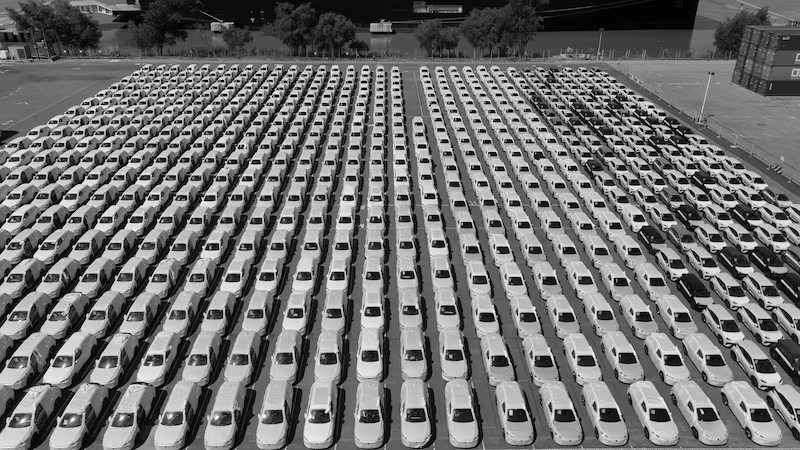
Argentina welcomes first shipload of Chinese EVs
More than 5,800 electric and hybrid vehicles from Chinese automaker BYD arrived on Wednesday aboard the BYD Changzhou at a river port in eastern Argentina, marking the country’s largest-ever shipment of electric vehicles and a striking symbol of its rapid turn toward trade liberalisation. While Chinese EV exports have become common across global markets, their large-scale arrival in Argentina is unprecedented and reflects a profound shift in economic policy.
“This milestone reflects a long-term vision in Argentina, to invest and steadily expand our dealer network across the entire national territory,” said Stephen Deng, BYD’s country manager in Argentina. The image of thousands of Chinese cars unloading duty-free onto a muddy riverbank sent shockwaves through a country long shaped by Peronist protectionism, which for decades shielded local industry with high tariffs and tight import controls. Claudio Damiano, a professor at Argentina’s National University of San Martin, said the ship carried powerful symbolism. “For decades, people here believed everything had to be manufactured locally. This is the first step for BYD, and everyone is watching how far it will go.”
The shipment also carried geopolitical weight. It underscored how China is capitalising on policy choices made elsewhere, benefiting both from US President Donald Trump’s trade disruptions and from Europe’s inability to secure a foothold in Argentina’s emerging EV market. On the same day the BYD vessel docked, European Union lawmakers voted to delay ratification of a long-pending free trade agreement with the Mercosur bloc, including Argentina , which could have lowered barriers for European electric vehicles. “The Europeans simply cannot compete with the Chinese,” Damiano said.
Argentina’s transformation follows a sharp break from its recent past. Under successive Peronist governments, the country became one of Latin America’s most closed economies, burdened by steep import taxes and a chronically weak currency that severely limited consumer choice. President Javier Milei, a radical libertarian elected on a platform of dismantling the state, has taken the opposite path, slashing tariffs, cutting red tape, simplifying customs rules and stabilising the peso to make imports cheaper. As a result, Argentina’s imports jumped 30 per cent last year, with low-cost goods from Asian retailers flooding the market.
Chinese automakers, previously constrained by import duties of up to 35 per cent, are now among the biggest beneficiaries of Milei’s policies. A new government measure allows 50,000 electric and hybrid vehicles to enter the country tariff-free this year, provided they are priced below USD 16,000 at origin. The first shipment arrived at Zárate port after a 23-day voyage from Singapore, with BYD models such as the Dolphin Mini and Yuan Pro positioned to appeal to cost-conscious buyers in a country where EV adoption has so far been minimal.
Milei’s ideological affinity with Trump including shared hostility toward climate regulation, multilateral institutions and what they describe as “wokeness” , has strengthened ties between Buenos Aires and Washington. Trump last year backed Argentina with a USD 20 billion credit swap, a rare show of support in the region. Yet the contrast between their economic strategies is stark. While Trump has relied on tariffs and protectionism, Milei has embraced open markets, a divergence that has allowed Chinese exports to surge even as European and US automakers struggle to keep pace.
Chinese imports to Argentina rose more than 57 per cent last year, far outstripping growth in shipments from the United States. Chinese investment has also expanded in Argentina’s energy and mining sectors, reinforcing Beijing’s economic footprint. BYD and other Chinese brands are already reshaping automotive markets across Latin America, from Mexico City to Rio de Janeiro, and analysts say Argentina’s zero-tariff EV quota gives them a decisive advantage.
“Chinese manufacturers have the technology, the scale and the pricing power to meet the government’s limits,” said Andrés Civetta, an economist specialising in the auto sector at consulting firm Abeceb. “China has won the race.”