
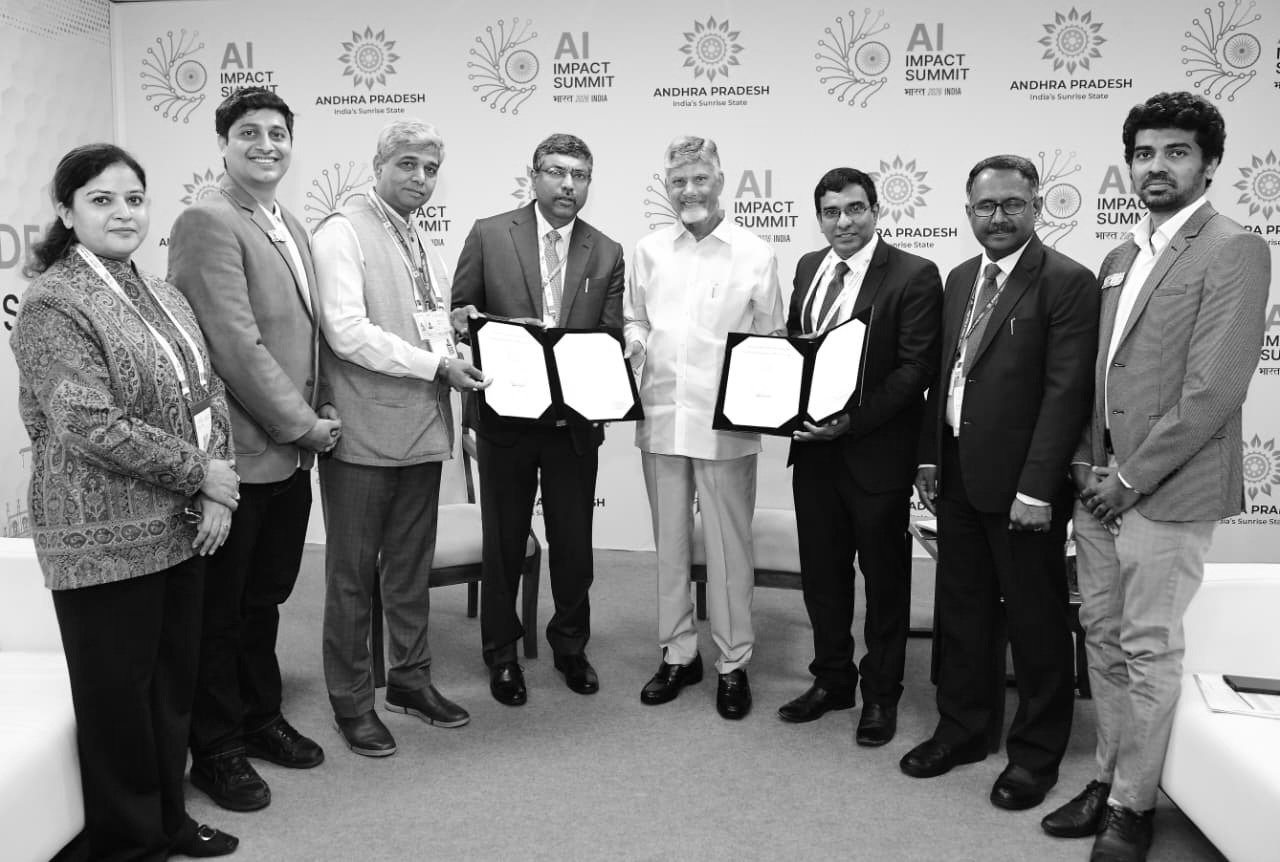
AP Signs 7 AI Pacts to Build Quantum-Ready Education and Tech Ecosystem
Andhra Pradesh has moved decisively to position itself at the forefront of emerging technologies by signing seven strategic agreements at the AI Impact Summit, reinforcing a long-term vision to embed artificial intelligence, quantum computing and advanced digital skills across education, governance and industry. The agreements were formalised in the presence of Chief minister N. Chandrababu Naidu , highlighting the state’s strategy of building its AI future through students, research ecosystems and global partnerships.
A central collaboration with IBM aims to train one lakh learners over the next three to five years in artificial intelligence, cybersecurity and quantum computing. By providing access to global digital learning platforms and industry-aligned training, the initiative seeks to strengthen Andhra Pradesh’s future technology workforce and prepare youth for high-value roles in next-generation sectors.
In partnership with the United Nations International Computing Centre (UNICC) , the state will establish a Centre of Excellence for AI and Quantum Computing at Amaravati Quantum Valley by 2026. With UNICC’s experience supporting international organisations, the centre is expected to promote secure and sovereign AI systems while positioning Amaravati as a trusted global hub for responsible AI deployment.
The government has also partnered with the National Institute of Electronics & Information Technology (NIELIT) to establish a deemed-to-be university campus dedicated to AI and quantum technologies — the first of its kind in South India. Supported by central funding, state-provided land and access to quantum hardware, the campus is expected to emerge as a national hub for advanced research, talent development and deep-tech innovation.
To strengthen higher education transformation, Andhra Pradesh signed an agreement with Calibo AI to enhance AI and digital innovation capabilities across more than 50 higher education institutions. The initiative will support AI-integrated curricula, faculty development, innovation labs and applied research use cases aimed at improving employability and industry readiness. Complementing this effort, the Real Time Governance Society will establish a state-level AI sandbox in partnership with Calibo Inc., providing a secure environment to design and test AI solutions for governance and public service delivery.
Further advancing the Amaravati Quantum Valley ecosystem, the state signed an MoU with WISER (Washington Institute for STEM, Entrepreneurship and Research) to establish a Centre of Excellence and Talent Hub. The programme has already trained over 62,000 learners and aims to scale training to several lakhs annually, reflecting the state’s ambition to build one of the largest deep-tech talent pipelines in the country.
In collaboration with BharatGen, NexGen and IBM , Andhra Pradesh will also launch a statewide AI Tech Hub built on a five-layer swadeshi AI stack. The platform will integrate indigenous large language models, more than 500 sovereign GPUs and support for 22 Indian languages to enable AI-driven solutions in governance, welfare delivery, agriculture, MSMEs and education, ensuring inclusive and citizen-centric digital services.
To bring AI into classrooms, the state has partnered with IIT Madras and Bodhan AI to deploy an AI Tutor across government, aided and private schools. The initiative aims to introduce students to AI-enabled learning early, strengthen foundational digital literacy and ensure future readiness from the school level onward.
These initiatives form part of the broader Amaravati Quantum Valley vision, which seeks to establish Andhra Pradesh as a global hub for quantum technologies, secure AI and deep-tech innovation aligned with India’s National Quantum Mission. Officials emphasise that the state views artificial intelligence not merely as an economic lever but as an educational and societal transformation — one that begins in classrooms, scales through universities and enables smarter governance while preparing an entire generation for the AI-quantum era.