
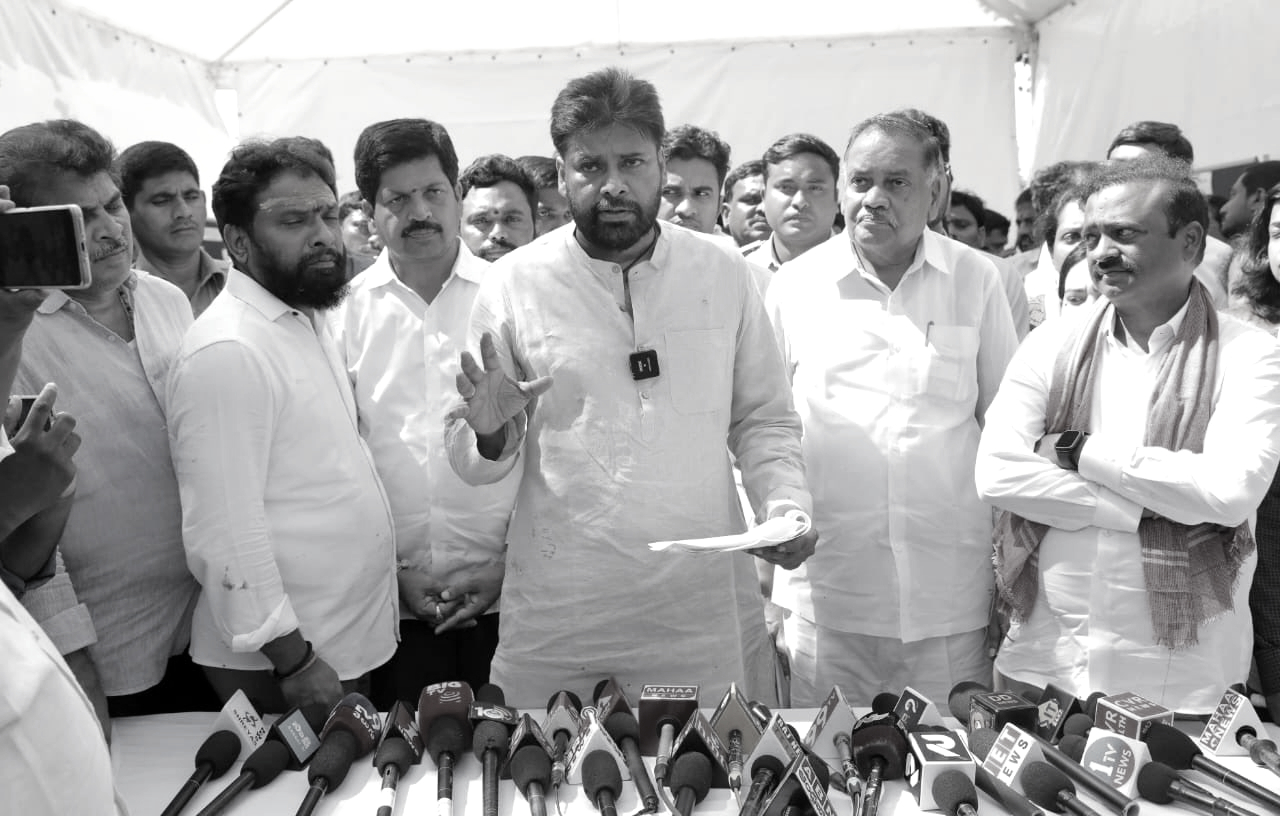
AP Deputy CM Pawan Kalyan assures complete assistance to cyclone-hit farmers
Deputy Chief Minister Pawan Kalyan has assured that every farmer affected by Cyclone Motha will be fully supported by the Andhra Pradesh government. The statement was made during his visit to cyclone-hit areas in Avanigadda constituency of Krishna district on Thursday, where he reviewed crop damage, interacted with farmers, and assessed ongoing relief operations.
It was reported that standing crops in about 1.38 lakh hectares across the state were damaged due to heavy rain and flooding caused by the cyclone, of which nearly 46,000 hectares were in Krishna district alone. Preliminary estimates suggested that around 56,000 farmers in the district suffered crop losses. The Deputy Chief Minister assured that compensation and rehabilitation would be extended to every affected farmer and urged them not to lose hope.
Pawan Kalyan stated that the extent of the damage was considerably reduced due to the advance preparedness of the government under the leadership of Chief Minister N. Chandrababu Naidu. It was said that round-the-clock monitoring was conducted through video conferences and the Real-Time Governance System (RTGS), ensuring coordination between district administrations and village-level teams.
Before landfall, about 1.16 lakh people from low-lying coastal villages in Krishna and adjoining districts were evacuated to rehabilitation camps as a precautionary measure. Essential arrangements were made to ensure their safety and welfare. Each evacuee was provided with ₹1,000 in financial aid before returning home, while families of fisherfolk and handloom workers were supplied with 50 kg of rice. Additional food items such as pulses, onions, potatoes, sugar, and cooking oil were also distributed free of cost. The total immediate cash assistance disbursed amounted to approximately ₹11.6 crore.
Post-cyclone relief works were taken up on a war footing. Under the Panchayat Raj Department, it was found that about 274 km of rural roads were damaged by floodwaters in Krishna district. Orders were issued for their permanent restoration. To prevent the outbreak of water-borne diseases, the government initiated super sanitation and super chlorination drives in the affected villages. A total of 21,055 sanitation workers were deployed across 1,583 villages to carry out disinfection and cleaning operations. Alternative arrangements were made for drinking water supply wherever disruptions occurred.
Speaking to the media after reviewing a photo exhibition on cyclone damage at Avanigadda, the Deputy Chief Minister said that tenant farmers who also incurred losses would be brought to the notice of the Chief Minister for inclusion in compensation plans. He emphasised that post-disaster rehabilitation was being handled in a structured and transparent manner.
Pawan Kalyan further stated that funding assistance from NABARD (National Bank for Agriculture and Rural Development) would be sought for rebuilding damaged coastal infrastructure. The outfall sluice near Koduru mandal, which was damaged during the cyclone, would be reconstructed with NABARD’s support. He added that the Edurumondi–Gollamanda coastal road, linking five villages vulnerable to sea erosion, had been sanctioned at a cost of ₹13.08 crore under the Rural Infrastructure Development Fund (RIDF). The tender process for the project was already completed.
Under the RIDF, NABARD provides low-interest, long-term loans to state governments for rural infrastructure such as roads, bridges, irrigation, and flood-control structures. The interest rate generally ranges between 3.5% and 4.5% per annum, with repayment over 7 to 15 years. Andhra Pradesh has so far received ₹64,200 crore in RIDF assistance since 1995, of which ₹57,800 crore has been disbursed and ₹43,100 crore repaid, maintaining a record of timely payments. Similar funding has been utilised for rehabilitation after previous cyclones such as Hudhud (2014), Titli (2018), Gulab (2021), and Michaung (2023).
The Deputy Chief Minister was accompanied by Ministers , Officials among others.The government’s overall response was said to have focused on saving lives, restoring livelihoods, and rebuilding essential rural infrastructure through coordinated inter-departmental efforts. Officials reaffirmed that no affected farmer or village would be left without support as post-cyclone relief and rehabilitation continue across coastal Andhra Pradesh.