
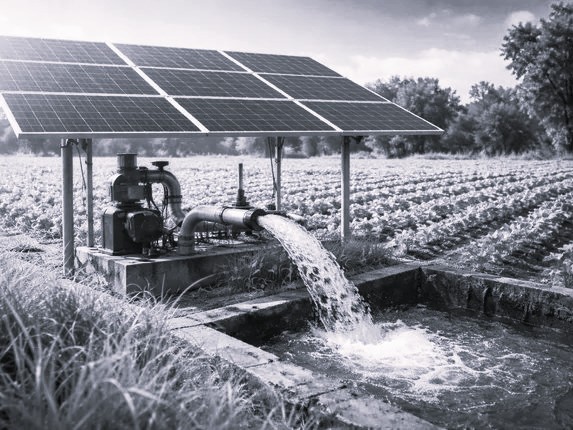
AP Accelerates PM-KUSUM Solarisation, Targets 109.7 MW in Two Months
Andhra Pradesh has reached another significant milestone in its clean-energy transition, with feeder-level solarisation (FLS) capacity under Component-C of the Pradhan Mantri Kisan Urja Suraksha evam Utthaan Mahabhiyan (PM-KUSUM) reaching 1,162.8 MW. The capacity is being developed through 228 solar power plants across the state, Energy Department Special Chief Secretary K. Vijayanand said.
The state is now looking to accelerate implementation and bring an additional 109.7 MW of solar capacity into operation during September and October. The expansion is expected to strengthen renewable power generation while improving the availability of reliable and quality daytime electricity to agricultural feeders.
Vijayanand said land acquisition has already been completed for all 228 feeder-level solar plants. He directed officials of the distribution companies and developers to identify implementation challenges at an early stage and resolve them promptly. The agencies have also been asked to adhere strictly to the scheduled timelines for completing the projects.
Under the Andhra Pradesh Central Power Distribution Company Limited (APCPDCL), 49 FLS plants with a combined capacity of 191.5 MW are currently being implemented. A 3 MW solar plant at the 33 kV NN Tandra substation in Palnadu Circle was commissioned on August 27. Another 62 MW is targeted to be brought into service in the APCPDCL region during September and October.
Meanwhile, 33 FLS plants with 220.3 MW are under implementation in the southern distribution area. The plan envisages commissioning 11.99 MW in September and 13.5 MW in October, with the remaining capacity scheduled for November and December.
The largest concentration of projects is under APSPDCL and Kuppam Renewable Energy Cooperative Society (KRECS), which together account for 146 plants with 751 MW. Projects in Adamaragam, Mallepalli, Dasamanupalli and Kuppam Town are expected to contribute around 19.9 MW during September.
As per the commissioning schedule, 27 MW is planned for September and 82.7 MW for October, taking the additional capacity expected over the two months to 109.7 MW.
Vijayanand said the programme provides a dual benefit: expanding renewable energy generation while ensuring more dependable daytime electricity for agricultural feeders, offering a stronger and cleaner power supply for farmers.