
Another War Casualty: Not Just Fuel, Every Price Set to Rise Despite Duty Cut on Petrochemicals
India’s decision to scrap customs duty on a wide basket of petrochemical imports till June 30 may appear like a relief measure. In reality, it signals a deeper disruption. The cost of making almost everything is going up and there is very little the government can do to stop it.
The products covered under the exemption are not consumer goods. They are industrial intermediates , the invisible building blocks of the modern economy. The list spans three broad categories. Basic chemicals such as methanol, acetic acid and ammonia. Intermediates like styrene, phenol and vinyl chloride. And polymers and engineering plastics including polyethylene, polypropylene, PVC, ABS and polycarbonates. These feed directly into sectors ranging from plastics and textiles to automobiles, pharmaceuticals and construction.
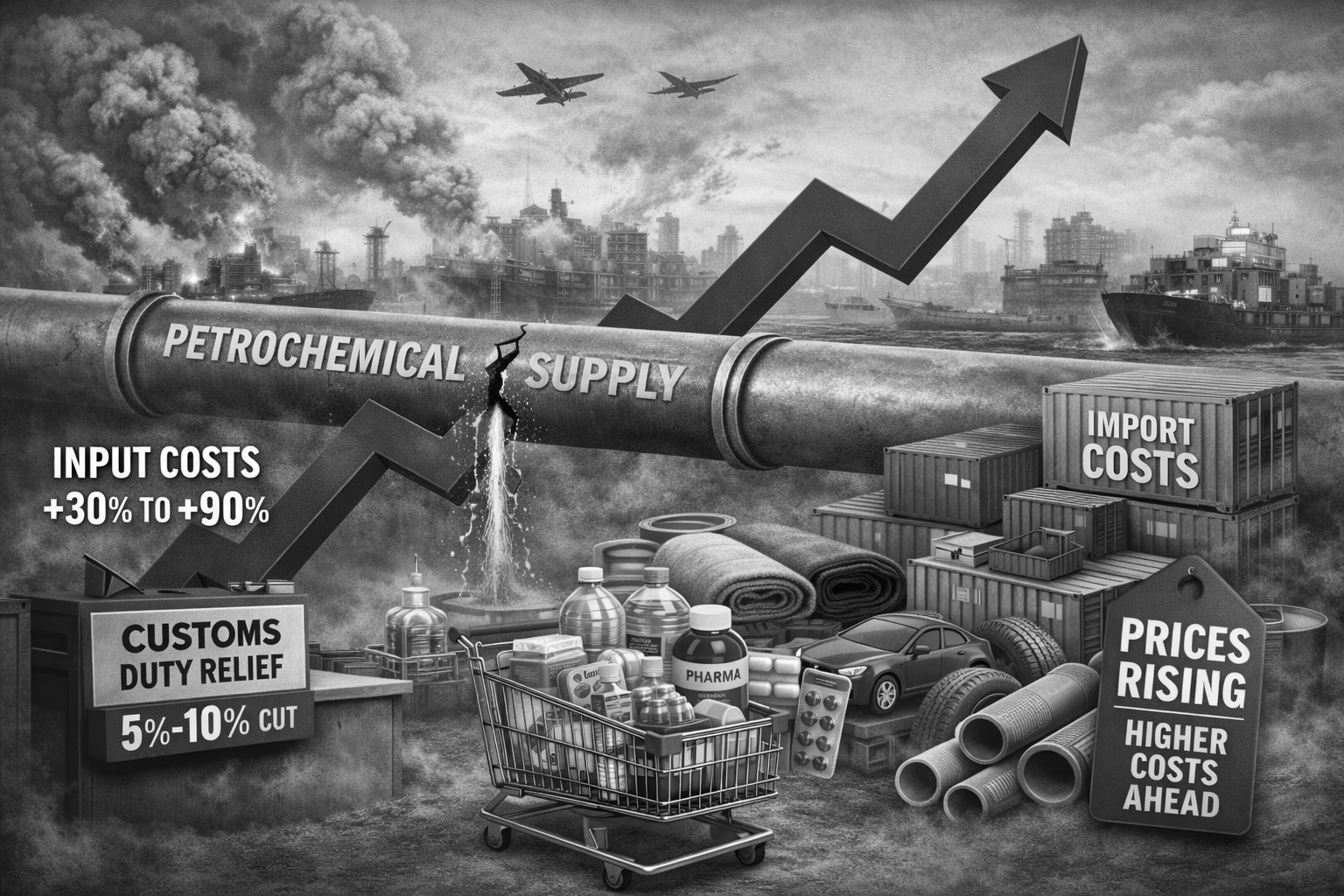
India imports a substantial portion of these inputs. Even in normal times, the country brings in an estimated $3 to $5 billion worth of petrochemical intermediates every month , part of a larger $6 billion monthly chemical import bill . With supply chains now disrupted due to the West Asia conflict , prices of key inputs have surged anywhere between 30 percent and 90 percent within weeks, depending on the chemical and its dependence on crude linked feedstock.
This is where the arithmetic becomes uncomfortable. A typical customs duty of 5 percent to 10 percent has been removed , but input prices themselves have jumped by as much as 60 percent on average . Even after the duty cut, manufacturers are still staring at a net 50 percent increase in raw material costs .
And because these are intermediates, the impact is not confined to one sector. Plastics and packaging will get costlier, pushing up prices of everyday FMCG goods. Textiles , especially polyester based clothing, will see upward pressure due to higher PTA and MEG costs. Automobiles will absorb higher costs for plastics, synthetic rubber and coatings. Pharmaceuticals face rising input costs for APIs, while construction will see increases in pipes, paints and insulation materials. Even electronics and appliances will feel the pinch through engineering plastics.
The effect will not be dramatic in any one product. Instead, it will be broad and pervasive , a steady increase of 5 percent to 20 percent across a wide range of goods , driven by higher input and packaging costs.
This is what makes the current situation a double whammy . The government, by eliminating customs duty, is forgoing revenue at a time of rising fiscal pressure . Yet, the relief is marginal compared to the scale of the price shock. Costs are still rising sharply and those increases will inevitably be passed on to consumers.
In effect, the duty cut is not about making goods cheaper. It is about preventing supply disruption . Prices, however, are already on a one way trajectory. Upward.