
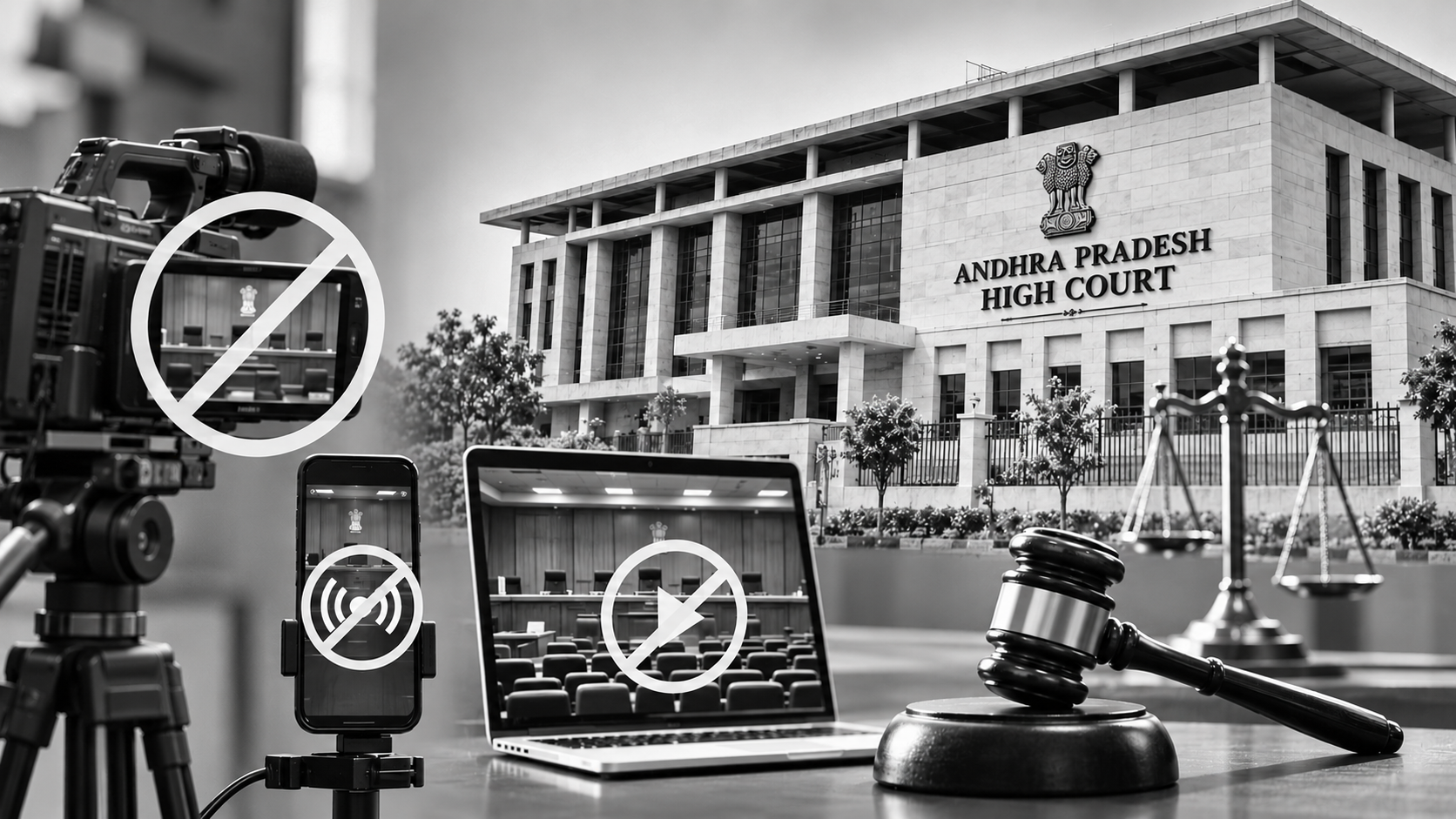
Andhra HC Bans Unauthorised Recording, Broadcasting of Court Proceedings
The Andhra Pradesh High Court on Wednesday strictly prohibited the unauthorised recording, reproduction, transmission, publication and broadcasting of its judicial proceedings, warning that violations would invite appropriate legal action. The court said no individual or organisation could record, upload, circulate, livestream or broadcast its proceedings without due authorisation, covering television channels, websites, social media platforms, messaging applications and other electronic or digital media.
In an official press release, the High Court said the restrictions were necessary to preserve the dignity and sanctity of judicial proceedings, maintain courtroom discipline and ensure the orderly administration of justice. It warned that violations would attract action under applicable laws, rules, judicial directions and orders.
The directive comes amid growing concerns over the selective editing, circulation and commercial exploitation of courtroom videos on digital platforms. Clips of exchanges between judges and lawyers, when shared without context, can distort judicial observations and mislead audiences.
The Supreme Court addressed the issue through an interim order on July 24, 2026, prohibiting the unauthorised extraction, editing, uploading, dissemination, storage and monetisation of audio-visual recordings of judicial proceedings. A three-judge Bench headed by Chief Justice Surya Kant, comprising Justices Joymalya Bagchi and V. Mohana, required prior permission from the competent court authorities for such activities. On July 31, the apex court clarified that legitimate news reporting would not be affected, although unauthorised use of courtroom video clips remained restricted.
The court continued its intervention on October 9, asking the Union government to formulate a comprehensive policy. On October 31, it directed the Ministry of Electronics and Information Technology (MeitY) to ensure compliance and incorporate measures against violators.
Andhra Pradesh already has the 2023 Rules for Live-Streaming and Recording of Court Proceedings, published on June 10, 2023, and effective from May 1, 2024. They exclude sensitive matters, including matrimonial disputes, child custody, sexual offences, POCSO cases and in-camera proceedings, from ordinary public livestreaming. They also provide for a 10-minute streaming delay, recording supervision and encrypted archival retention.
The rules prohibit unauthorised recording and redistribution, with possible action under the Copyright Act, 1957, Information Technology Act, 2000 and contempt provisions.
The framework follows the Supreme Court's 2018 Swapnil Tripathi judgment recognising livestreaming as a means of strengthening open justice, and its 2021 Model Rules balancing transparency with privacy and confidentiality.