
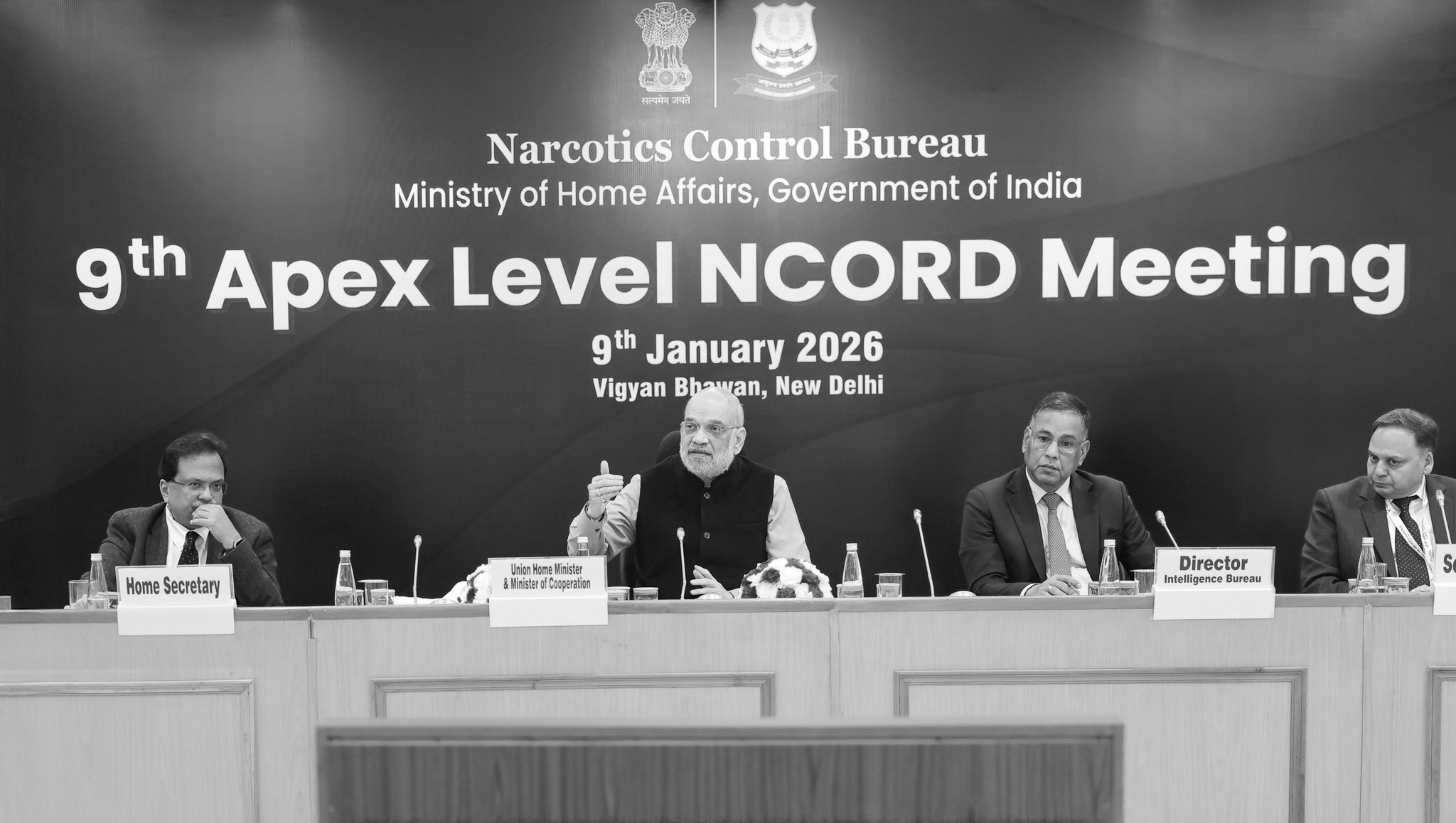
Amit Shah announces March 31 deadline for anti-drug plans, launches 3-year national mission
Union Home Minister Amit Shah on Friday announced a three-year nationwide campaign against narcotics, set to begin on March 31, 2026, with the aim of eradicating the drug menace across India . Addressing the ninth apex-level meeting of the Narco-Coordination Centre in New Delhi, Shah stressed that the crisis poses a threat to national security and the future of the country’s youth. He emphasised the need for a unified, coordinated response involving central and state authorities, clear roadmaps, and time-bound reviews to ensure effective implementation.
The campaign will engage a range of authorities, including the Narcotics Control Bureau, state police, anti-narcotics task forces, customs and border protection agencies, forensic science laboratories, health and social welfare departments, and district magistrates . All departments have been directed to prepare detailed roadmaps by March 31, with periodic review mechanisms up to 2029. Shah stressed that the drug problem is not only a law and order issue but also connected to narco-terror, undermining health, productivity, and social harmony, while endangering the future of young generations.
Data from enforcement agencies show the scale of the challenge. In 2025, the Narcotics Control Bureau seized about 1.3 lakh kilograms of illicit drugs worth nearly ₹2,000 crore and arrested nearly 1,000 traffickers , including foreign nationals. The operations also dismantled international trafficking networks, shut down clandestine labs, and resulted in the destruction of tens of thousands of kilograms of drugs. Past trends show that states like Kerala, Himachal Pradesh, Haryana, Karnataka, and Trichy in Tamil Nadu have seen a sharp increase in registered cases, while women and minors are increasingly involved as users or couriers.
Shah outlined a three-fold strategy to tackle the menace. The first step is a ruthless disruption of supply chains, targeting cartels, trafficking routes, financial networks, and logistics. The second is strategic demand reduction through schools, communities, and workplace awareness programs. The third is a humane approach to harm reduction and rehabilitation, treating addiction as a health issue rather than only a crime. Technology, including AI tools and darknet monitoring, will be used to track and dismantle complex networks, while international and interagency cooperation will help curb cross-border trafficking.
The social impact of drugs in India is severe. Tens of millions of people aged 10 to 75 use substances like cannabis, opioids, sedatives, and stimulants. Minors and young adults are particularly vulnerable. In states like Punjab , more than six lakh minors and over 63 lakh adults are estimated to be using various substances, highlighting a crisis that affects families, education, employment, and mental health.
The campaign, Shah said, will build on past successes and address gaps in enforcement, conviction, and community outreach. By strengthening inter-agency coordination, expanding prevention and rehabilitation efforts, and ensuring accountability at all levels, the government aims to move India closer to a drug-free future, protecting the country’s youth and securing societal well-being.