
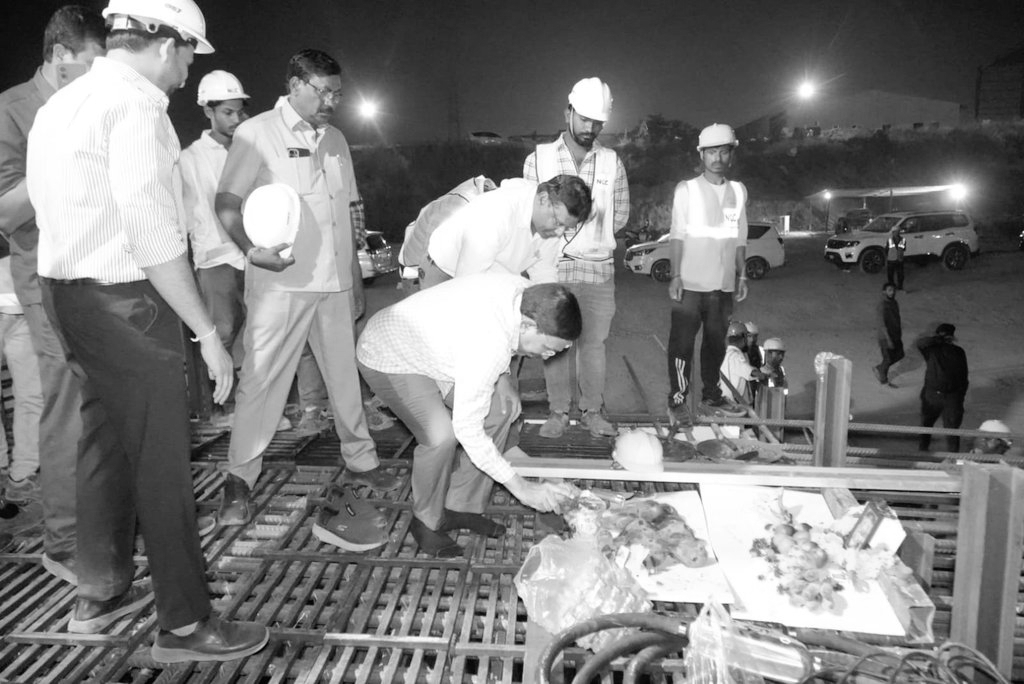
Amaravati High Court Project Resumes After Years of Delay, Target Completion by 2027
The restart of construction works for the permanent Andhra Pradesh High Court building in Amaravati has brought renewed focus not only on the capital city’s long-delayed development but also on the continuing political debate over the location of the state’s judiciary. With the present coalition government reviving the Amaravati vision, questions are once again being raised about how the judiciary functioned for years without a permanent building, the decentralisation policy pursued by the previous YSRCP government, and whether the High Court could be shifted if there is a change in political power.
Following the bifurcation of Andhra Pradesh in 2014, Amaravati was designated as the capital city, and the government promised a world-class High Court building as part of a larger government complex. While some initial foundation-related works were taken up during the 2014–2019 period , the project did not progress further. In January 2019, when the Andhra Pradesh High Court formally came into existence, it began functioning from a temporary campus at Nelapadu near Amaravati. This interim arrangement, created to meet immediate needs, was never intended to serve as a permanent judicial complex.
Despite operating from temporary infrastructure for several years, the judiciary continued its work, even as advocates and bar associations repeatedly highlighted the limitations of the make shift facility. Lawyers raised concerns over inadequate court halls, lack of chambers, insufficient parking, and the absence of space for future expansion. They consistently demanded the construction of a permanent High Court building, arguing that a constitutional institution of such importance should not function indefinitely from temporary premises.
The issue took a political turn after YS Jagan Mohan Reddy became Chief Minister in 2019. His government introduced the three-capitals policy through the Andhra Pradesh Decentralisation and Inclusive Development of All Regions Act, 2020, proposing Visakhapatnam as the executive capital, Amaravati as the legislative capital, and Kurnool as the judicial capital. Under this model, Kurnool was projected as the future seat of the High Court, with the aim of ensuring balanced regional development, particularly for Rayalaseema.
However, despite this policy declaration, the judiciary was never shifted to Kurnool during Jagan Mohan Reddy’s tenure . Constitutional procedures require the consent of the Chief Justice of the High Court, approval by the Supreme Court Collegium, and a formal notification by the Central Government before a High Court can be relocated or a permanent bench established. These approvals were not secured, and no fully sanctioned High Court construction project or dedicated budget was finalised for Kurnool or Kadapa. As a result, the High Court continued to function from its temporary campus near Amaravati.
During this period, advocates in Rayalaseema repeatedly demanded the establishment of a High Court bench in Kurnool, citing regional access to justice and historical commitments such as the Sribagh Pact. While preparatory discussions and land identification exercises were reported, they did not translate into concrete construction or financial allocations. The absence of permanent judicial infrastructure in Kurnool underscored the gap between policy intent and execution.
With the change of government in 2024, the coalition led by the TDP has revived the Amaravati capital works, including the permanent High Court building. Municipal Administration and Urban Development Minister P. Narayana recently launched the raft foundation works for the High Court complex. Designed by the internationally renowned firm Foster + Partners, the building will span about 21 lakh square feet, house 52 court halls , and include a basement, ground floor, and multiple upper floors, with the Chief Justice’s court located at the top level.
The project’s estimated cost ranges between ₹786 crore and ₹1,048 crore, based on various approvals and tender stages. The Andhra Pradesh Capital Region Development Authority invited tenders in early 2025, and NCC Limited emerged as the L1 bidder for the High Court construction. The government has set an ambitious target to complete the project by the end of 2027, describing it as a cornerstone of Amaravati’s revival.
Opposition reaction to the renewed Amaravati push has largely remained within the broader political debate rather than focusing specifically on the High Court building. Former Chief Minister and YSRCP president YS Jagan Mohan Reddy has criticised Amaravati construction in general, alleging inflated costs and questioning the financial prudence of large-scale capital projects. Other YSRCP leaders have defended the three-capitals model, reiterating that decentralisation was aimed at reducing regional imbalances and avoiding excessive expenditure in one location.
Speculation has also emerged over whether Jagan Mohan Reddy, if he were to return to power, would attempt to shift the judiciary to Kurnool. While his earlier stance clearly favoured Kurnool as the judicial capital, legal experts point out that any such move would still require judicial consent and central approval. Without these, a unilateral decision by a state government would not be sufficient to relocate the High Court, regardless of political intent.
At present, the Andhra Pradesh High Court continues to function from its temporary campus near Amaravati, even as construction begins on a permanent building intended to serve the state for decades. For the legal fraternity, the restart of High Court construction is seen as a long-overdue step towards fulfilling the original promise made at the time of Amaravati’s conception. For the political class, it remains a symbol of the larger contest between competing visions for Andhra Pradesh’s capital and governance structure.