
Akashvani at 90: Honouring a Legacy of Music, Public Welfare and Nation-Building
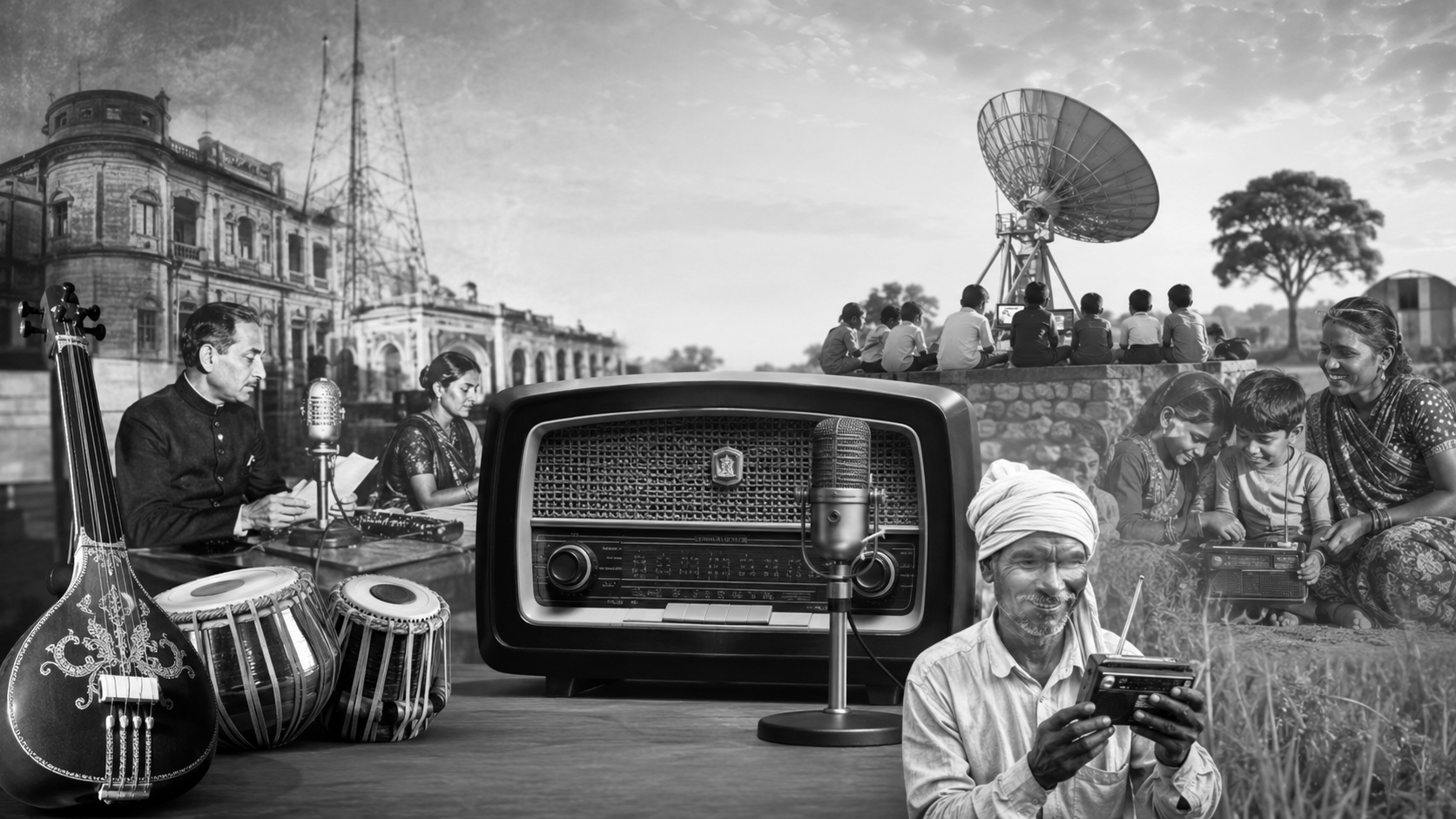
For nearly nine decades, the voice of Akashvani has travelled across India’s mountains, villages, cities, deserts, forests, and border regions carrying with it news, music, culture, public welfare messaging, and the pulse of a nation in transition. Long before television entered Indian households and decades before the internet revolution transformed communication, radio emerged as the country’s most trusted companion. Today, as India celebrates 90 years of Akashvani , the institution stands not merely as a broadcaster but as a living archive of India’s democratic, cultural, and developmental journey.
As part of the nationwide AKASHVANI@90 celebrations, Akashvani Ahmedabad will organize a grand musical evening titled “AKASHVANI@90 – Sugam Sangeet Samaroh” on May 27 at Dinesh Hall in Ahmedabad. The event will feature celebrated singers Biren Purohit, Archit Patadia, Srushti Tripathi, and Mirande Shah under the musical direction of renowned composer Hasmukh Patadia. But beyond the melodies and celebrations lies a much deeper story: the story of how Akashvani became one of India’s most influential public institutions.
From Colonial Broadcasting to National Identity
The origins of Akashvani date back to the early years of broadcasting in colonial India. Radio broadcasting began experimentally in the 1920s, but the foundation of national public broadcasting took shape in 1930 with the establishment of the Indian State Broadcasting Service . In 1936, it was formally renamed All India Radio (AIR) , while the term “Akashvani,” meaning “voice from the sky,” was later officially adopted in 1956.
Over time, the institution evolved into one of the largest radio networks in the world, reaching nearly every corner of India through hundreds of stations and broadcasts in multiple languages and dialects. In pre-Independence India, radio became a powerful instrument of communication during politically turbulent times, carrying official information and shaping public discourse.
After Independence in 1947, Akashvani assumed an even greater responsibility helping unite a newly independent and linguistically diverse nation.
The Government’s Most Powerful Welfare Messenger
At a time when literacy rates were low and access to information remained limited, radio became the government’s most effective medium for mass communication. Through Akashvani, people learned about agricultural reforms, public health programmes, educational campaigns, weather updates, and national policies.
Farmers tuned in to agricultural advisories, students listened to educational programming, and rural communities depended on radio bulletins for crucial information affecting their daily lives.
Over the decades, Akashvani played a pivotal role in spreading awareness about government welfare schemes , vaccination drives, literacy missions, sanitation campaigns, women’s empowerment initiatives, and disaster preparedness programmes. In remote villages where newspapers arrived late and television penetration remained weak, radio served as a vital bridge between the government and citizens.
Its importance became especially evident during moments of national crisis. During wars, natural disasters, pandemics, and emergencies, Akashvani emerged as one of the most trusted sources of verified information. From the 1962 Sino-Indian War and the 1971 Indo-Pak conflict to flood warnings and cyclone alerts in later decades, radio remained a dependable medium capable of reaching even the most inaccessible regions of the country.
Preserving India’s Cultural Soul
Akashvani’s legacy extends far beyond information dissemination. The broadcaster became one of India’s strongest custodians of art, literature, and music. Through legendary programmes and platforms such as Vividh Bharati , radio dramas, classical concerts, poetry recitals, and regional cultural broadcasts, Akashvani nurtured generations of artists and preserved India’s diverse traditions.
Several iconic musicians and performers found national recognition through Akashvani studios. Voices that later became synonymous with Indian classical and film music were introduced to millions through radio broadcasts. From maestros like Ravi Shankar and Bismillah Khan to legendary vocalists such as MS Subbulakshmi and Begum Akhtar, Akashvani played a defining role in democratizing access to culture and music.
The institution also preserved regional traditions that may otherwise have faded with time. Folk songs, tribal storytelling traditions, regional theatre, devotional music, and literary discussions found space on Akashvani’s airwaves, creating a shared cultural identity while simultaneously celebrating linguistic diversity.
Akashvani in the Digital Era
Even in the age of smartphones, streaming platforms, and social media, Akashvani continues to retain significance in modern India. Operating under Prasar Bharati, the network today broadcasts in 23 languages and over 140 dialects , maintaining one of the widest communication reaches in the country.
Its role remains particularly critical in rural India, border regions, and disaster-prone areas where internet connectivity and digital infrastructure remain inconsistent.
Recognizing the continuing relevance of public broadcasting, the Union government has launched major modernization efforts in recent years to revive and strengthen Akashvani’s infrastructure. Under the Broadcasting Infrastructure and Network Development (BIND) Scheme , the Centre approved significant investments aimed at upgrading both Akashvani and Doordarshan facilities across India.
Government estimates indicate that modernization projects worth over ₹2,500 crore are being undertaken to improve transmission infrastructure, expand FM coverage, digitize archives, install modern broadcasting systems, and strengthen communication outreach in remote regions.
The initiatives also include digital transformation measures such as online streaming, podcast services, mobile applications, and archival preservation.
Celebrating 90 Years Through Music
The AKASHVANI@90 celebrations reflect the dual identity of the institution — deeply rooted in tradition while adapting to changing times. Across the country, commemorative programmes are being organized to honour the broadcaster’s contribution to journalism, music, education, and nation-building.
The Ahmedabad musical evening captures this spirit perfectly. The Sugam Sangeet performances by Biren Purohit, Archit Patadia, Srushti Tripathi, and Mirande Shah are expected to celebrate not only Gujarat’s musical traditions but also Akashvani’s decades-long role in nurturing regional art forms.
Under the direction of Hasmukh Patadia, the programme aims to evoke nostalgia for generations who grew up listening to radio while also introducing younger audiences to the enduring charm of public broadcasting.
More Than a Broadcaster
For millions of Indians, Akashvani is not merely a station on the radio dial. It is the sound of early morning devotional songs, cricket commentary echoing through neighbourhoods, breaking national news during historic moments, educational broadcasts in rural schools, and timeless melodies that transcended generations.
In an era dominated by algorithm-driven digital media and fragmented information ecosystems, the journey of Akashvani serves as a reminder of the enduring power of credible public broadcasting. Ninety years after its inception, the “voice from the sky” continues to resonate carrying with it the history, diversity, and collective memory of India itself.