
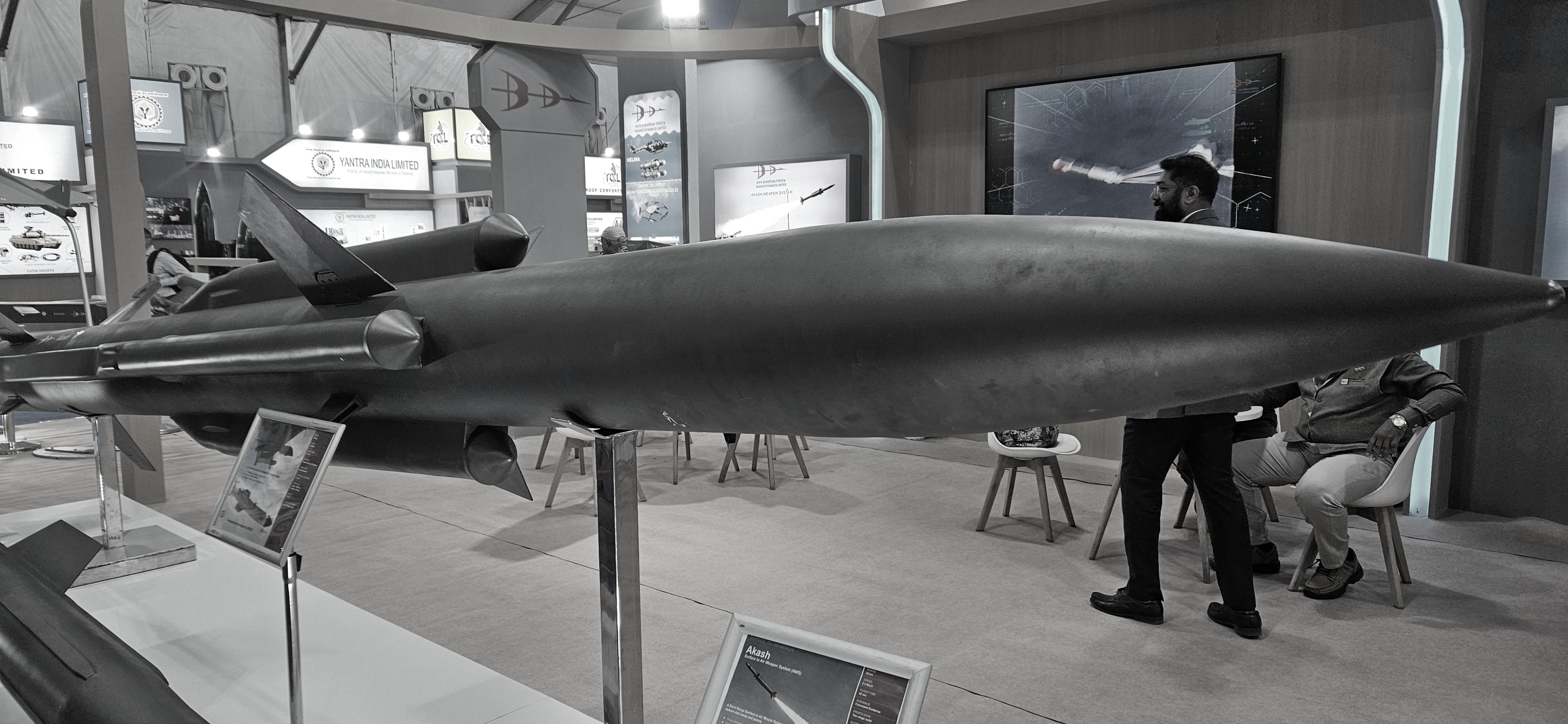
Akash-NG marks major leap over earlier Akash Missiles
The successful completion of User Evaluation Trials (UET) of the Next Generation Akash missile system (Akash-NG) marks a significant technological upgrade over India’s earlier Akash surface-to-air missile variants, substantially enhancing the country’s air-defence capabilities.
Developed by the Defence Research and Development Organisation (DRDO), Akash-NG represents a complete redesign rather than an incremental improvement. The most critical upgrade is the induction of an indigenous active Radio Frequency (RF) seeker, which allows the missile to independently detect, track and engage aerial targets in the terminal phase. Earlier Akash variants such as Akash Mk-1 and Akash-1S relied primarily on ground-based radar command guidance, requiring continuous tracking support throughout the missile’s flight.
Another major enhancement is the significant increase in engagement range. While earlier Akash missiles had an operational range of about 25–30 kilometres, Akash-NG is designed to strike targets at distances of up to 70 kilometres, enabling wider airspace coverage and reducing the number of launch units required to defend strategic assets.
Akash-NG is also considerably lighter and faster. Weighing around 350 kilograms, nearly half the weight of earlier Akash missiles, the new system offers quicker reaction times and improved mobility. This reduction in weight has been achieved through the replacement of the older ramjet propulsion system with a high-energy solid rocket motor, which simplifies maintenance and ensures reliable performance across diverse weather and terrain conditions.
In terms of altitude coverage, Akash-NG improves upon the previous ceiling of about 18 kilometres, with the ability to intercept high-altitude targets beyond 20 kilometres, while also demonstrating strong performance against low-altitude, near-boundary threats such as drones and cruise missiles during recent trials.
The missile system has also been integrated with advanced AESA radars and modern command-and-control networks, enabling it to engage multiple targets simultaneously and operate effectively in electronically contested environments. Enhanced resistance to electronic warfare and radar jamming further improves its survivability against sophisticated adversaries.
Defence experts note that these upgrades position Akash-NG as a key component of India’s layered air-defence architecture, complementing systems such as MR-SAM, QR-SAM and the S-400. The successful user trials indicate that the system is moving closer to induction by the Indian Army and the Indian Air Force.
Overall, Akash-NG stands out as a faster, longer-ranged, lighter and more autonomous air-defence missile, reinforcing India’s push for self-reliance in critical defence technologies under the Atmanirbhar Bharat initiative.