
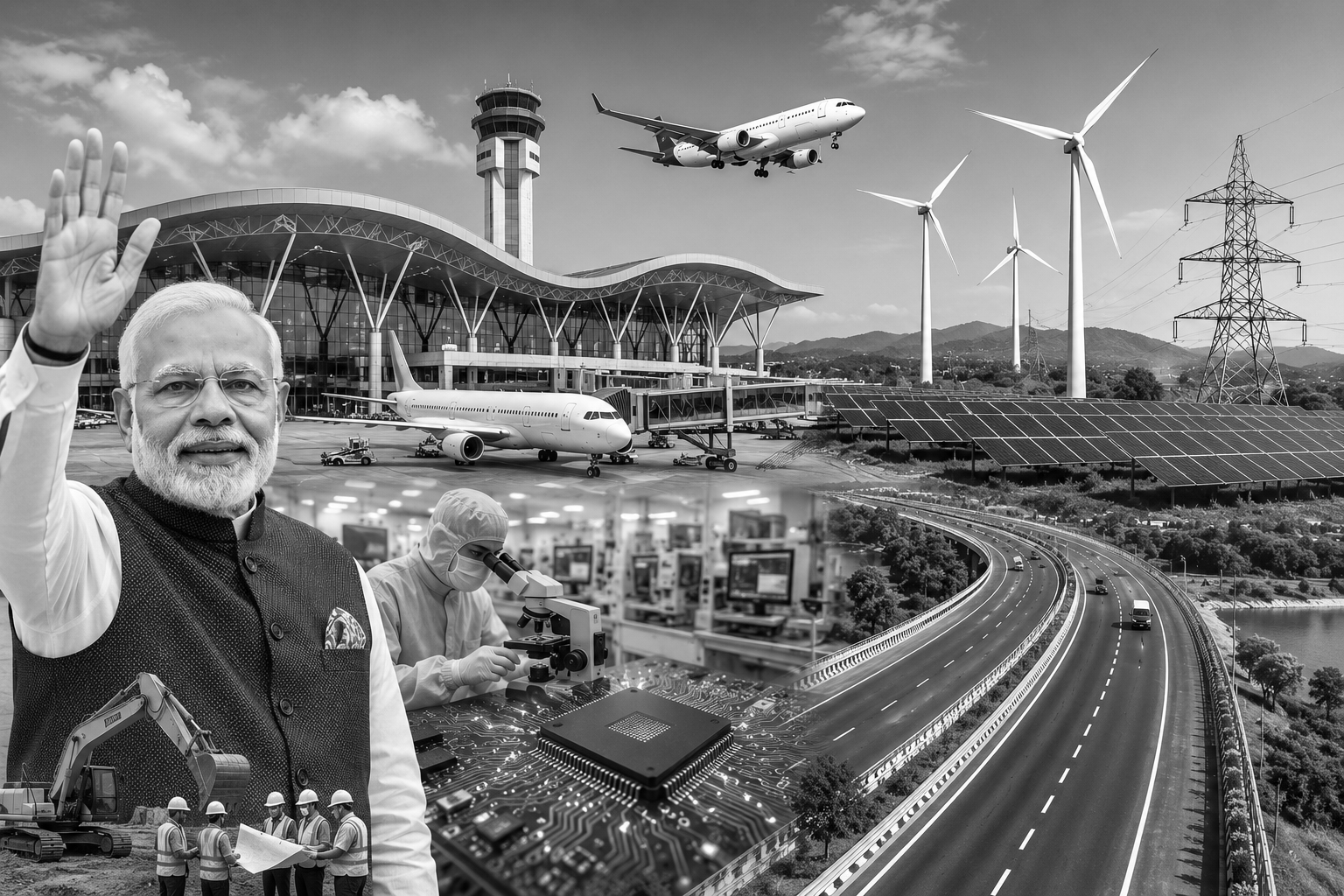
Airport, Chip Plant, Green Energy: PM Modi's Vision for a New Andhra Pradesh
Prime Minister Narendra Modi will visit Andhra Pradesh and Karnataka today, where he will inaugurate and lay the foundation stone for multiple development projects worth over ₹17,900 crore. While the visit includes the inauguration of the Swami Vivekananda Cultural Youth Centre (Viveka Smaraka) in Mysuru, the overwhelming focus is on Andhra Pradesh, which is set to receive investments across aviation, semiconductor manufacturing, renewable energy transmission, and national highway infrastructure.
The package represents one of the largest integrated infrastructure and industrial investment initiatives for Andhra Pradesh in recent years. More than a collection of individual projects, it seeks to strengthen the state's economic foundation by improving connectivity, promoting high-tech manufacturing, accelerating clean energy integration, and expanding transport networks. If implemented successfully, these projects could significantly boost employment, attract private investment, improve logistics, and position Andhra Pradesh as a key industrial and technology hub in India.
Bhogapuram Airport: A New Gateway for Andhra Pradesh
The centrepiece of the Prime Minister's visit is the inauguration of the Alluri Sitarama Raju International Airport at Bhogapuram in Vizianagaram district. Developed under the Public-Private Partnership (PPP) model at a cost of over ₹5,640 crore, the greenfield airport has been designed to handle six million passengers annually, making it one of the state's largest aviation infrastructure projects.
The airport is expected to transform air connectivity across North Coastal Andhra Pradesh, serving districts such as Vizianagaram, Visakhapatnam, and Srikakulam. It is likely to improve access for domestic and international travellers, reduce pressure on existing airport infrastructure, and strengthen the movement of passengers and cargo. Improved connectivity is also expected to encourage greater investment, enhance exports, and support business travel.
The terminal has been designed to provide a seamless travel experience through the use of advanced technologies, including Artificial Intelligence (AI), Building Information Modelling (BIM), Airport Predictive Operations Centre (APOC), biometric passenger processing, automated baggage handling systems, and intelligent operational monitoring solutions. These systems are expected to improve efficiency, enhance passenger convenience, strengthen safety, and optimize airport operations.
Sustainability has also been incorporated into the airport's design. It features a 5 MW solar power plant, rainwater harvesting, energy-efficient heating, ventilation and air-conditioning systems, LED lighting, smart building management, waste management initiatives, electric vehicle charging infrastructure, and environmental monitoring measures. The terminal has been designed according to Green Building Standards and is registered with the U.S. Green Building Council (USGBC).
Architecturally, the airport reflects Andhra Pradesh's cultural identity. Its roof profile is inspired by the state's traditional Chuttilu cottages, the scenic landscapes of Araku Valley, and the graceful movement of a flying fish, combining regional heritage with contemporary airport design. Besides improving connectivity, the airport is expected to promote tourism, facilitate trade, attract investments, and generate employment opportunities across the region.
A Major Boost for Tourism and Regional Development
The new airport is expected to become an important gateway for tourists visiting Araku Valley, Borra Caves, Visakhapatnam's beaches, Buddhist heritage sites, and the Eastern Ghats. Better air connectivity could increase tourist arrivals, benefiting hotels, restaurants, transport operators, and local businesses.
Improved connectivity is also expected to support export-oriented industries, fisheries, agriculture, pharmaceuticals, and manufacturing by reducing transportation time and improving logistics efficiency. The project aligns with Andhra Pradesh's long-term objective of strengthening its position as a logistics and industrial hub along India's eastern coast.
Andhra Pradesh Enters India's Semiconductor Era
Among the most strategically important announcements is the foundation stone for the ASIP Semiconductor Project at Visakhapatnam, the state's first semiconductor manufacturing facility. Developed with an investment of over ₹460 crore by ASIP Technologies Pvt Ltd in partnership with APACT, Republic of Korea, the project has been approved under the India Semiconductor Mission.
The facility is expected to manufacture around 96 million semiconductor chips every year, creating high-skilled employment opportunities while supporting the development of a broader semiconductor ecosystem.
The significance of the project extends well beyond Andhra Pradesh. Semiconductors form the foundation of modern technology, powering smartphones, computers, automobiles, industrial machinery, telecommunications equipment, medical devices, defence systems, and consumer electronics. India's dependence on imported chips has highlighted the need for domestic manufacturing, particularly following global supply chain disruptions witnessed in recent years.
The semiconductor facility therefore represents an important milestone in India's efforts to strengthen technological self-reliance. It supports the objectives of the India Semiconductor Mission, which aims to establish a domestic semiconductor manufacturing ecosystem capable of meeting growing national demand while attracting global technology investments.
The project is also expected to encourage ancillary industries, including chip packaging, testing, electronic component manufacturing, specialised equipment suppliers, logistics providers, and research institutions. Together, these developments could help Andhra Pradesh emerge as an important destination for high-value electronics manufacturing.
Strengthening Renewable Energy Infrastructure
Renewable energy infrastructure forms another major component of the development package.
Prime Minister Modi will lay the foundation stone for the Transmission System for Integration of Kurnool-IV Renewable Energy Zone (REZ) – Phase I, being developed by POWERGRID through a Special Purpose Vehicle with an investment of around ₹5,550 crore.
He will also inaugurate transmission systems for the Kurnool Wind Energy Zone, Solar Energy Zone, and transmission schemes serving Ananthapuram and Kurnool, together involving investments exceeding ₹4,300 crore.
These projects will strengthen India's National Grid by enabling efficient evacuation of renewable electricity generated in Andhra Pradesh's solar and wind energy zones. Improved transmission infrastructure will reduce transmission bottlenecks, improve electricity availability across demand centres, and facilitate the integration of larger volumes of renewable energy into the national power network.
The projects also contribute to India's clean energy transition by reducing dependence on fossil-fuel-based electricity generation while supporting national decarbonisation goals. Andhra Pradesh, already one of India's leading renewable energy-producing states, is expected to play an even larger role in supplying clean electricity across the country.
National Highway Projects to Improve Connectivity
Road infrastructure worth over ₹1,880 crore will also be inaugurated and launched during the visit. The projects include the four-lane access-controlled Greenfield highway from Recherla to Guruvaygudem on NH-365BG, the Guruvaygudem to Devarapalle section of the same highway, the Tadipatri Bypass on NH-67, and the foundation stone for the high-level bridge at Lingasamudram on the Penchalakona–Yerpedu section of NH-565.
These projects are expected to reduce congestion, improve road safety, shorten travel distances, and decrease travel time between Visakhapatnam and Hyderabad. Better highway connectivity will also improve freight movement, lower logistics costs, and support industrial growth across Andhra Pradesh.
A Multi-Sector Development Strategy
The significance of the ₹17,900-crore package lies in its integrated approach. Instead of focusing on a single sector, the investments simultaneously target transport infrastructure, advanced manufacturing, renewable energy, and logistics.
The airport improves mobility and attracts tourism and investment. The semiconductor facility introduces Andhra Pradesh to India's high-technology manufacturing sector. Renewable energy transmission strengthens the state's role in clean energy generation, while highway projects improve regional connectivity and logistics.
Together, these projects create conditions for sustained industrialisation by encouraging private investment, improving ease of doing business, supporting exports, and generating employment across multiple sectors.
Karnataka's Cultural Investment
During the same visit, the Prime Minister will inaugurate the Swami Vivekananda Cultural Youth Centre – Viveka Smaraka at the Sri Ramakrishna Ashrama in Mysuru. The centre commemorates Swami Vivekananda's historic visit to Mysuru in November 1892, during which he interacted with scholars and received support from Maharaja Sri Chamarajendra Wadiyar X before his journey to the Parliament of Religions in Chicago in 1893.
Spread across more than 81,000 square feet, the facility houses a 4-D Experience Centre, exhibition hall, amphitheatre, classrooms, library, meditation and yoga hall, and dedicated facilities for students preparing for competitive examinations. It aims to benefit more than 10,000 students and young people through programmes focused on value-based education, leadership development, and personality building.
The Road Ahead
The projects announced during Prime Minister Modi's visit represent more than infrastructure expansion; they reflect a long-term strategy to strengthen economic competitiveness through modern connectivity, advanced manufacturing, clean energy, and human capital development.
For Andhra Pradesh, the combination of an international airport, semiconductor manufacturing facility, renewable energy transmission network, and expanded highway infrastructure has the potential to transform the state's industrial landscape. These investments could attract domestic and global companies, generate thousands of direct and indirect jobs, improve exports, and strengthen Andhra Pradesh's position as a gateway for manufacturing, logistics, tourism, and technology.
For Karnataka, the inauguration of the Viveka Smaraka reinforces investments in education, culture, and youth development.
Taken together, the ₹17,900-crore development package reflects an effort to combine economic infrastructure with social development, creating foundations for long-term, sustainable growth in both states while contributing to India's broader goals of industrial expansion, energy transition, and technological self-reliance.