
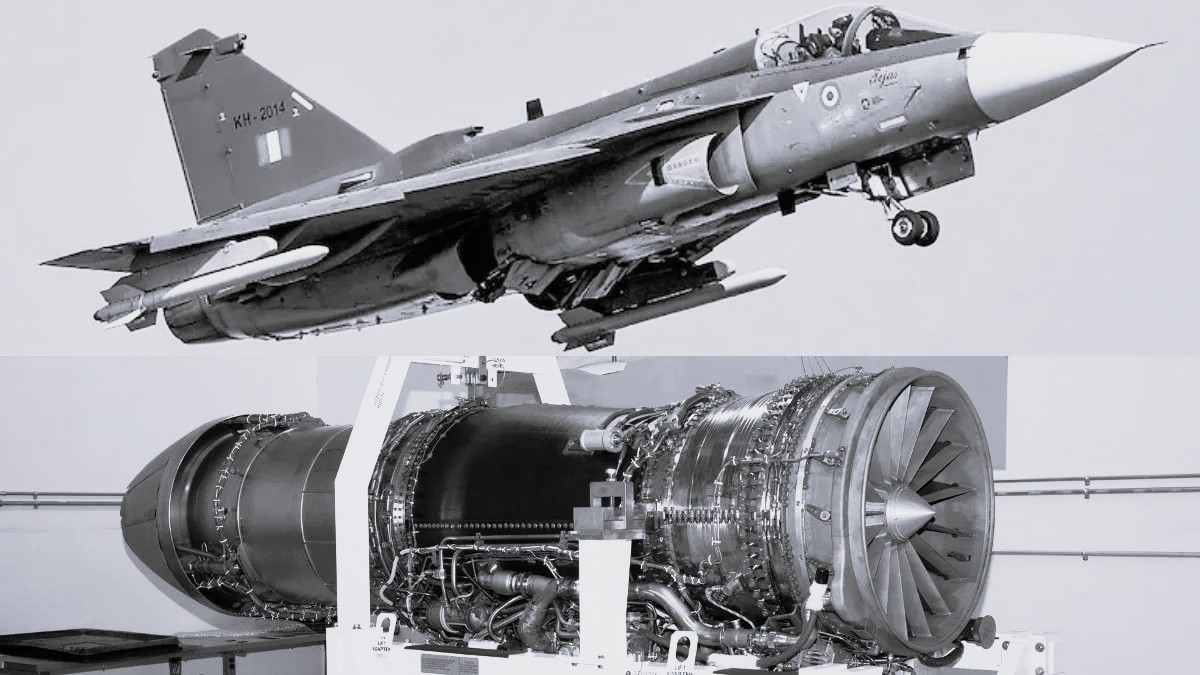
Air marshal bharti: India to develop own jet engine in 10 - 12 Years
India is stepping up its push for self-reliance in defense technology, with plans to develop an indigenous fighter jet engine within the next 10–12 years, Air Marshal Awadhesh Kumar Bharti, Deputy Chief of the Air Staff, said on Tuesday. Speaking at Aero Tech India 2025, organised by FICCI in partnership with CAPSS in Delhi, Bharti underlined the strategic importance of indigenization in the country’s defense sector.
“We are exploring indigenous engine production, and potentially, within 10–12 years, we will have an indigenous engine. That is our goal. If you put your efforts into it and if the industry puts their efforts into it, then it will definitely be achieved,” Bharti told reporters. He stressed that while achieving 100% indigenization immediately is challenging, starting with achievable milestones is essential. “In times of crisis, you can’t bank on anybody. It has to be yourself. If something comes, then it is a bonus. However, it must originate within the country. So, indigenisation is a prerequisite,” he added.
Currently, Hindustan Aeronautics Limited (HAL) is collaborating with American General Electric (GE) to procure GE-404 engines for the Light Combat Aircraft (LCA) Mk-1A. HAL has already received the third engine, with a fourth expected by the end of September 2025. The company plans to ramp up production, targeting a total of 12 engines by the end of the financial year. India’s indigenous engine initiative builds on decades of research under the Kaveri engine program, led by the Gas Turbine Research Establishment (GTRE) under DRDO. Although the Kaveri engine faced technical challenges in the past, including performance issues at high altitudes, its development laid the foundation for future high-thrust, domestically produced engines. The new engine is expected to power India’s next-generation fighter, the Advanced Medium Combat Aircraft (AMCA).
The AMCA is India’s ambitious fifth-generation stealth multirole fighter, designed to operate alongside the LCA and other combat aircraft. With a twin-engine configuration, stealth features, advanced avionics, and network-centric warfare capabilities, the AMCA is expected to play a critical role in India’s future air defense. The aircraft will carry a wide array of air-to-air and air-to-ground weapons, while its stealth design and supercruise capability allow it to evade enemy radar and operate efficiently at high speeds. The AMCA program, led by the Aeronautical Development Agency (ADA) in collaboration with HAL, has completed design work and received approval for prototype development in 2024. The first prototype is expected in late 2026 or early 2027, with the first flight scheduled for 2028, certification by 2032, and induction into service by 2034.
In the near term, Air Marshal Bharti highlighted the recent contract signed by the Defence Ministry with HAL for 97 additional LCA Mk1A aircraft, including 68 single-seaters and 29 twin-seaters, valued at over Rs 62,370 crore. Deliveries are expected to begin in 2027–28 and continue over six years. These aircraft will feature over 64% indigenous content, with 67 additional items incorporated compared to previous contracts. To accelerate engine development, India has partnered with France’s Safran to co-develop a high-thrust engine for the AMCA, with technology transfer and local production facilities forming part of the $7-billion collaboration. The program aims to produce over 400 engines for the AMCA and the Twin-Engine Deck-Based Fighter (TEDBF), with scalability to future sixth-generation platforms. Two Su-30MKI aircraft are also being converted into flying testbeds to expedite engine testing and certification.
Bharti warned that even 99% indigenous content is insufficient if critical components remain dependent on imports. “If the supplies of those critical components are choked, we will not be able to ramp up production when needed. We need to put our innovation on the afterburner. This cruise setting will not do,” he said, urging industry to aim for 100% indigenization within defined timelines.
In conclusion, India’s drive for an indigenous fighter engine and the development of the AMCA represent a decisive step toward self-reliance in defense technology. The combined focus on domestic manufacturing, strategic international collaboration, and technological innovation ensures that India is on track to strengthen its aerospace capabilities, reduce dependence on foreign suppliers, and emerge as a leader in next-generation fighter aircraft development.