
AI vs Jobs: Which Careers Are Safest in India in 2026?
Artificial Intelligence ( AI) has become one of the biggest forces reshaping India's employment landscape. From writing code and analyzing financial data to assisting doctors and automating customer service, AI is transforming almost every major industry. While this technological revolution is raising fears about job losses, experts believe it is also creating new opportunities that could redefine careers over the next decade.
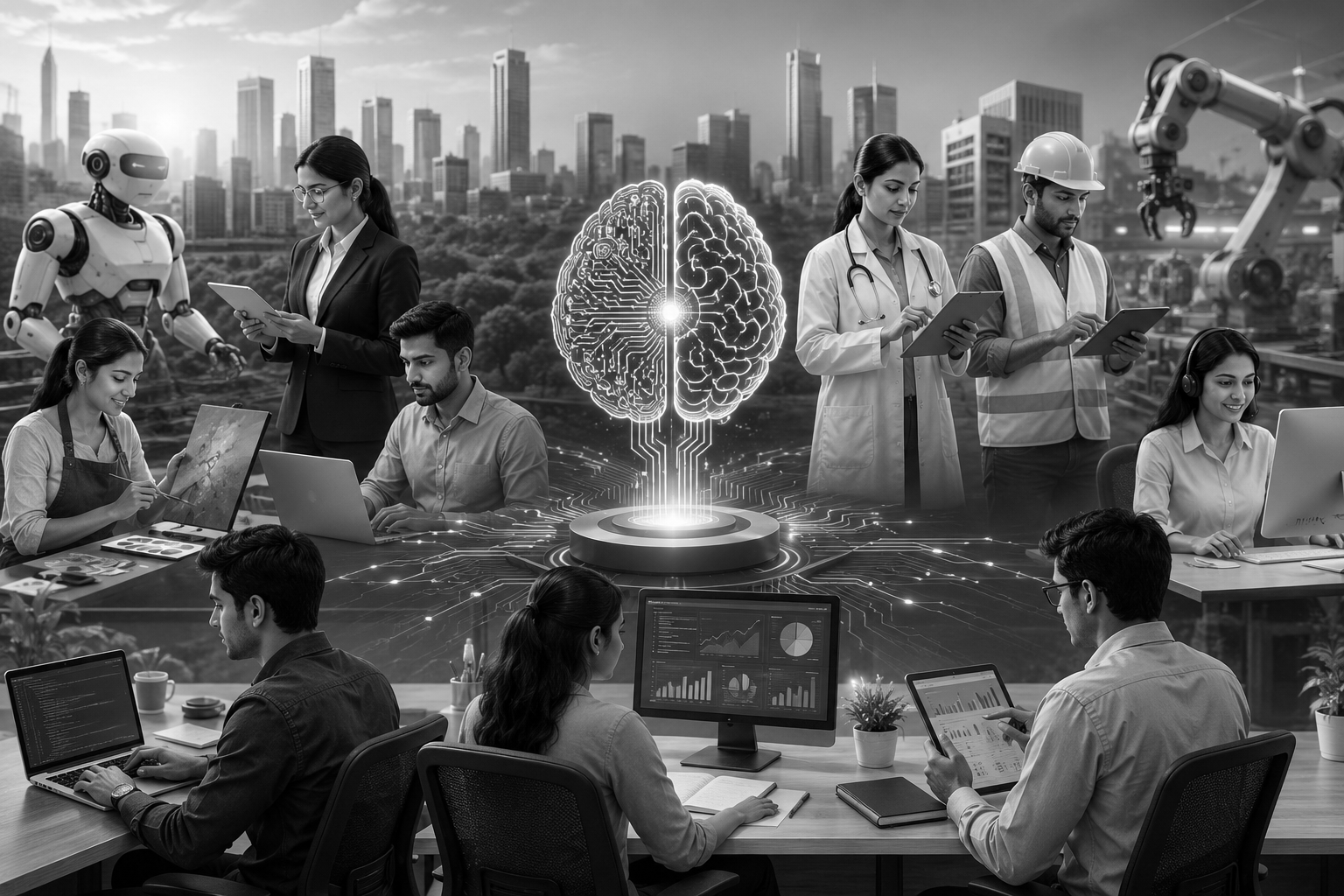
The question that dominates discussions among students, fresh graduates and working professionals today is whether AI will replace human jobs. The answer, according to economists and industry leaders, is both yes and no. AI is expected to automate many repetitive and predictable tasks, but it is also generating demand for skilled professionals who can develop, manage and effectively use AI systems. The future belongs less to those competing against AI and more to those learning how to work alongside it.
A recent report by Goldman Sachs estimates that Generative AI (GenAI) could replace 8–12 percent of India's non-farm jobs, primarily those involving repetitive and routine work. At the same time, the report notes that 42–48 percent of jobs are likely to be enhanced rather than eliminated, as AI takes over mundane tasks while allowing employees to focus on decision-making, creativity and strategic work. This suggests that AI is more likely to reshape jobs than erase them entirely.
The World Economic Forum has echoed a similar view, stating that technological advances, including AI, are expected to create millions of new jobs globally over the coming years. While some occupations may shrink, entirely new roles are emerging across technology, healthcare, finance, education and manufacturing. The challenge for workers is not simply avoiding automation but adapting to an evolving workplace where AI becomes an everyday tool.
The first jobs feeling the impact of AI are those built around repetitive processes. Data entry operators, telemarketing executives, basic customer support staff, routine bookkeeping professionals, manual software testers and administrative clerks are among the roles increasingly supported or partially replaced by AI-powered software. Businesses are adopting automation to improve efficiency, reduce costs and speed up operations, leading to slower hiring in these segments. However, experts point out that complete replacement is unlikely in the near future, as human supervision remains essential in many industries.
In contrast, careers requiring critical thinking, creativity, technical expertise and emotional intelligence continue to witness strong demand. AI engineers, machine learning specialists, data scientists, cybersecurity analysts, cloud architects, DevOps engineers and robotics professionals are among the fastest-growing technology careers in India. Software engineering itself is evolving rather than disappearing, with developers increasingly expected to use AI coding assistants, review AI-generated code and solve complex engineering challenges that machines cannot handle independently.
Healthcare remains another sector where AI is expected to complement rather than replace professionals. Doctors, nurses, physiotherapists, mental health specialists and medical researchers continue to play irreplaceable roles despite rapid advances in AI-assisted diagnosis and medical imaging. Similarly, financial analysts, investment advisors, chartered accountants and risk management professionals are increasingly using AI to improve productivity instead of viewing it as competition.
The creative economy is also undergoing a transformation. While AI can generate text, images and videos, businesses continue to seek professionals capable of original storytelling, branding, design strategy and audience engagement. Digital marketers, UX/UI designers, content strategists, video producers and graphic designers who understand how to integrate AI into their workflows are expected to remain highly employable. Skilled trades such as electricians, renewable energy technicians, industrial automation specialists, EV service engineers and robotics maintenance experts are also projected to experience sustained demand because they require hands-on expertise that AI cannot easily replicate.
Alongside traditional careers, AI has created an entirely new category of professions that barely existed a few years ago. Companies are now hiring Prompt Engineers, LLM Engineers, AI Product Managers, AI Ethics Specialists, AI Auditors, AI Trainers, AI Security Experts and AI Governance Consultants. These professionals help organizations build, monitor and responsibly deploy AI systems while ensuring compliance with emerging regulations.
India is also witnessing a rapid expansion of AI hiring beyond the technology sector. Banking and financial services, healthcare, manufacturing, retail, e-commerce, logistics, telecommunications, automotive and semiconductor industries are among the biggest recruiters of AI talent. The rapid growth of Global Capability Centres (GCCs) established by multinational corporations is expected to generate thousands of high-value engineering, analytics and AI-related jobs, positioning India as a global innovation hub.
Industry estimates indicate that India is on track to become one of the world's largest AI talent pools. According to projections cited by the government and NASSCOM, the country's AI workforce is expected to grow from around six lakh professionals in 2024 to more than 12.5 lakh by 2027. However, demand is rising even faster, creating a significant shortage of skilled AI professionals. This gap presents a major opportunity for students and working professionals willing to upskill in emerging technologies.
Companies are increasingly looking beyond traditional degrees and focusing on practical skills. Technical expertise in Python, Machine Learning, Data Science, Cloud Computing, Cybersecurity, SQL, Generative AI and Prompt Engineering has become highly valuable. At the same time, employers consistently emphasize the importance of communication, creativity, leadership, emotional intelligence, adaptability and problem-solving. As AI becomes capable of handling technical tasks, uniquely human skills are becoming even more valuable in the workplace.
This demand is also reflected in salaries. AI Engineers in India can earn between ₹10 lakh and ₹30 lakh per annum, while experienced Machine Learning Engineers and LLM Engineers often command packages exceeding ₹35 lakh annually. Data Scientists, Cloud Engineers, Cybersecurity Analysts and DevOps Engineers continue to receive attractive compensation, particularly in major technology hubs such as Bengaluru, Hyderabad, Pune and Gurugram. Industry experts note that salaries increasingly depend on practical project experience, certifications and the ability to solve real-world business problems rather than academic qualifications alone.
One of the biggest misconceptions surrounding AI is that only engineers can benefit from it. In reality, graduates from commerce, arts, science and management backgrounds are finding opportunities in AI-powered finance, HR analytics, digital marketing, legal technology, healthcare administration, education technology and business consulting. Rather than becoming AI developers, many professionals are learning to use AI tools to improve productivity and decision-making within their existing careers.
Recognizing the importance of AI skills, the Government of India has significantly expanded its digital skilling initiatives. The IndiaAI Mission aims to strengthen AI infrastructure, innovation, research and startup development across the country. Programmes such as FutureSkills Prime, Skill India Digital, YUVA AI and iGOT Karmayogi provide free or affordable training in AI, cloud computing, cybersecurity, data science and other emerging technologies. These initiatives are designed to help students, professionals and government employees prepare for an increasingly AI-driven economy.
Career experts advise that preparing for the future does not necessarily mean becoming an AI specialist. Instead, individuals should develop AI literacy, learn to work with AI-powered tools, strengthen digital skills, build practical project portfolios and continuously upgrade their knowledge. Professionals who combine technical competence with creativity, business understanding and strong interpersonal skills are expected to enjoy the greatest long-term career security.
Looking ahead to the next five years, AI is expected to transform rather than destroy India's job market. Routine administrative work will continue to decline, while demand for professionals capable of designing, managing and integrating AI into business operations will grow rapidly. With its expanding startup ecosystem, digital infrastructure and technology talent, India is well positioned to emerge as one of the world's leading AI economies.
The AI revolution is therefore not simply about machines replacing people—it is about people learning to use intelligent machines more effectively. For students deciding on careers, fresh graduates entering the workforce and professionals planning their next move, the message is clear: the safest jobs in 2026 will belong to those who embrace continuous learning, adapt to technological change and develop skills that complement Artificial Intelligence rather than compete with it.