
AI, Quantum, Semiconductors and Beyond: Inside India's Expanding Research Ecosystem
For decades, India has produced some of the world's brightest scientists, engineers and technologists. From leading laboratories in the United States to heading global technology companies and prestigious university departments, Indian-origin talent has become a powerful force in shaping the world's scientific future. Yet one question has continued to haunt policymakers in New Delhi: Can India build a research ecosystem capable of retaining and attracting the very talent it exports to the world?
The launch of the Prime Minister Research Chair (PMRC) Scheme 2026 is being seen as India's most ambitious attempt yet to answer that question. Announced by the Department of Higher Education under the Ministry of Education , the programme seeks to attract accomplished Indian-origin researchers, scientists, technologists and industry leaders working in globally renowned universities, laboratories, research institutions and corporations.
More than just a fellowship programme, PMRC represents a strategic effort to integrate global expertise into India's rapidly evolving innovation ecosystem and strengthen the country's journey towards a Viksit Bharat . But while the initiative has generated excitement across academic circles, it has also reignited a broader debate about the strengths and weaknesses of India's research landscape.
A New Push to Reverse Brain Drain
The origins of PMRC can be traced to discussions at the 56th IIT Council meeting in August 2025 , where policymakers explored ways to address India's long-standing brain drain challenge. The proposal subsequently received in-principle approval and moved rapidly towards implementation. Applications officially opened on June 1, 2026 , marking a significant milestone in India's science and technology policy.
The scheme is open to Indian nationals working abroad, Overseas Citizen of India (OCI) cardholders and Persons of Indian Origin (PIO) with proven achievements in research, innovation and technology. The goal is to create pathways for global Indian talent to collaborate with premier institutions, national laboratories and research centres across the country.
For decades, India has witnessed a steady migration of top researchers to countries offering better funding, advanced infrastructure and stronger research ecosystems. PMRC seeks to change that equation by offering internationally competitive research opportunities within India.
The Technologies That Will Define India's Future
Unlike conventional fellowship programmes, PMRC is sharply focused on strategic sectors that are expected to shape the global economy over the next several decades.
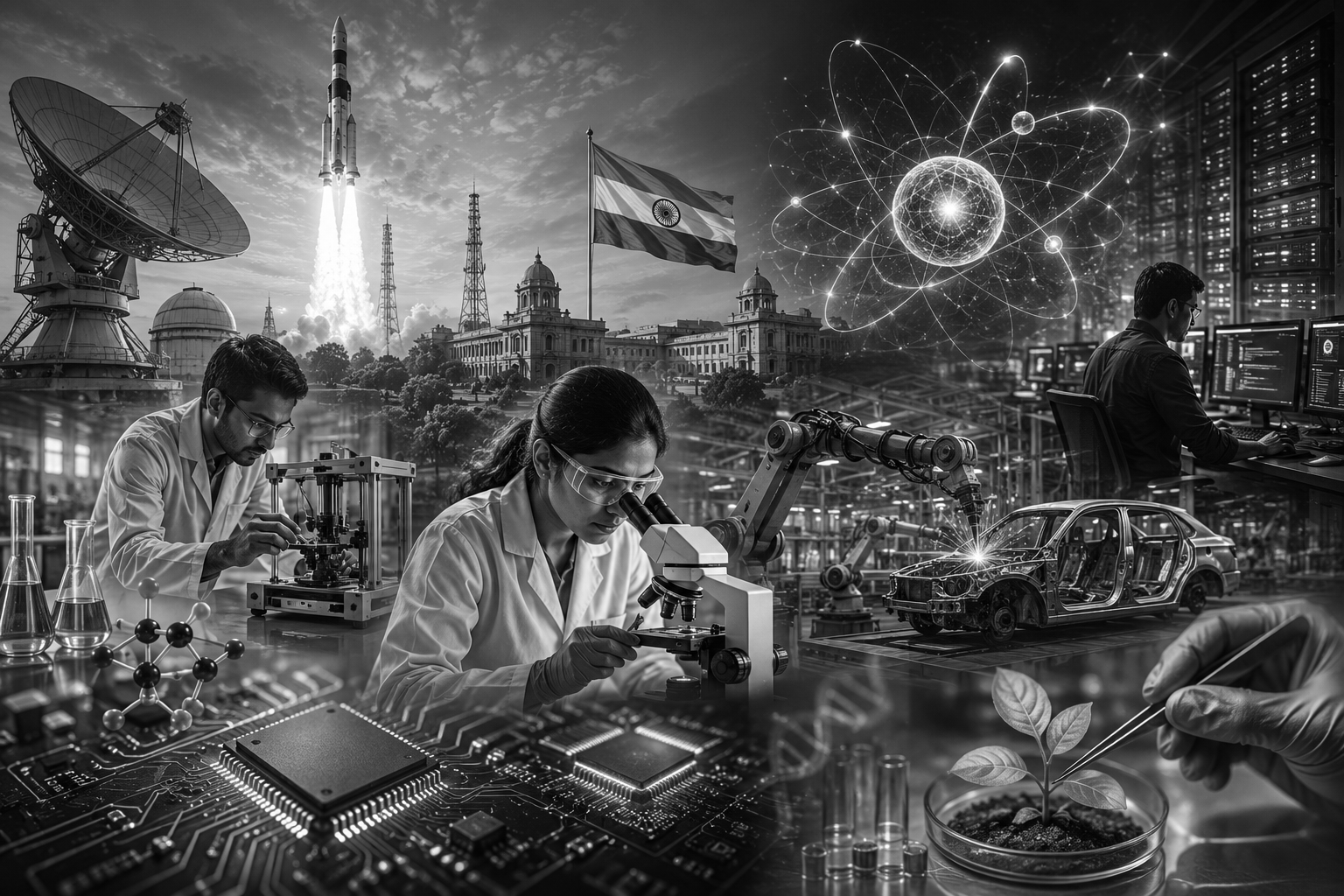
The scheme covers Artificial Intelligence, Quantum Computing, Semiconductors, Cybersecurity, Biotechnology, Healthcare and MedTech, Advanced Materials and Critical Minerals, Space and Defence, Next-Generation Communications, Manufacturing and Industry 4.0, Agri and Food Technologies, Blue Economy, Energy and Climate Technologies, and Atomic Energy .
These sectors have emerged as critical arenas of technological competition worldwide. Whether it is AI-driven productivity, semiconductor self-reliance, quantum computing breakthroughs, next-generation communication systems or clean-energy innovation, countries that dominate these fields are likely to command significant economic and strategic advantages in the future.
How the PMRC Framework Will Operate
The PMRC scheme is built around three pillars — Lead Institutions, Host Institutions and PMRC Fellows . An empowered committee chaired by the Principal Scientific Advisor to the Government of India will oversee the selection process to ensure alignment with national priorities.
To anchor the programme, the government has identified seven premier institutions as lead institutions: IIT Delhi, IIT Bombay, IIT Madras, IIT Kanpur, IIT Hyderabad, IIT (ISM) Dhanbad and IISc Bengaluru . These institutions will coordinate research activities, facilitate collaborations and help integrate global expertise into India's research ecosystem.
The programme will support three categories of researchers - Young Research Fellows, Senior Research Fellows and Research Chairs - allowing participation across different career stages.
A Generous Funding Structure
One of the scheme's most attractive features is its funding structure. Young Research Fellows are expected to receive support worth around ₹4 crore , while Senior Research Fellows may receive approximately ₹6.5 crore . At the highest level, Research Chairs can receive support of up to ₹14 crore , along with access to laboratories, infrastructure and institutional support.
Reports indicate that approximately 120 positions may be created over a five-year period , making PMRC one of India's largest initiatives aimed at attracting globally accomplished researchers.
The funding model reflects an acknowledgement that attracting top researchers requires not only prestige but also world-class resources, long-term support and institutional flexibility.
India's Research Spending: A Decade of Growth
The PMRC initiative comes against the backdrop of a steadily expanding research ecosystem.
Official figures show that India's Gross Expenditure on Research and Development (GERD) increased from ₹60,197 crore in 2010-11 to ₹1.27 lakh crore in 2020-21 , more than doubling over a decade. Estimates suggest that cumulative R&D expenditure between 2014 and 2025 may have reached between ₹11 lakh crore and ₹14 lakh crore .
Despite this progress, India's research spending remains modest when compared with leading innovation economies. The country invests only about 0.6-0.7 percent of GDP in research and development , far below China's 2.5-2.6 percent , the United States' 3.4-3.5 percent , Germany's 3.1 percent , and South Korea's more than 5 percent .
While India ranks among the world's largest research spenders in absolute terms, the gap in research intensity highlights the challenge of competing with countries that invest a significantly larger share of their economic output in scientific advancement.
Building a Multi-Layered Research Ecosystem
PMRC is only one part of a much broader effort to strengthen India's innovation capacity.
The government launched the Prime Minister's Research Fellowship (PMRF) in 2018 to encourage top students to pursue doctoral research. The programme offers monthly fellowships ranging from ₹70,000 to ₹80,000 , along with annual research grants. In 2025, the government expanded the programme through PMRF 2.0 , which aims to support 10,000 additional fellowships over five years .
Other initiatives include the Prime Minister Professorship Programme , the Prime Minister's Fellowship for Doctoral Research , and the Anusandhan National Research Foundation (ANRF) , which carries a government commitment of ₹14,000 crore to strengthen research institutions and promote high-quality scientific output.
Together, these programmes are designed to build a talent pipeline ranging from doctoral researchers to globally recognised scientific leaders.
Massive Investments in Emerging Technologies
Beyond fellowships and institutional grants, India has increasingly adopted a mission-oriented approach to scientific development.
The National Quantum Mission , with an outlay of ₹6,003.65 crore , seeks to establish India as a major player in quantum computing, quantum communication, sensing and advanced materials.
The National Mission on Interdisciplinary Cyber-Physical Systems , backed by ₹3,660 crore , supports research in artificial intelligence, machine learning, robotics, cybersecurity and advanced computing through a network of Technology Innovation Hubs.
India's semiconductor ambitions are even more significant. The government's semiconductor ecosystem programme received an initial allocation of ₹76,000 crore , while the broader India Semiconductor Mission is estimated to involve commitments of nearly ₹1.25 lakh crore .
In biotechnology and healthcare, institutions such as the Department of Biotechnology (DBT) and the Indian Council of Medical Research (ICMR) continue to support cutting-edge research, with biotechnology research allocations alone exceeding ₹1,100 crore in recent years.
The ₹1 Lakh Crore Innovation Fund
Perhaps the most transformative development in India's research ecosystem is the announcement of the ₹1 lakh crore Research, Development and Innovation (RDI) Fund .
The fund aims to boost private-sector participation in research and technology development, an area where India continues to lag behind countries such as the United States, Japan, South Korea and China. Policymakers hope the initiative will encourage greater collaboration between academia, industry and government while accelerating deep-tech innovation.
Combined with the ₹14,000 crore ANRF , ₹6,003 crore National Quantum Mission , ₹3,660 crore Cyber-Physical Systems Mission , and the semiconductor ecosystem investments, India is building one of the largest research funding architectures in its history.
Not Everyone Is Convinced
Despite the optimism surrounding PMRC, several researchers and policy experts argue that attracting a limited number of globally accomplished scientists may not be sufficient to address the deeper structural challenges confronting Indian research.
One criticism is that the scheme focuses on roughly 120 researchers over five years , while thousands of talented students, doctoral scholars and postdoctoral researchers continue to leave the country annually in search of better opportunities. Critics argue that reversing brain drain requires broader reforms across the entire research ecosystem rather than a focus on elite talent alone.
Others point to the concentration of resources within premier institutions such as the IITs and IISc. While these institutions undoubtedly represent India's strongest research centres, many state universities and regional institutions continue to struggle with inadequate infrastructure, limited funding and weak research ecosystems. Some experts fear that the benefits of PMRC could remain confined to a handful of elite institutions unless broader institutional reforms are undertaken.
Administrative bottlenecks remain another concern. Researchers have frequently highlighted delays in procurement processes, funding approvals and administrative clearances. Several fellowship recipients across various schemes have also reported delays in stipend disbursement, raising concerns about the effectiveness of implementation mechanisms.
Critics further argue that world-class research depends not only on attracting star scientists but also on building strong research teams, modern laboratories, technical support systems and sustainable funding pipelines. Without addressing these foundational issues, some analysts caution that PMRC may create isolated centres of excellence rather than a broad-based transformation of India's research ecosystem.
There are also concerns about overall funding levels. Even with ambitious new programmes, India's R&D expenditure remains at 0.6-0.7 percent of GDP , considerably lower than major innovation economies. Many experts argue that sustained increases in research spending and stronger private-sector participation will be essential if India hopes to compete with global leaders.
A Defining Moment for India's Scientific Future
Supporters of PMRC counter that the scheme should not be viewed in isolation. Instead, they see it as part of a larger strategy that includes the PMRF , ANRF , National Quantum Mission , IndiaAI Mission , India Semiconductor Mission , and the ₹1 lakh crore RDI Fund .
Together, these initiatives represent one of the most significant expansions of India's research ecosystem since independence.
The challenge now lies in translating ambitious policies into measurable outcomes. Success will ultimately depend not only on attracting global talent but also on strengthening institutions, ensuring timely funding, improving administrative efficiency and fostering a culture of innovation.
As the world enters an era defined by Artificial Intelligence, Quantum Technologies, Semiconductors, Biotechnology and Advanced Manufacturing , India's ability to build a globally competitive research ecosystem may become one of the most important determinants of its economic future.
The PMRC scheme is therefore more than a recruitment programme. It is a test of whether India can transform itself from a nation known for producing talent into one that also provides the environment necessary for that talent to flourish. If successful, it could become a cornerstone of India's ambition to emerge as a leading scientific and technological power by 2047 .