
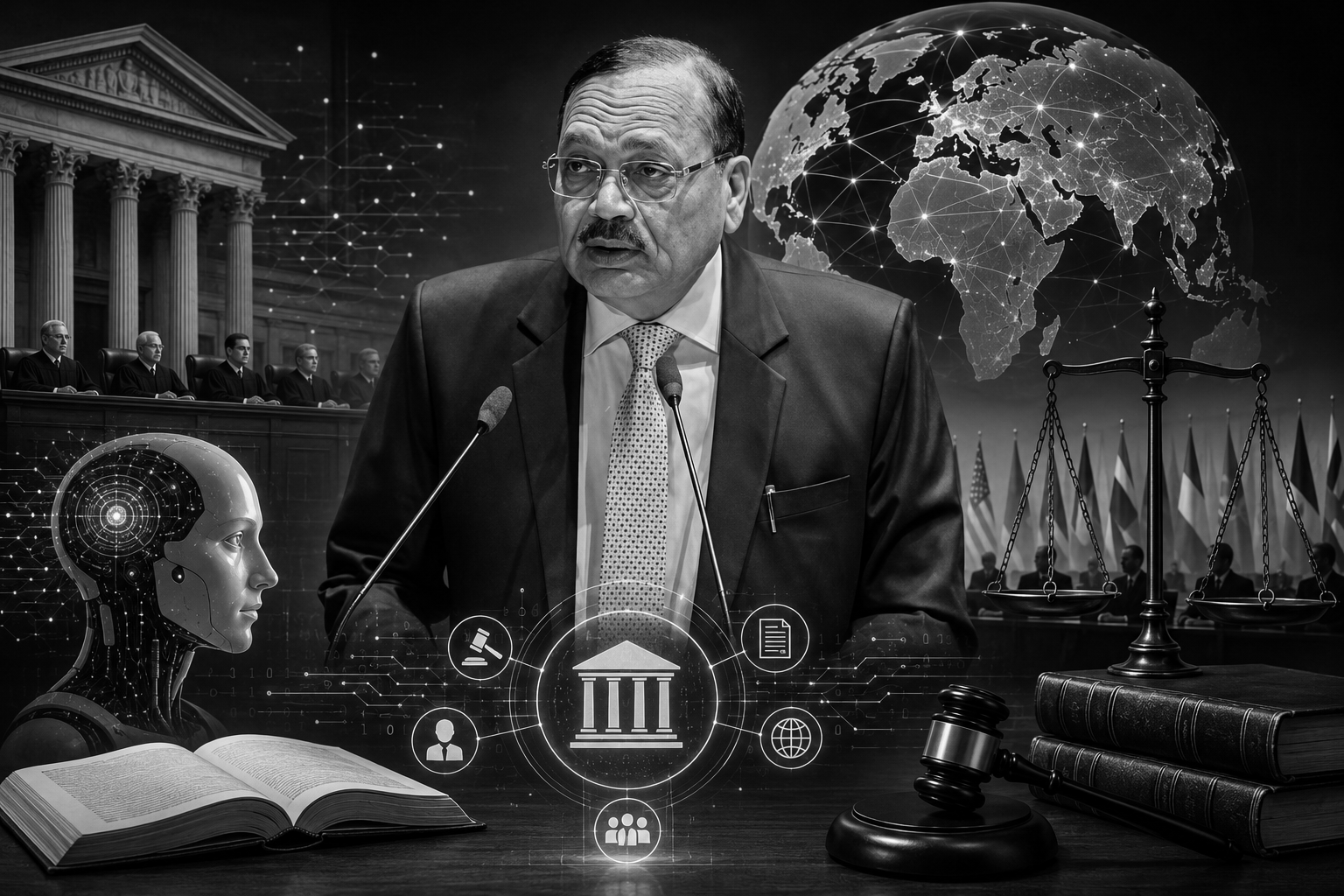
AI Poses One of the Biggest Tests for Global Legal Systems, Says CJI Surya Kant
Artificial Intelligence (AI) has emerged as one of the greatest challenges confronting modern international law, Chief Justice of India Surya Kant said, warning that the choices made by governments and legal institutions today will shape the future relationship between technology, power, freedom and justice for generations.
Speaking at a public lecture on “Artificial Intelligence and International Law” at Birkbeck, University of London , Justice Kant said AI is no longer a speculative technology but an operational reality that is transforming governance, commerce, warfare, public administration and even the exercise of judicial and sovereign power.
“Technology itself is neither inherently benevolent nor inherently harmful,” he said, stressing that its impact depends on the legal, political and ethical frameworks adopted by societies. The responsibility of law, he noted, is not to resist innovation but to ensure that technological power remains accountable to constitutional values, democratic legitimacy and human dignity .
The Chief Justice pointed out that governments across the world are already using AI-driven systems to allocate welfare benefits, process immigration applications, regulate financial systems, monitor borders and support policing functions. At the same time, militaries are developing autonomous capabilities, while courts are increasingly dealing with questions involving AI-generated evidence , automated decision-making and digital due process.
Justice Kant said AI also offers significant opportunities for improving justice delivery. Courts in several jurisdictions are using AI tools for legal research, case management, translation services, transcription of proceedings, document classification and identifying judicial precedents. When deployed under proper human supervision, these technologies can reduce delays, improve efficiency and expand access to justice, he said.
His remarks come amid a global push to regulate artificial intelligence. The European Union’s AI Act , the world’s first comprehensive AI law, and initiatives by organisations such as UNESCO and the United Nations reflect growing efforts to establish safeguards around rapidly advancing technologies.
Highlighting the scale of AI’s influence, Justice Kant noted that traditional international law is rooted in territorial sovereignty, whereas AI systems operate through globally distributed networks that transcend national borders. Data may be collected in one country, processed in another and used to make decisions affecting people elsewhere, creating complex questions about jurisdiction, liability and accountability.
Warning against an emerging “accountability gap,” he said responsibility could become fragmented among developers, corporations and governments, making accountability increasingly difficult to enforce.
“The central challenge before us is to ensure that, in an age of intelligent machines, humanity retains authorship of the principles by which it is governed,” Justice Kant said, calling for global cooperation to ensure technological progress strengthens rather than weakens the rule of law.