
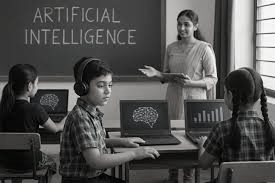
AI curriculum for classes 3–8 rolled out Nationwide to boost future-ready learning
Union Education Minister Dharmendra Pradhan on Wednesday launched a structured curriculum on artificial intelligence (AI) and computational thinking for students from Classes 3 to 8, marking a significant shift in India’s school education framework.
Announcing the initiative at the start of the academic year, Pradhan said the move formally integrates AI education into the school ecosystem at scale, with an emphasis on preparing students for a technology-driven future. He described the rollout as a “transformative step towards future-ready learning,” aimed at equipping young learners with essential digital competencies.
The curriculum has been developed with comprehensive modules, teacher handbooks, and student assessment frameworks to ensure systematic and age-appropriate learning. It seeks to introduce foundational concepts of AI and logical problem-solving at an early stage, while fostering critical thinking, creativity, and innovation among students.
Aligned with the government’s vision of “AI for Education, AI in Education,” the initiative is expected to promote augmented learning and nurture design-oriented thinking. Pradhan noted that as India’s global standing in technology continues to grow, early exposure to emerging technologies will enable students to actively participate in shaping the digital future.
The programme has been institutionalised by the Central Board of Secondary Education (CBSE) and the National Council of Educational Research and Training (NCERT), indicating a nationwide rollout across CBSE-affiliated schools. Previously, AI education was limited to a brief module from Class 6 and offered as an optional subject in senior classes.
With this expansion, the government aims to move beyond traditional learning models and embed technology-driven education more deeply within the school system.