
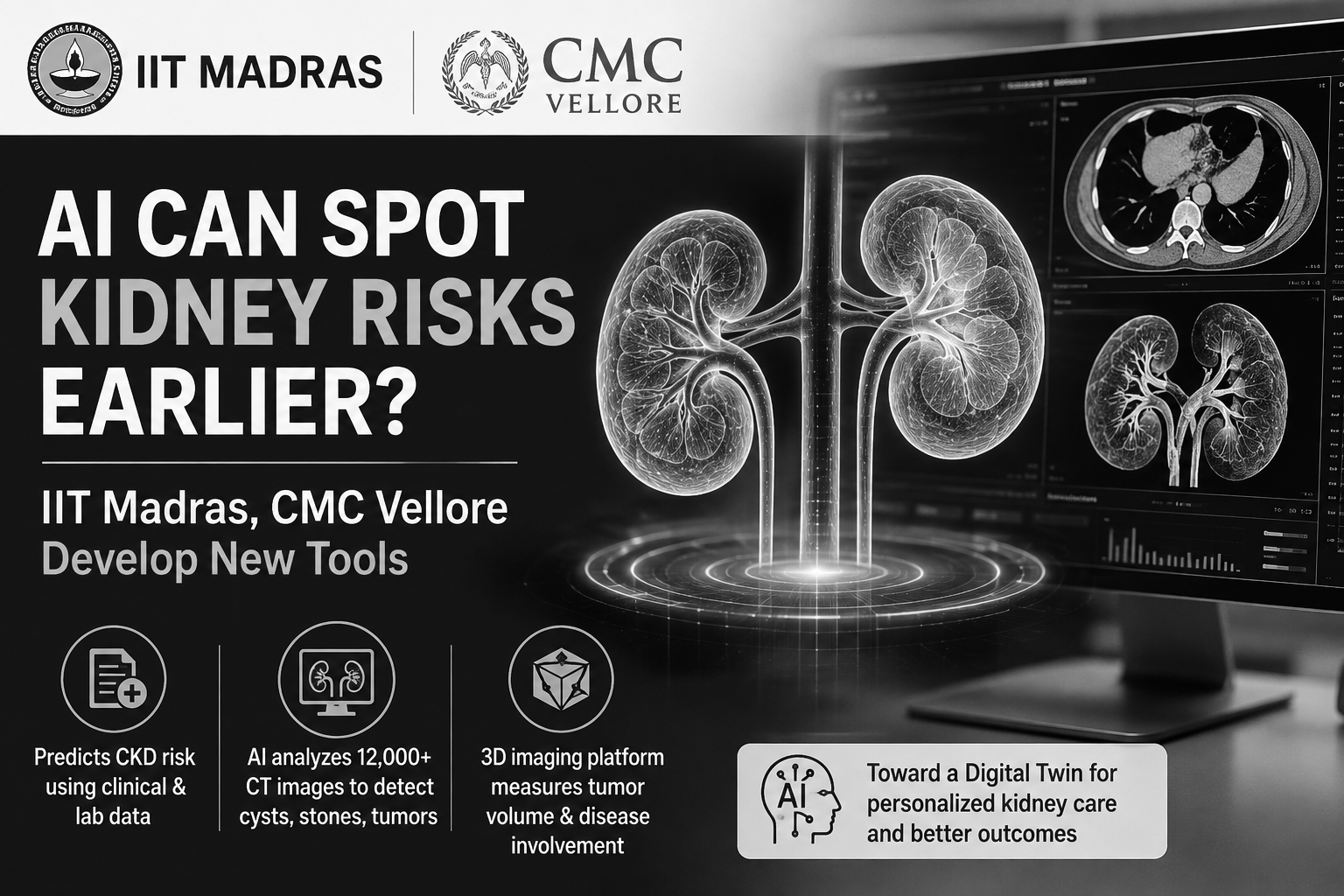
AI Can Spot Kidney Risks Earlier? IIT Madras, CMC Vellore Develop New Tools
Researchers at the Indian Institute of Technology Madras (IIT Madras) and Christian Medical College (CMC), Vellore, have developed a set of AI-driven technologies designed to help doctors detect and assess kidney diseases at an earlier stage.
The project brings together three different tools. One machine-learning model uses clinical and laboratory information to estimate a person’s risk of developing chronic kidney disease (CKD). A second deep-learning system examines kidney CT scans and categorises them into four groups: normal kidneys, cysts, stones and tumours. The third technology creates 3D reconstructions of kidneys from CT images, allowing doctors to estimate tumour volume and determine the extent of disease involvement.
The CT-based system was developed using more than 12,000 images. However, the latest announcement does not provide a definitive clinical accuracy or success rate for the complete AI system. The researchers are continuing validation and intend to assess its performance using data from multiple medical centres.
This is important because an AI model trained on a limited or single-source dataset may not perform equally well across different hospitals, patient groups or imaging equipment. Data diversity and external validation will therefore be essential before the technology can be relied upon for routine clinical use.
Privacy is another consideration. Medical AI systems require access to sensitive patient information, including laboratory results and medical images. Appropriate data protection, anonymisation, secure storage and controlled access will be necessary as the tools move towards wider clinical testing. The researchers also stress that the CKD model is intended to predict disease risk rather than independently provide a final diagnosis. AI-generated results would need to be interpreted alongside medical history, examinations and other clinical investigations.
The initiative, led by researchers from IIT Madras and CMC Vellore and supported by the SPARC initiative, could eventually contribute to a personalized kidney-care platform. The team plans further multi-centre validation and integration with wearable sensors, with the long-term goal of developing a “Digital Twin” approach for continuous health monitoring and personalised clinical decision-making.