
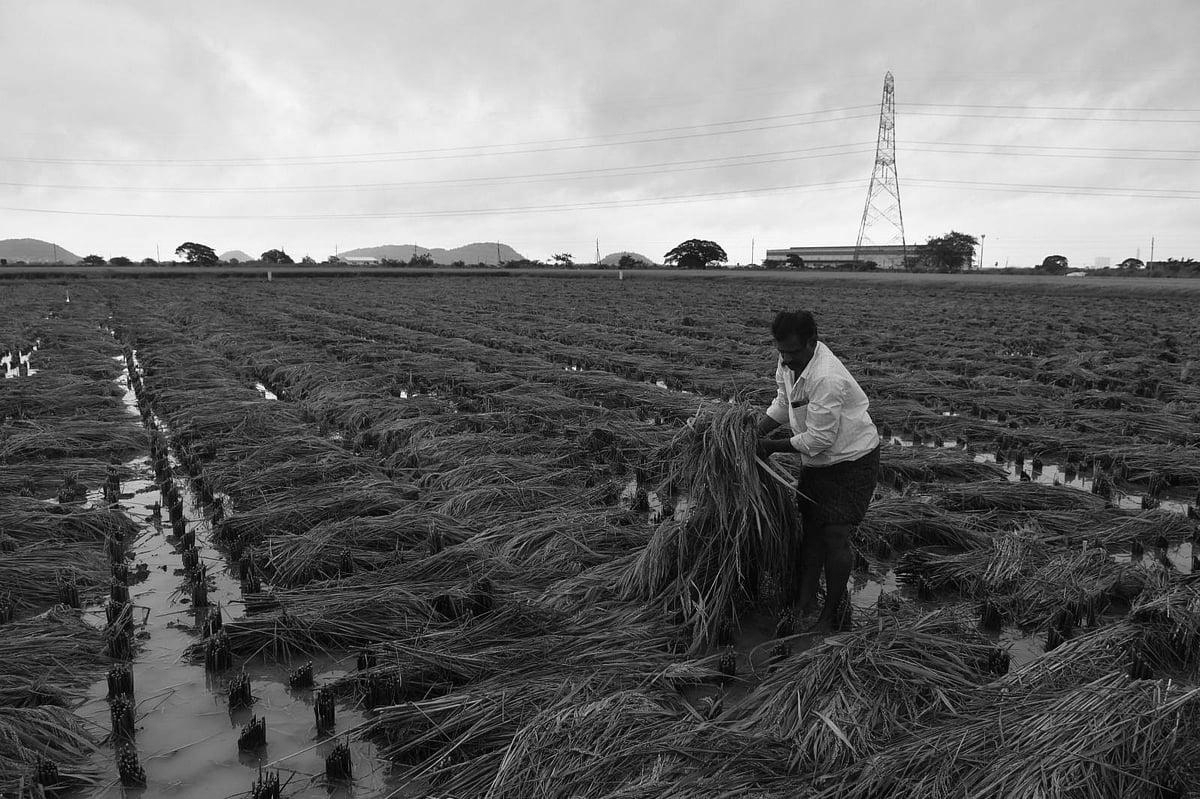
After the Storm, Farmers Face a Long Road to Recovery
For thousands of farmers across Andhra Pradesh's coastal districts, the end of a cyclone does not necessarily mean the end of their troubles. While rescue operations, road repairs and restoration of electricity remain priorities after two successive cyclones, Arnab and Murasu, the farming community is confronting a much longer struggle to rebuild its livelihoods. Standing crops have been submerged, agricultural investments have been wiped out, debts continue to mount and uncertainty over compensation has left many farmers wondering how they will finance their next cultivation cycle.
The two cyclones, which struck Andhra Pradesh within a short period, have dealt a severe blow to the state's agricultural economy. Farmers who had spent months investing in paddy, pulses, cotton and horticultural crops have suffered extensive losses due to heavy rainfall, strong winds and flooding. For many, the damage has come just when they were expecting returns from their investments. With fields inundated and crops damaged, the immediate concern is no longer harvesting the produce but finding the money and resources required to start cultivation again.
According to the preliminary assessment submitted by the Andhra Pradesh government to a visiting Central team on October 31, Cyclone Arnab damaged crops belonging to approximately 4.63 lakh farmers across 3.52 lakh hectares in 12 districts. Horticultural crops were damaged across another 23,383 hectares. The estimated overall loss caused by the cyclone was put at Rs 4,764 crore. Dr B.R. Ambedkar Konaseema and West Godavari were among the worst-affected districts.
The situation deteriorated further with Cyclone Murasu, which crossed the Andhra Pradesh coast on November 3. According to the preliminary assessment reviewed by Chief Minister N. Chandrababu Naidu on November 5, the cyclone damaged agricultural crops across 1,43,122 hectares, affecting 1,86,063 farmers. Horticultural crops suffered damage across another 6,749 hectares, impacting 12,586 farmers. Eight people lost their lives, while hundreds of houses, fishing boats and fishing nets were also damaged. The government estimated the overall loss caused by Murasu at Rs 1,918.55 crore.
These figures underline the scale of the agricultural crisis, particularly because the two weather systems affected several districts within a short period. Farmers in parts of the Godavari and Krishna delta regions, already struggling to protect their crops after Arnab, suffered additional damage when Murasu brought fresh rainfall. In several areas, farmers who had drained stagnant water from their fields and attempted to save their standing crops found themselves facing another round of inundation. The repeated damage has reduced their chances of recovering even a portion of their initial investment.
For a small farmer cultivating a few acres, the loss of a standing crop represents much more than the disappearance of agricultural produce. It also means losing the money spent on seeds, fertilisers, pesticides, agricultural machinery and hired labour. Many farmers depend on cooperative banks, commercial banks and private moneylenders to finance each cultivation cycle. They usually plan to repay these loans after harvesting and selling their produce. When the crop is destroyed, the expected income disappears, but the outstanding debt remains. Some farmers may now have to borrow additional money simply to meet household expenses and prepare their fields for the next season.
The financial pressure is particularly severe for tenant farmers, who cultivate agricultural land without owning it. Unlike landowners, they must arrange money to pay rent for leased fields in addition to meeting cultivation expenses. Many enter into informal tenancy arrangements based on verbal agreements, making it difficult to establish their cultivation rights through official records. When a cyclone destroys their crops, they may lose their entire investment without having the documents required to establish their eligibility for government assistance.
Andhra Pradesh has introduced the Crop Cultivator Rights Card (CCRC) under the Andhra Pradesh Crop Cultivator Rights Act, 2019, to recognise tenant farmers and help them access eligible agricultural benefits. The card can facilitate access to crop loans, insurance, input subsidies and compensation for crop damage without transferring ownership of the land. However, obtaining the card remains a challenge for some cultivators. Certain landowners hesitate to enter into formal tenancy agreements, while farmers working under oral arrangements may remain outside the official system. Consequently, the person who actually invested money and cultivated the land may struggle to receive recognition when compensation is distributed.
The issue has gained importance following the successive cyclones. Union Minister of State for Rural Development Pemmasani Chandrasekhar, during his visit to cyclone-affected villages in Kollipara mandal of Guntur district, interacted with farmers whose paddy, black gram and cotton crops had been inundated. He assured affected cultivators of maximum possible assistance and urged landowners to ensure that tenant farmers also receive the subsidies extended following the cyclones. However, ensuring that such assistance reaches actual cultivators, particularly those without formal documentation, remains an important challenge.
For farmers waiting for financial assistance, the difference between government announcements and actual payments is becoming increasingly important. The state government has initiated crop-loss assessments and insurance verification, but the process involves several stages. Officials must identify damaged crops, verify cultivation details, establish insurance eligibility and determine the extent of losses before admissible payments can be processed. Although the government has released Rs 37 crore to districts for immediate relief and assistance following Murasu, this allocation should not be confused with completed crop-insurance settlements or individual crop-loss compensation payments.
The Agriculture Department has stepped up efforts to speed up insurance claim verification. On November 6, Agriculture Director Dr Manazir Jeelani Samoon directed officials to cross-check insurance premiums paid by farmers with cultivation records available on the e-Panta portal. He also reviewed the progress of Crop Cutting Experiments (CCEs), which play an important role in determining eligibility for yield-based insurance claims. Officials have been asked to submit weekly reports to support crop-yield estimates and procurement planning.
The government has planned 30,286 Crop Cutting Experiments under the Kharif 2026 crop insurance programme. Chief Minister N. Chandrababu Naidu has directed officials to ensure that insurance claims and input subsidies reach eligible farmers without unnecessary delays. During a review of the agricultural situation on November 3, he said crops cultivated by 17.07 lakh farmers had insurance coverage during the current Kharif season. The state has notified 22 crops for insurance, including 15 under yield-based coverage and seven under weather-based coverage. Paddy, red gram, groundnut, cotton, chilli and maize account for a major share of the insured area.
The government is also using digital and satellite-based systems to improve crop-loss assessments. The YES TECH system, which uses satellite technology for crop-yield estimation, is being implemented alongside field-level verification. Officials have initiated damage assessments in 16 cyclone-affected districts, with 13 districts covered under YES TECH monitoring. While these measures are expected to improve the accuracy of assessments, farmers are concerned about how quickly the process will translate into financial assistance. For those who have lost their entire investment, even a few weeks of uncertainty can affect their ability to arrange seeds, fertilisers and labour for the next cultivation cycle.
The state has also sought substantial financial assistance from the Centre to address the damage caused by the two cyclones. Chief Minister Naidu requested more than Rs 4,500 crore in immediate assistance, estimating losses from Arnab and Murasu in separate preliminary assessments. The government has highlighted damage to agricultural land, horticultural plantations, roads, electricity infrastructure and houses. The Central team's assessment is expected to play an important role in determining the extent of additional assistance required for restoration and rehabilitation.
Beyond compensation, another major concern is the impact on the next agricultural season. Farmers who have lost their Kharif crops may struggle to arrange money for Rabi cultivation. Waterlogged fields may require additional time for drainage and soil preparation, while damaged irrigation channels, farm roads and electrical infrastructure could delay agricultural operations. Farmers may also have to purchase fresh seeds and other inputs after losing supplies stored in flooded areas. Those who depend on agricultural income to repay previous loans could find it particularly difficult to secure fresh credit.
The problem could be more serious for small and marginal farmers who have limited savings and depend almost entirely on seasonal agricultural earnings. Some may be forced to reduce the area under cultivation, shift to less expensive crops or postpone sowing until they receive financial assistance. Others could approach private lenders for additional loans, increasing their debt burden. If a large number of farmers are unable to resume cultivation on time, the consequences could extend to agricultural labourers, input suppliers, local traders and rural markets that depend on farming activity.
Horticultural farmers face a different but potentially longer recovery process. In districts such as Konaseema, where coconut and other plantation crops contribute significantly to rural livelihoods, damaged or uprooted trees can affect income beyond a single season. Replacing damaged trees and restoring plantations requires money, labour and considerable time before farmers can expect normal production. Unlike seasonal paddy crops, the loss of a mature plantation can affect household earnings for several years.
The impact is also likely to be felt by agricultural labourers. When fields remain submerged or farmers postpone cultivation because of financial constraints, the demand for agricultural workers declines. Labourers who depend on transplanting, weeding, harvesting and other farm activities may lose several weeks of employment. Families that rely on daily wages could face difficulties meeting expenses at a time when agricultural work is already limited.
The immediate priority, therefore, is not only to assess crop damage but also to ensure that recovery assistance reaches the people who need it most. Farmers require timely insurance settlements, input subsidies, affordable institutional credit, subsidised seeds and restoration of damaged irrigation and drainage facilities. Tenant cultivators must receive equal attention, while agricultural labourers and families dependent on farm-related activities also need support. The government must ensure that crop-loss assessments are transparent and that eligible beneficiaries are not excluded because of documentation gaps or delays in updating official records.
For the affected farming community, the real test of recovery will be whether farmers can return to their fields and begin another cultivation cycle without falling deeper into debt. Government announcements and preliminary damage figures provide an indication of the scale of the crisis, but the actual impact will be measured by the assistance reaching individual families. Farmers who have lost their crops need financial support at a time when they are preparing for another season, not after their opportunity to cultivate has passed.
As Andhra Pradesh works to restore normalcy in cyclone-hit districts, thousands of farming families are facing an uncertain future. The storms may have passed, but their economic consequences are likely to remain long after the floodwaters recede. For farmers who have lost their standing crops, accumulated debts and immediate source of income, rebuilding their livelihoods will require more than short-term relief. It will demand timely compensation, accessible credit, protection for tenant cultivators and sustained support to help them return to agriculture without carrying the burden of one disaster into the next season.