
After the Raid: Are India's Restaurants Really Becoming Safer?
As food safety inspections intensify across Telangana and the country, the real test lies beyond sealed kitchens and suspended licences. From laboratory failures and regulatory delays to restaurant accountability, consumer awareness and the cost of compliance, India faces a larger question: Can enforcement turn into lasting food safety?
A restaurant can have a familiar name, a busy dining hall and hundreds of customers every evening, yet the condition of its kitchen may tell a different story. Spoiled ingredients, pest infestations, unsafe refrigeration, contaminated food and poor sanitation can remain hidden from customers until an inspection exposes them. Across India, food safety raids have increasingly brought such concerns into public view. In Telangana, a series of enforcement drives targeting restaurants, hotels, cafés and other food establishments has sharpened the debate over how effectively the country protects the food reaching consumers' plates.
The central question is no longer simply how many eateries have been inspected or how many licences have been suspended. What happens after the raid? Do restaurants correct violations and maintain safe practices, or does compliance weaken once the immediate scrutiny fades? The answer depends on inspections, laboratory testing, legal proceedings, staff training and the willingness of businesses to make food safety a daily priority.
Telangana's crackdown exposes kitchen-level risks
The Telangana Standards Authority for Food and Essential Drugs (TG SAFE) has intensified enforcement through food safety teams, with police assistance during certain operations. Inspections have covered Hyderabad's restaurant clusters and establishments in districts including Nalgonda, Suryapet, Yadadri Bhuvanagiri, Kamareddy and Nizamabad.
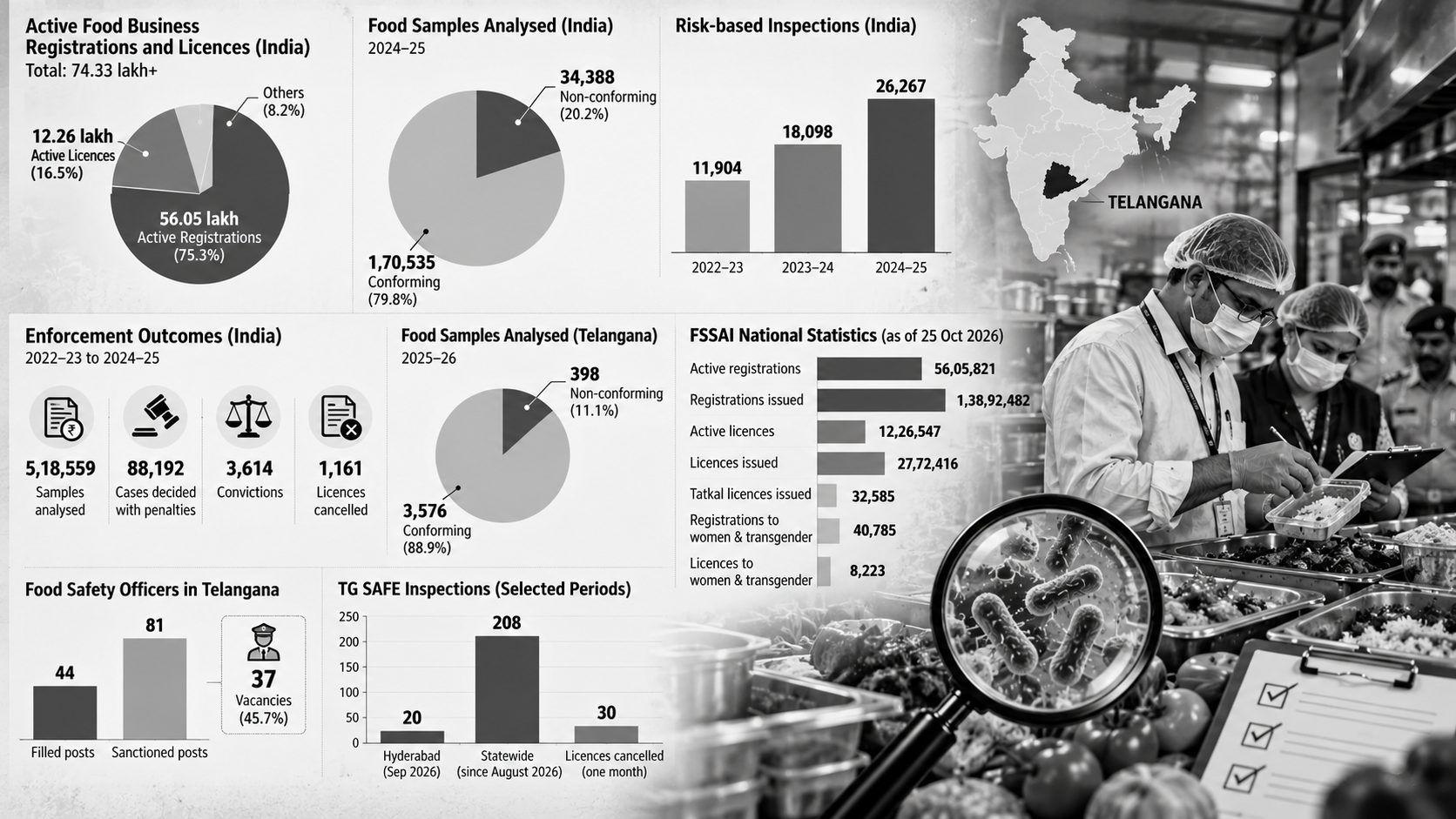
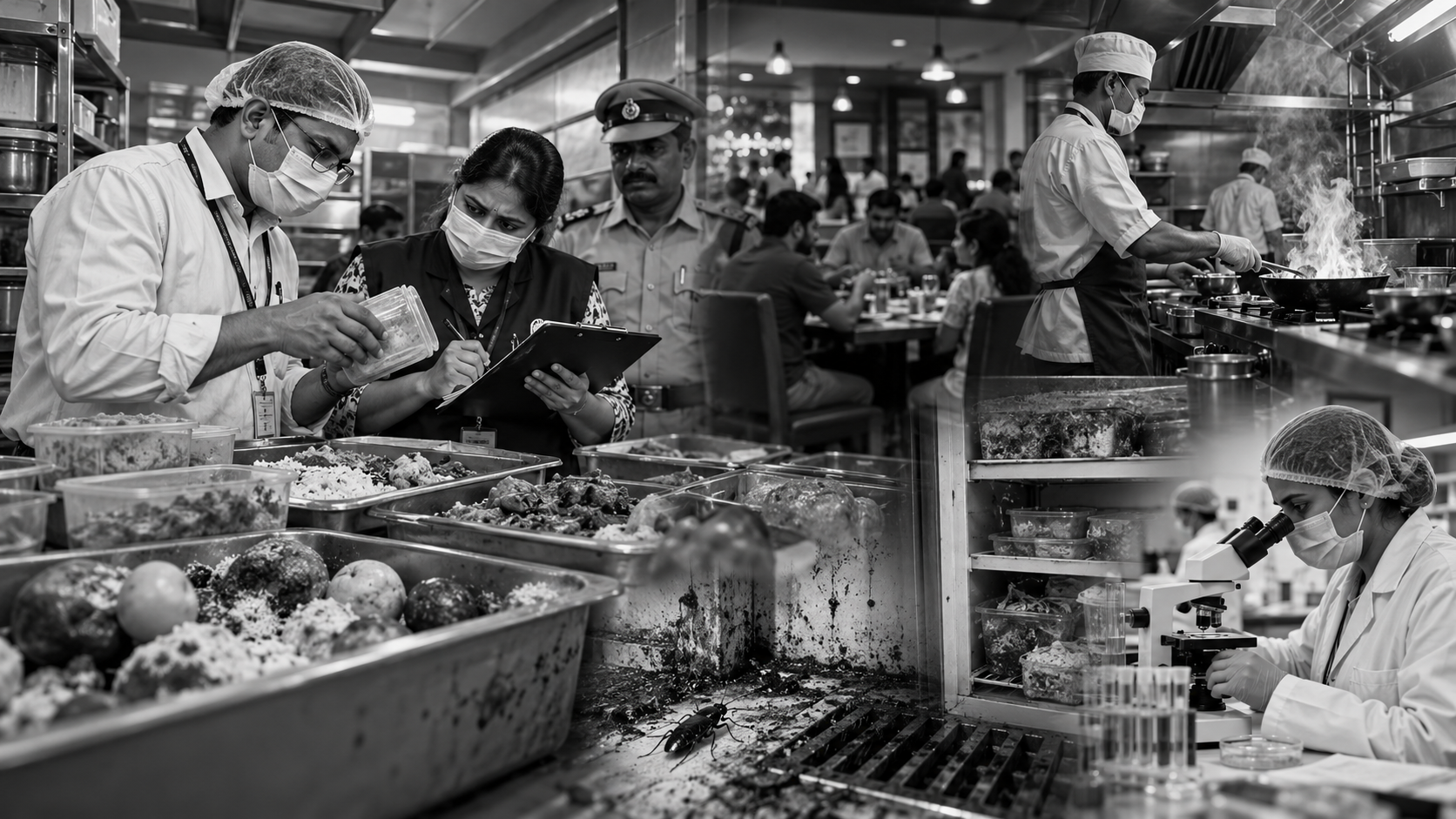
During a September 2026 drive across Hyderabad's Madhapur, HITEC City and Gachibowli areas, 20 restaurants were reportedly inspected, 21 food samples collected and 11 FSSAI licences suspended. The reported violations included pest infestations, expired ingredients, fungal contamination, improper refrigeration and unhygienic kitchens.
The establishments named in reports included Monastery, Shivani – The Restaurant and Bar, Al Saba Restaurant, Lucky Multicuisine Restaurant, Sai Ram Mess, Udupi's Upahar, Coal Spark Multi Cuisine Restaurant, Kanchi Cafe, AnTeRa Kitchen and Bar, Am Aha Telugu Kitchen and Bar, and Fusion 9/Amnesia Sky Bar.
At Coal Spark, officials reportedly discarded 22 kg of peanuts, 25 kg of pepper and 8.9 kg of cashews after detecting fungal contamination. Other inspections identified problems such as cockroaches, rodents, uncovered food, clogged drains and raw meat stored alongside prepared food.
Several other well-known establishments, including Rameshwaram Cafe, Ishtaa, Hotel Shadab, Shah Ghouse, Minerva Grand and Hotel Avasa, were reported to have faced improvement or show-cause notices. Such notices must not be confused with licence suspensions: they represent different stages of regulatory action.
Enforcement extended to other districts in October, with suspensions reported at establishments in Kamareddy, Nizamabad, Nalgonda, Suryapet and Yadadri Bhuvanagiri. These operations demonstrate the geographical reach of inspections, but the number of raids alone cannot establish whether food safety has improved.
National figures reveal a persistent challenge
India's food safety system covers a vast industry. The Union government reported more than 74.33 lakh active food business registrations and licences in July 2026, spanning manufacturers, distributors, vendors and food-service establishments.
During 2024–25, authorities analysed 1,70,535 food samples nationally and found 34,388 non-conforming samples, approximately 20.2% of those tested. This is not the percentage of restaurants found unsafe; the samples cover different food categories and reflect the products selected for testing.
Risk-based inspections increased from 11,904 in 2022–23 to 26,267 in 2024–25, according to FSSAI. Across 2022–23 to 2024–25, government data recorded 5,18,559 enforcement samples analysed, 88,192 cases decided with penalties, 3,614 convictions and 1,161 licence cancellations.
The figures show expanded regulatory activity alongside continuing violations. However, more inspections can uncover more failures simply because authorities are testing more extensively. Measuring progress requires examining failure rates, the severity of violations, legal outcomes and repeat-offender records together.
The enforcement gap: What happens after closure?
The effectiveness of food safety raids depends on what follows an inspection. A September 2026 report raised concerns about restaurants resuming operations soon after suspension or sealing orders, while officials cited difficulties in serving notices promptly. Such cases require individual verification, including whether the order had taken effect and whether reopening was authorised.
Under the Food Safety and Standards Act, 2006, an improvement notice, show-cause notice, suspension and cancellation are distinct legal measures. A show-cause notice seeks a response; a suspension restricts operations covered by the order while it remains in force. There is no universal reopening period applicable to every restaurant.
The real test is whether deficiencies are corrected and independently verified. Authorities should track establishments immediately after inspections, at reopening and again 30 to 90 days later. Such follow-up would reveal whether kitchens remain compliant or repeat the same violations.
Telangana's enforcement capacity also deserves scrutiny. A report citing government data recorded 44 filled Food Safety Officer posts against 81 sanctioned positions, leaving 37 vacancies. It also highlighted delays in adjudication and pending cases. Staffing shortages and slow proceedings could weaken the deterrent effect of penalties, although their precise impact requires further examination.
A licence does not guarantee a safe kitchen
India already has hygiene standards under Schedule 4 of the FSSAI licensing regulations. Licensed businesses must follow applicable sanitation requirements and maintain a documented Food Safety Management System.
That means safe sourcing, proper refrigeration, separation of raw and ready-to-eat foods, thorough cooking, hygienic food handling, pest control, waste disposal and regular cleaning. Restaurants should maintain relevant records of temperature checks, staff training, cleaning and corrective actions.
Yet a valid licence cannot guarantee that these practices are followed every day. The gap between formal registration and actual kitchen conditions makes regular supervision, risk-based inspections and accountable management essential.
Awareness, training and the cost of compliance
FSSAI's Eat Right India initiative, launched in 2018, promotes safe and healthy food practices. Its Food Safety Training and Certification programme trains food safety supervisors and handlers, while the Hygiene Rating Scheme helps consumers assess participating establishments. Mobile Food Safety on Wheels units also support basic testing and public awareness.
These programmes demonstrate increased investment in prevention, but training numbers alone do not prove that restaurants have become safer. Authorities must measure whether trained establishments maintain better hygiene and record fewer repeat violations.
Compliance also has an economic dimension. Closures can interrupt revenue while rent, salaries and other expenses continue. Small businesses may face costs for refrigeration, pest control, equipment repairs and staff training. These pressures do not excuse unsafe practices, but accessible guidance and training can help prevent violations before they require severe enforcement action.
Beyond the raid
The next stage of food safety reform must focus on transparent data: inspections, laboratory results, penalties, prosecutions, reopening decisions and repeat violations. Authorities should also examine food poisoning reports and trace contaminated ingredients through suppliers and distributors, rather than concentrating exclusively on restaurants where problems are discovered.
India has expanded testing, risk-based inspections and awareness programmes. Telangana's recent operations show that authorities are taking visible action, but the available figures do not yet establish whether the changes are producing lasting improvements.