
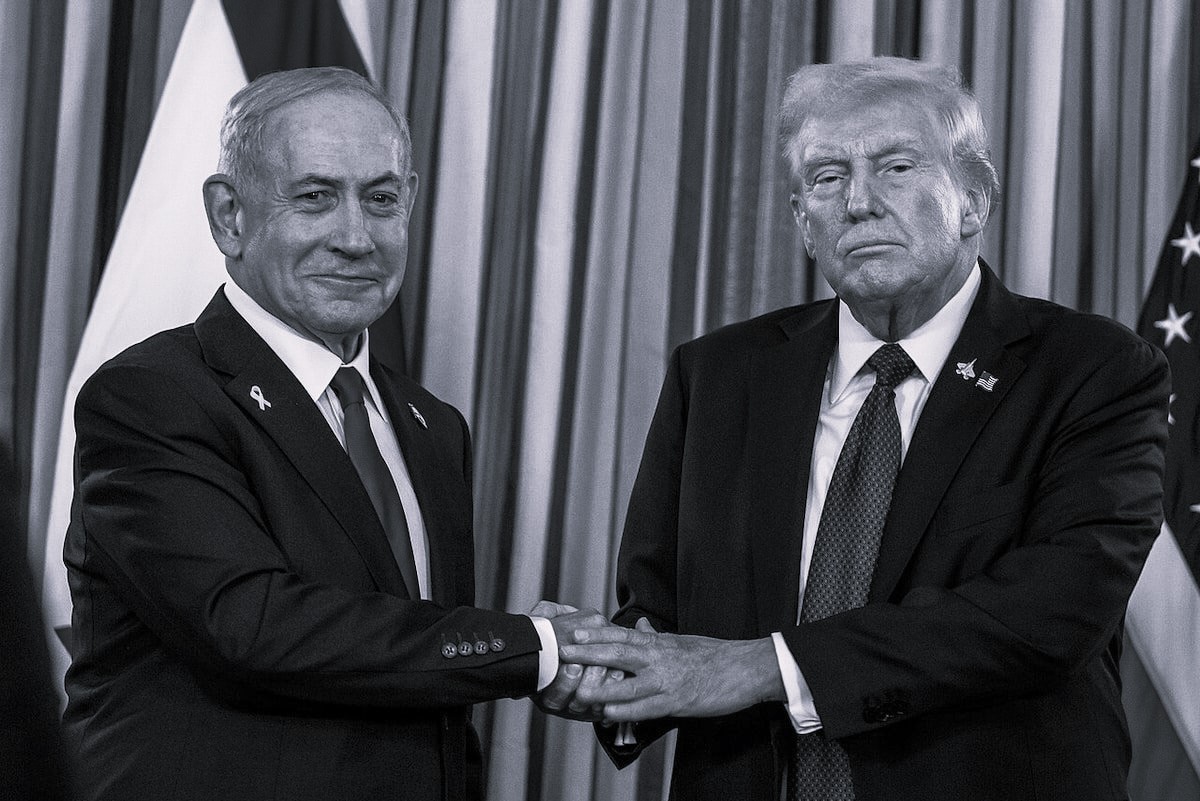
After bombing Gaza to pieces, Israel now joins Trump’s ‘Board of Peace’
On the very day Israeli fire killed 13 Palestinian civilians including two teenage boys collecting firewood and three journalists documenting a displacement camp Israel also agreed to join the United States-led “Board of Peace” to oversee Gaza’s reconstruction . The timing could not have been more stark.
As hospitals across the besieged enclave received the bodies of children, journalists and civilians , Washington confirmed that Israeli Prime Minister Benjamin Netanyahu had accepted President Donald Trump’s invitation to become part of a new international body tasked with supervising Gaza’s ceasefire, reconstruction and post-war governance .
The contradiction has drawn sharp global attention. A state accused by humanitarian agencies and rights groups of committing genocide is now being formally inducted into a peace mechanism meant to rebuild the very territory it has relentlessly bombarded for more than two years .
Trump’s Board of Peace , initially conceived as a limited oversight panel for the Gaza ceasefire , has rapidly expanded into a far more ambitious geopolitical structure. Chaired by Trump himself , the board is being projected as a global conflict-resolution platform that could operate beyond Gaza and, by the US president’s own admission, potentially rival the role of the United Nations .
Under the framework, a Gaza Executive Board will oversee ceasefire enforcement, international security arrangements, reconstruction funding and civil administration . A parallel Palestinian technocrats committee is expected to manage day-to-day governance, but under the supervision of the executive board not independently .
That distinction has become central to growing criticism.
With Israel now a formal member of the structure, analysts argue the arrangement effectively ensures that Gaza will remain under Israeli control administratively and financially even without permanent troops on the ground . Control of borders, airspace, aid corridors and reconstruction contracts would continue to rest with institutions shaped by Israel and its closest allies.
More than 50 countries were invited to join the initiative, with the White House claiming around 30 are expected to participate . Those that have accepted include Israel, Egypt, the UAE, Morocco, Bahrain, Pakistan, Hungary, Argentina, Armenia, Azerbaijan, Kazakhstan and Vietnam .
Major global powers, however, remain cautious.
India, China, Russia, the European Union, Britain, Germany and Italy have not committed. France, Norway and Sweden have declined outright, warning that the initiative risks undermining the United Nations and international law .
China has stated it will not support any peace framework operating outside the UN system . Russia has said it will examine the proposal carefully . India has received an invitation but has made no announcement so far .
The hesitation among major powers underscores the core dilemma of Trump’s plan: while marketed as an international peace initiative , its legitimacy weakens when one of the principal belligerents becomes both participant and overseer .
By joining the board, Israel assumes the dual role of actor and adjudicator , influencing reconstruction funds, security deployments and governance models effectively shaping Gaza’s future on its own terms .
As Gaza continues to bury its dead children, journalists and civilians the world is being asked to accept a peace process in which the destroyer is also the architect of reconstruction .
Whether this marks a genuine pathway to stability or merely repackages domination as diplomacy remains the defining question.