
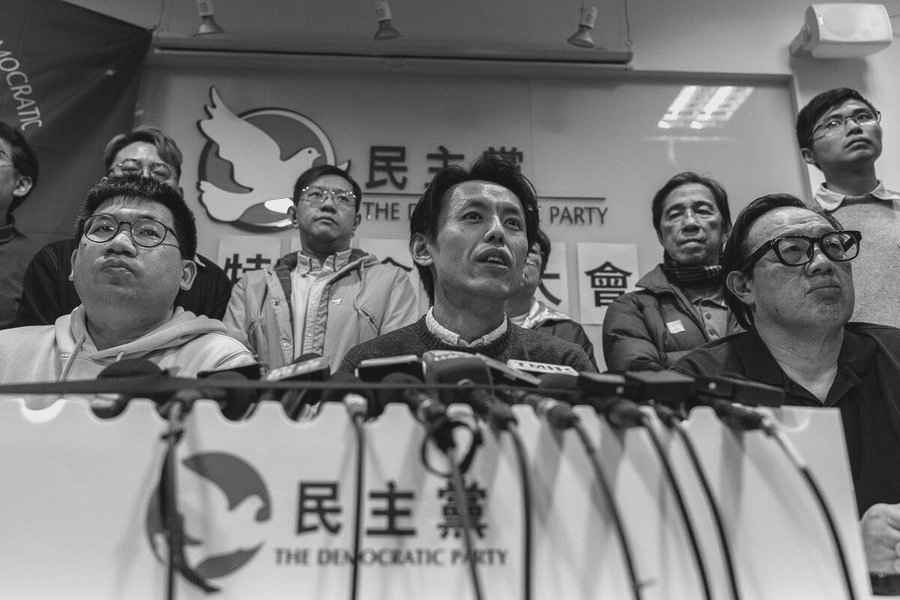
After 30 years of activism, Hong Kong’s democratic party moves to disband
Hong Kong’s largest pro-democracy party has voted to dissolve , drawing the curtain on more than three decades of political activism and marking a decisive shift in the city’s once- plural political landscape .
The Democratic Party confirmed on Sunday that nearly 97 per cent of ballots cast by its members supported liquidation of the organisation. Party chairperson Lo Kin-hei said the decision was considered the most viable path forward for members amid changing political realities. He said the chapter was being closed with deep regret as circumstances in the city had significantly evolved.
Lo earlier indicated that the move toward disbandment was shaped by the prevailing political situation and broader social climate. However, party veterans told The Associated Press that some members had been cautioned about possible consequences if the party continued operating.
The party’s dissolution underscores the erosion of political freedoms pledged to Hong Kong when it was handed back to China by Britain in 1997 under the “one country, two systems” framework .
Founded in 1994, the Democratic Party emerged as a moderate opposition force advocating democratic reforms, civil liberties and universal suffrage in the election of the city’s leader and legislature. Over the years, it became a central pillar of Hong Kong’s pro-democracy movement, winning multiple seats in the Legislative Council and securing dozens of directly elected district councillors who focused on local governance and community issues. Some former party members later joined the government as senior officials.
The party counted among its prominent figures Martin Lee, widely regarded as the city’s “father of democracy”, former chairs Albert Ho and Wu Chi-wai, and journalist-turned-politician Emily Lau. Its approach of engaging Beijing through dialogue culminated in its proposal being incorporated into the 2010 political reform package, a decision that drew criticism from radical democracy activists who sought faster and broader change.
The party’s influence waned as newer pro-democracy groups gained prominence, but it regained support during the 2019 anti-government protests.
Beijing’s imposition of a sweeping national security law in June 2020, following the protests, dramatically altered the political environment. Authorities said the law was necessary to restore stability, but it led to the arrest of numerous opposition figures, including former Democratic Party leaders and lawmakers. Media tycoon Jimmy Lai, founder of the now-defunct Apple Daily newspaper, was also charged under the law and is due to hear his verdict on Monday.
Apple Daily was among several independent media outlets shut down in recent years, as dozens of civil society organisations disbanded. These included the Civic Party , once the city’s second-largest pro-democracy group , and the organisation behind annual Tiananmen Square vigils . In June , the League of Social Democrats also announced its closure , citing intense political pressure .
In the years following the crackdown, the Democratic Party increasingly functioned as a pressure group, holding news conferences on livelihood issues and continuing limited advocacy. Electoral reforms aimed at ensuring that only “patriots” govern the city effectively excluded pro-democracy figures from the legislature and district councils. Despite this, the party submitted views on local national security legislation before it was enacted in March 2024 .
Earlier this year, the party established a task force to examine the procedures for winding up its affairs , and its leadership subsequently secured a mandate from members to proceed toward dissolution.
With its decision to disband, one of Hong Kong’s longest-standing symbols of organised democratic opposition has formally exited the political stage , reflecting the profound transformation of the city’s civic and political life .