
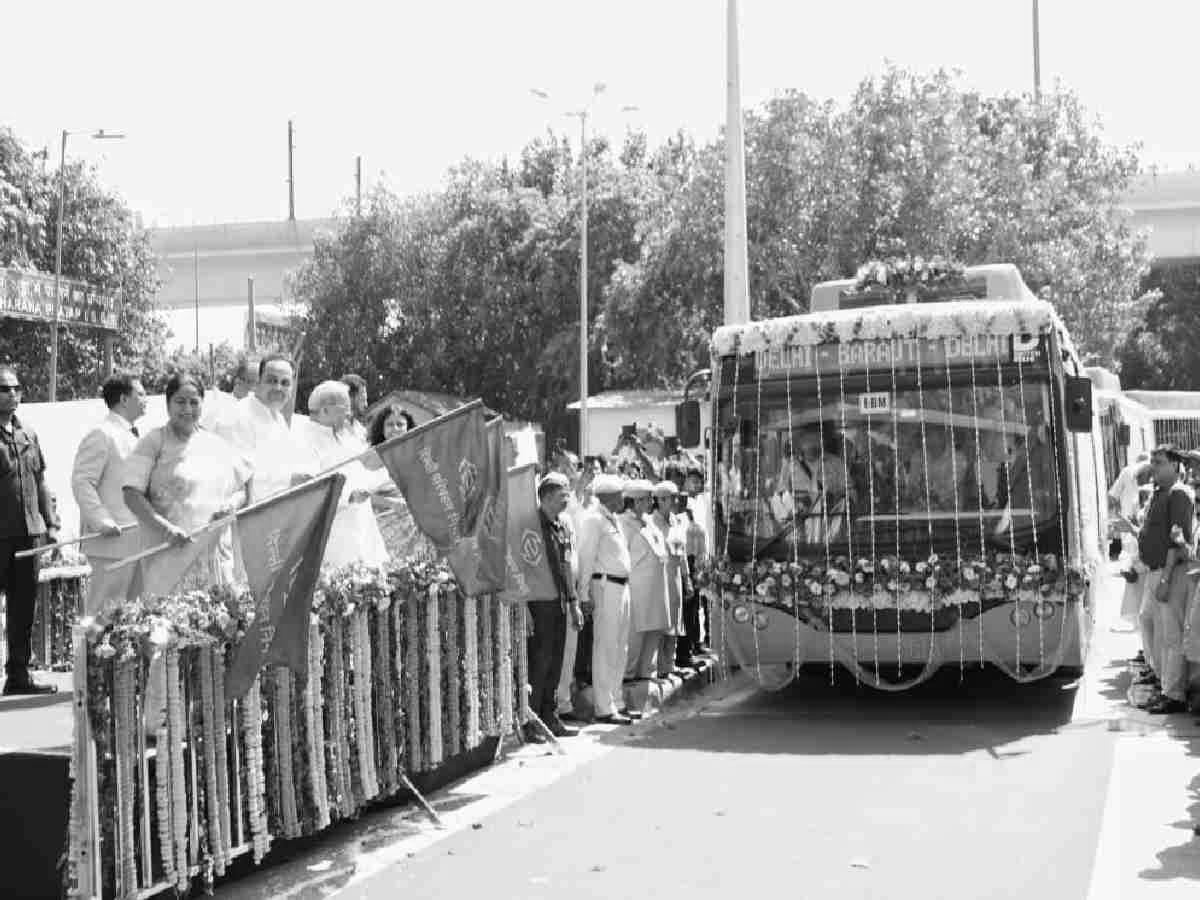
After 18 years, Delhi’s inter-state buses are back!
Delhi Chief Minister Rekha Gupta has brought back inter-state bus services in the national capital after an 18-year pause. On Tuesday, she inaugurated the electric DTC Delhi-Baraut air-conditioned bus service from Kashmere Gate, marking a new chapter for Delhi’s public transport. Baghpat MP Rajkumar Sangwan also joined the launch.
Grateful to the Delhi government officials and DTC staff, Gupta called them the “Hanuman” of Delhi’s development, highlighting their dedication in making this project a reality. She pointed out that for nearly two decades, Delhi had not run its own inter-state buses, even though buses from other states were operating within the city. “If private buses can run, why not Delhi Government buses? Citizens deserve these services,” she said.
The Delhi-Baraut route is just the first step. Gupta announced plans to introduce new inter-state routes every month, particularly connecting religious sites. She questioned why earlier governments had shut down a revenue-generating service for DTC and expressed confidence that the new system would be more efficient and transparent.
A major part of the revamp is the Automated Fare Collection System (AFCS), developed with Canara Bank. These modern machines replace manual ticketing and support cash, UPI, debit/credit cards, static QR codes, and National Common Mobility Cards (NCMC). Stickers with QR codes have been placed on all buses to enable contactless payments. “Now, every ticket sold will directly contribute to DTC’s revenue. This will help reduce losses and allow the government to address citizens’ needs better,” Gupta said. Initially, 3,000 machines are being installed across buses free of cost.
The government also launched the Chalo App on the ONDC platform, allowing passengers to book tickets digitally. To encourage adoption, a 10% discount is being offered. This integration aims to simplify commuting, particularly for younger users, and bring Delhi’s transport system in line with global standards.
To improve reliability, the government has introduced a system to tackle bus breakdowns efficiently. Mechanics from the nearest depot will be deployed quickly, reducing delays and traffic disruptions. Route rationalisation is also planned, ensuring buses reach every corner of the city and fixing past gaps in connectivity.
The newly-launched fully-electric Delhi - Baraut buses operate on fixed schedules and cover major stops, including Maharana Pratap ISBT, Khajoori Khas, Bhajanpura, Loni, Mandola, Khekra, Baghpat, and Baraut. These services aim to reduce dependence on private operators, improve regional connectivity, and promote eco-friendly travel.
Gupta also announced Delhi’s first major automated pollution checking station at Nand Nagri, sparing drivers the hassle of going to neighbouring states for checks. In addition, agreements have been made with private schools, starting with Sardar Patel School, to transition their fleets to electric buses.
Transport Minister Pankaj Singh added that the government is committed to revitalising DTC, restoring its past dignity, and modernising the entire transport system. The vision is clear: a cleaner, more reliable, and digitally enabled public transport system that benefits every citizen of Delhi.