
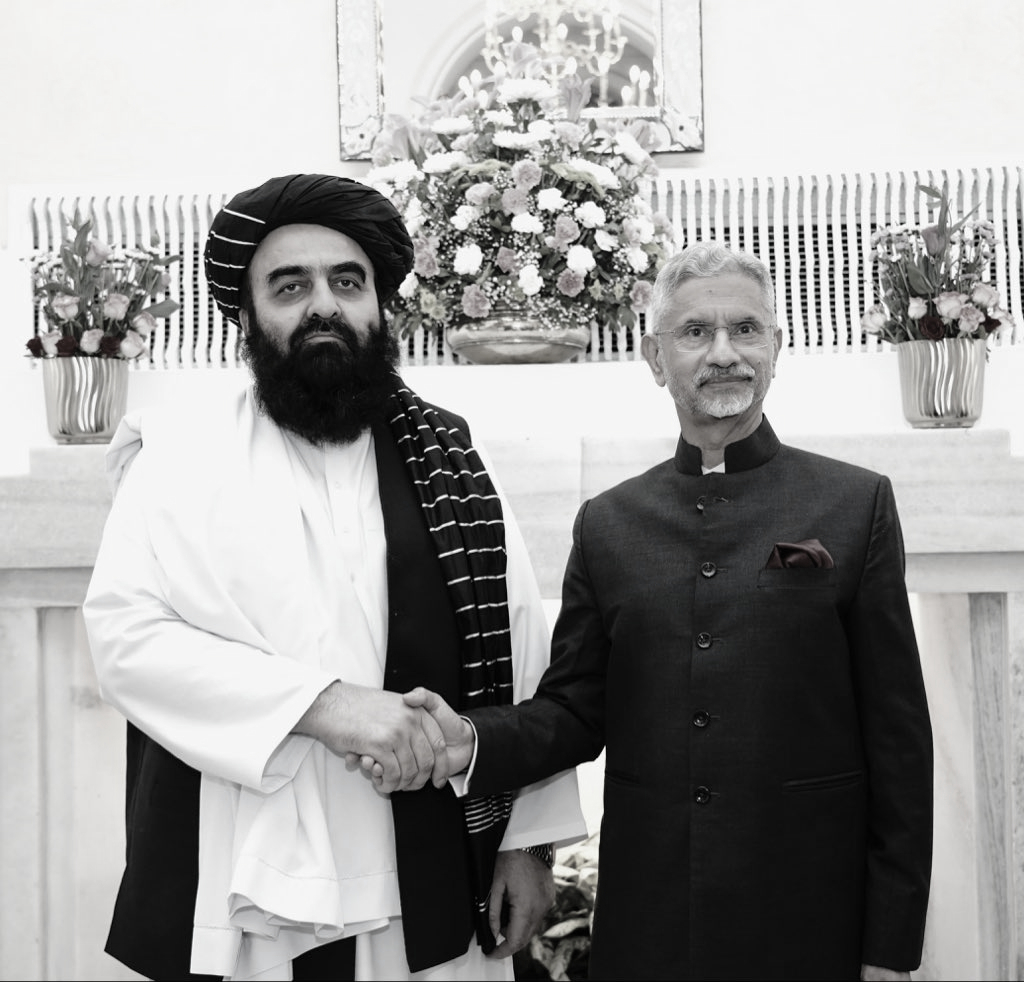
Afghan FM Muttaqi in India: Jaishankar extends warm welcome
Afghanistan’s Foreign Minister Mawlawi Amir Khan Muttaqi met with India’s External Affairs Minister S. Jaishankar at Hyderabad House in New Delhi. The meeting covered political, economic, diplomatic, regional, and security issues, representing a significant step in India’s pragmatic engagement with the Taliban government. During the talks, Jaishankar announced that India’s Technical Mission in Kabul would be upgraded to the full status of the Embassy of India, saying, “India is fully committed to the sovereignty, territorial integrity and independence of Afghanistan… To enhance that, I am pleased to announce today the upgrading of India’s Technical Mission in Kabul to the status of Embassy of India.”
Muttaqi arrived in New Delhi on Thursday, October 9, for a week-long visit (October 9-16). This marks the first high-level delegation from Kabul to India since the Taliban took control of Afghanistan in August 2021. The UN Security Council granted a temporary travel exemption for Muttaqi to allow his visit, despite his name being listed under international travel sanctions.
Jaishankar, in a statement posted on X, reaffirmed India’s commitment to Afghanistan’s stability, emphasizing cooperation against terrorism. He said, “We have a common commitment towards growth and prosperity. However, these are endangered by the shared threat of cross-border terrorism that both our nations face. We must coordinate efforts to combat terrorism in all its forms and manifestations.” He appreciated Afghanistan’s solidarity after the Pahalgam terror attack, calling it “noteworthy.” Muttaqi, highlighting the depth of bilateral ties, stated, “Afghanistan looks at India as a close friend.” Analysts observed that this sentiment reflects Kabul’s shifting perception, especially as Pakistan has failed to act like a genuine friend to the Afghan people, accused of bombing Afghan border regions, making India’s role increasingly important for stability and cooperation.
India also unveiled a range of new development and humanitarian projects during the meeting. Twenty ambulances were gifted to Afghanistan, with five handed over personally to Muttaqi as a symbolic gesture. Additional assistance included MRI and CT scan machines for hospitals, vaccines and cancer medicines for public health, and drug rehabilitation materials supplied through the UNODC. A new consignment of food aid reached Kabul on the same day, alongside India’s pledge to support reconstruction in earthquake-affected areas. Six new development projects were also announced, details of which will be revealed later. The projects build on India’s previous contributions, including landmark initiatives such as the Salma Dam (Afghan-India Friendship Dam), reinforcing India’s long-standing support for Afghan reconstruction.
Muttaqi reaffirmed Afghanistan’s stance on sovereignty and security, saying, “Afghanistan will never allow anyone to use the territory of Afghanistan against others.” He made it clear that no foreign military presence would be tolerated, including at the former Bagram Air Base. “Afghanistan is a sovereign country, and it will remain so. If you want relations, you can engage through a diplomatic mission, but we do not accept anyone in military uniform,” he added. He also acknowledged India’s early humanitarian response after recent natural disasters, such as the Herat earthquake, calling it a sign of “true friendship.”
Both sides agreed to establish a Trade Committee to enhance economic cooperation. Muttaqi invited Indian businesses to explore investment opportunities in Afghanistan’s mineral and energy sectors and to expand the air corridor that facilitates trade between the two countries. The discussions reflected mutual recognition that economic stability is key to long-term peace in the region.
Jaishankar reiterated India’s broader message, emphasizing the importance of stability and development in Afghanistan. He said India, as a contiguous neighbour and well-wisher, has a deep interest in Afghanistan’s future. He underscored, “We must coordinate efforts to combat terrorism in all its forms and manifestations.” Jaishankar also thanked Afghanistan for its understanding of India’s security sensitivities and noted the importance of continued dialogue through diplomatic missions.
Muttaqi highlighted that earlier engagements with Indian officials, such as his meeting with Foreign Secretary Vikram Misri in Dubai and the visit of India’s envoy Anand Prakash to Kabul in April, had opened a new chapter in relations. He added that a diplomatic delegation from the Islamic Emirate would soon arrive in Delhi to continue discussions. Both sides agreed to enhance dialogue and cooperation in trade, health, and cultural sectors, drawing on the centuries-old civilizational ties between the two nations, immortalized in Rabindranath Tagore’s “Kabuliwala,” a story that continues to symbolize the enduring bond between Indians and Afghans.
The United Nations approved Muttaqi’s visit under a tightly controlled travel exemption meant to facilitate diplomatic and humanitarian dialogue. The exemption, however, does not imply recognition of the Taliban government. The UN emphasized that the purpose was to ensure continuity of humanitarian projects and maintain stability in a region still grappling with economic and social challenges.
Pakistan’s response to the visit was cautious and critical. The Pakistani Foreign Office warned that any Indian “misadventure” in Afghanistan would be met with a “robust posture,” expressing concern that Afghan territory could become a haven for anti-Pakistan militant groups such as the Tehreek-e-Taliban Pakistan (TTP). Pakistani analysts viewed the visit as a diplomatic setback, noting that India’s growing engagement could reduce Islamabad’s traditional influence in Kabul.
Coinciding with Muttaqi’s visit, Kabul experienced explosions near Abdul Haq Square, reportedly targeting TTP militants such as Noor Wali Mehsud. Although some speculated a possible Pakistani link, officials clarified that the blasts were unrelated to the diplomatic meetings, though their timing underscored Afghanistan’s volatile security environment.
From the international perspective, the United States is likely to view India’s outreach with cautious understanding. Washington recognizes that India’s engagement remains limited to humanitarian, developmental, and counterterrorism dialogue, not political recognition. While some analysts interpret the visit as a tilt toward Russia—particularly since Moscow formally recognized the Taliban in July 2025, India’s position remains balanced. It continues to maintain close relations with the U.S. and its partners while adopting a pragmatic approach to regional diplomacy.
As of October 2025, Russia remains the only country to have formally recognized the Taliban government. China, the UAE, Pakistan, Iran, Turkmenistan, and Kazakhstan have accepted Taliban diplomats but stopped short of granting full recognition. India’s engagement must therefore be understood as interest-driven, focused on protecting humanitarian operations, securing regional stability, and maintaining diplomatic flexibility, not as an endorsement of the Taliban regime.
In essence, Amir Khan Muttaqi’s visit to India marks a delicate yet strategic step toward pragmatic engagement. It reflects India’s ability to engage with Afghanistan’s de facto rulers without conferring legitimacy, while pursuing humanitarian and security priorities. For Afghanistan, the visit offers a platform for limited international legitimacy and much-needed development cooperation. The visit underscores a shared recognition that stability in Afghanistan serves not just its people but the broader region, as India reasserts its historic role as a trusted friend of the Afghan nation.