
Adani-Embraer Tie-Up to Build ₹5,000-Crore Regional Aircraft Ecosystem in India
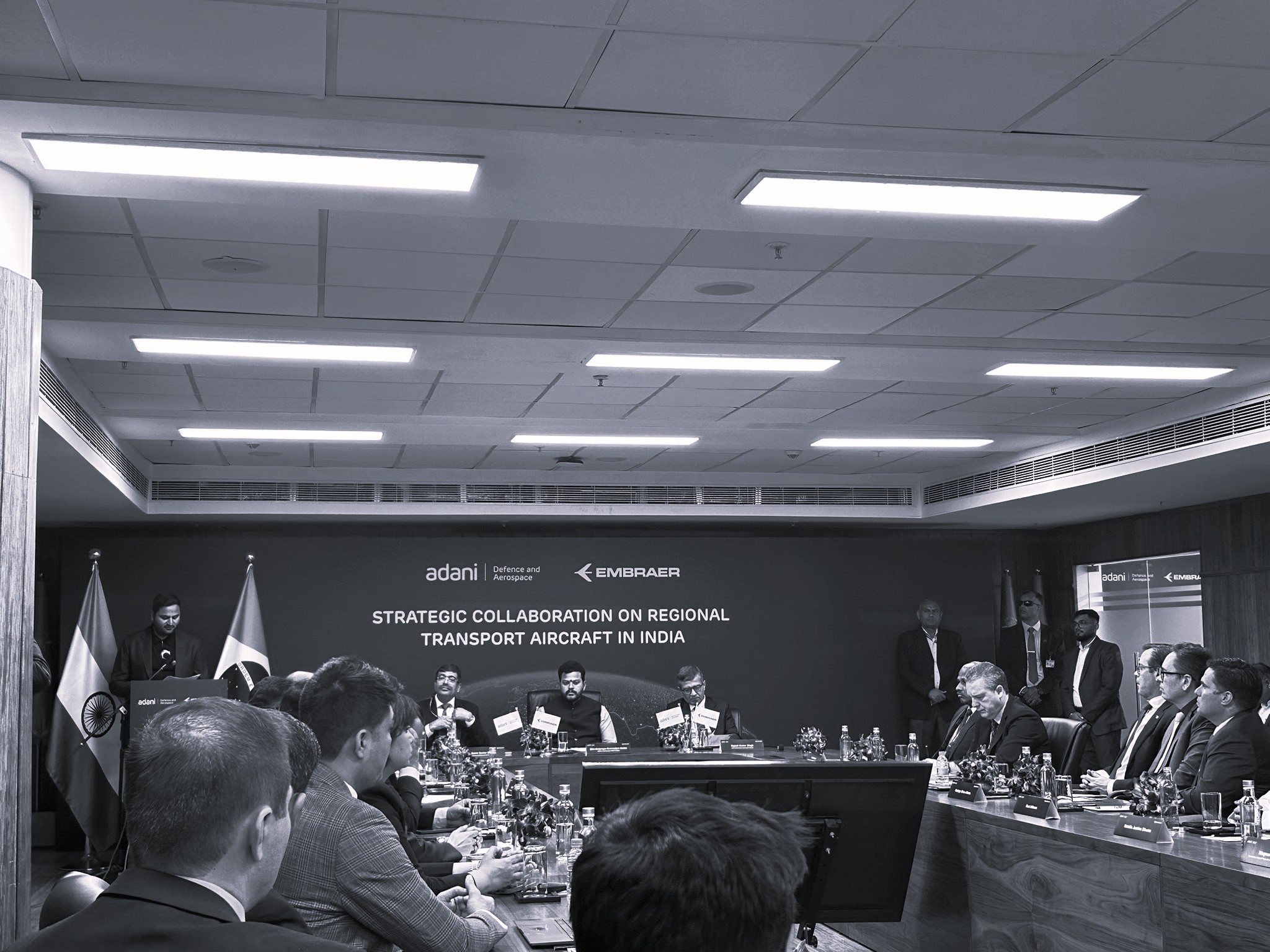
The Adani Group and Brazilian aerospace major Embraer have signed a strategic agreement to establish a regional aircraft manufacturing ecosystem in India, marking a significant shift in the country’s civil aviation landscape. The Memorandum of Understanding was formalized under the guidance of the Ministry of Civil Aviation, with participation from Adani Defence & Aerospace and senior government officials. The partnership aligns with national initiatives like Make in India and Atmanirbhar Bharat , aiming to reduce import dependence and position India as a future aircraft manufacturing hub.
Under the agreement, a Final Assembly Line (FAL) will be set up in India where aircraft will initially be assembled using imported components, followed by phased technology transfer to enable domestic production of parts and systems. The project is expected to involve an initial investment ranging between ₹2,000–5,000 crore , covering assembly infrastructure, testing facilities, hangars, and maintenance units. Potential locations under evaluation include Gujarat and Maharashtra , with a final site decision likely in the coming months.
The focus will be on Embraer’s E-Jet E2 family , particularly aircraft in the 80–150 seat category suited for regional connectivity. India’s aviation market is projected to require nearly 500 regional aircraft over the next two decades, especially to connect Tier-2 and Tier-3 cities. These aircraft are capable of operating from shorter runways, which strengthens the government’s UDAN scheme aimed at improving access to underserved regions.
The partnership is structured as a strategic industrial collaboration, with the exact ownership model and joint venture details to be finalized in subsequent agreements. Beyond assembly, the project envisions development of testing centers, maintenance and repair operations, delivery systems, and pilot training facilities. This integrated approach is expected to create high-skilled jobs for engineers, technicians, and aviation professionals, while also supporting a wide supplier base of MSMEs involved in component manufacturing.
Government leaders and company executives emphasized the long-term vision of building a complete aviation value chain in India. Adani officials described the initiative as a milestone in strengthening domestic aerospace capabilities, while Embraer highlighted India’s importance as a growth market and strategic partner. Over time, the project is also expected to open export potential , enabling India to supply aircraft and components to regional and global markets.
Strategically, this collaboration becomes one of the most important private-sector aviation manufacturing initiatives in India after the Tata–Airbus project. By combining global aerospace expertise with India’s industrial capacity, the Adani–Embraer partnership could play a defining role in transforming the country into a competitive global aviation hub , boosting employment, technology depth, and long-term industrial growth.