
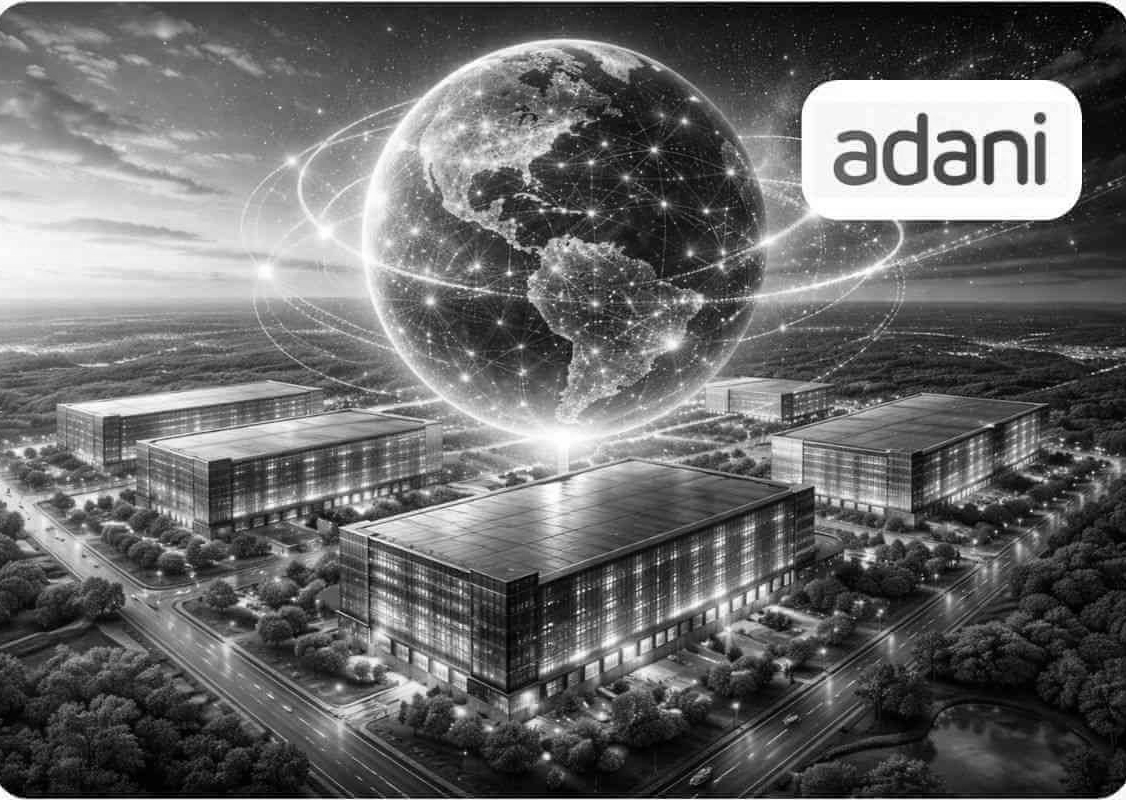
Adani Unveils $100 Billion Renewable-Powered AI Data Centre Plan for India
The Adani Group has unveiled an ambitious plan to invest USD 100 billion by 2035 to build renewable-energy-powered, hyperscale AI-ready data centres across India, positioning the country at the forefront of the global artificial intelligence infrastructure race. The conglomerate said the initiative could catalyse an additional USD 150 billion in related sectors including server manufacturing, cloud platforms, grid equipment, and digital supply chains potentially creating a USD 250 billion AI infrastructure ecosystem .
Announcing the initiative, chairman Gautam Adani described the moment as an “intelligence revolution” more transformative than past industrial shifts, arguing that nations capable of aligning energy capacity with computing power will shape the next decade. He emphasised that India has the opportunity to become not merely a consumer of AI technologies but a creator, builder, and exporter of intelligence , supported by a sovereign digital backbone.
At the core of the roadmap is an integrated model that combines green energy generation, storage, and hyperscale computing a critical advantage as AI workloads require enormous and uninterrupted electricity. The plan builds on AdaniConneX’s existing 2-gigawatt national data centre platform , expanding capacity toward 5 GW , one of the largest such footprints globally. Renewable power, grid resilience systems, and battery storage are expected to ensure low-carbon, reliable energy for compute-intensive AI operations.
Strategic partnerships are central to the expansion. The group has collaborated with Google to develop a gigawatt-scale AI data centre campus in Visakhapatnam , while Microsoft is working with the company on hyperscale facilities in Hyderabad and Pune . Discussions are also underway with other global technology players to establish additional campuses. The conglomerate is deepening collaboration with Flipkart to build another AI data centre designed to support high-performance workloads and next-generation digital commerce.
India’s growing digital economy and data localisation requirements are accelerating demand for domestic infrastructure. Although the country generates a significant share of global data, its data centre capacity remains comparatively limited, creating a substantial opportunity for expansion. With strong subsea cable connectivity, power availability, and skilled talent pools, cities such as Visakhapatnam and Hyderabad are emerging as strategic hubs in the evolving AI ecosystem.
Industry analysts view data centres as the “factories of the AI age,” enabling innovation across fintech, e-commerce, smart cities, research, and government digital services. If realised at scale, the initiative could strengthen India’s position in the global AI supply chain, stimulate domestic electronics manufacturing, create high-skill employment, and enhance data sovereignty.
However, the plan also faces challenges, including high capital intensity, cooling and water requirements, regulatory complexities, and rapid technological evolution. Even so, the project signals India’s shift from an IT services powerhouse to a potential global hub for AI infrastructure , underscoring the strategic convergence of energy security, digital sovereignty, and advanced computing in the decades ahead.