
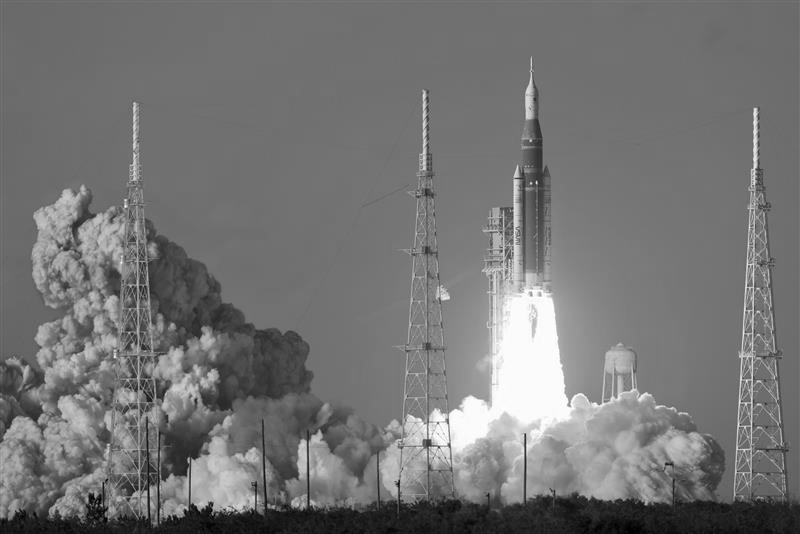
A Trip to the Moon After 50 Years Explodes into Action with Artemis II Launch
In a historic return to deep space exploration, NASA’s Artemis II mission has set humanity on a renewed path toward the Moon, marking the first crewed journey in more than 50 years. Launched aboard the Space Launch System (SLS) rocket from Kennedy Space Center, the mission is not merely a symbolic revisit of past achievements, but a carefully designed step toward building a sustained human presence beyond Earth.
The 10-day mission carries four astronauts Reid Wiseman , Victor Glover , Christina Koch , and Jeremy Hansen forming the most diverse crew ever sent on a lunar trajectory. Representing a significant shift from the Apollo era, the mission includes the first woman, the first person of colour, and the first non-American astronaut to participate in a lunar mission, underscoring a broader vision of space exploration as a shared human endeavour.
At its core, Artemis II is a critical test mission aimed at validating the technologies and systems required for future lunar landings. Unlike earlier missions that focused on reaching and landing on the Moon, Artemis II is designed to ensure that astronauts can safely travel, operate, and survive in deep space. The Orion spacecraft , equipped with full life-support systems for the first time, will be tested under real conditions far beyond Earth’s protective magnetosphere.
The mission will unfold in carefully planned phases. During the first 24 to 25 hours, the crew will remain in Earth orbit, conducting detailed checks of onboard systems. Once these evaluations are complete, Orion will fire its engines and begin its journey toward the Moon. The spacecraft will travel roughly 400,000 kilometres from Earth, swing around the Moon, and venture nearly 6,400 kilometres beyond it farther than any human has ever gone before beginning its return.
This trajectory, known as a free-return trajectory , allows the spacecraft to loop back to Earth using gravitational forces, reducing fuel dependency and enhancing safety. Throughout the journey, astronauts will test manual control of the spacecraft, evaluate navigation and communication systems, and capture unprecedented views of the Moon, including a rare solar eclipse observation from space.
The core objectives of Artemis II are central to the future of human spaceflight. These include testing life-support systems in deep space, assessing astronaut safety under radiation exposure, validating propulsion and navigation systems, and ensuring the spacecraft can withstand the extreme heat of high-speed re-entry into Earth’s atmosphere.
The crew is expected to return to Earth around the 10th day of the mission, concluding with a splashdown in the Pacific Ocean. This safe return will be one of the most critical indicators of mission success, confirming that both the spacecraft and its systems can perform reliably under the most demanding conditions.
Despite its promise, Artemis II carries inherent risks. The Space Launch System has previously encountered technical challenges, including hydrogen fuel leaks, while the Orion capsule’s heat shield showed unexpected wear during the earlier uncrewed mission. Additionally, astronauts will face the dangers of deep space radiation and the complexities of operating far beyond Earth’s immediate support systems.
Beyond its technical significance, Artemis II is unfolding within a broader geopolitical context. With countries like China advancing their own lunar ambitions, the mission reflects a renewed global competition in space this time focused on long-term presence, scientific advancement, and strategic advantage.
Looking ahead, Artemis II is a foundational step in NASA’s long-term vision of establishing a sustainable human presence on the Moon. Future missions aim to test landing systems, explore the lunar south pole, and build infrastructure that can support continuous human activity, ultimately preparing humanity for missions to Mars.
Ultimately, Artemis II represents a turning point in human exploration. Moving beyond the era of brief visits and symbolic milestones, it signals a commitment to long-term exploration and habitation in space, opening the door to humanity’s next great chapter beyond Earth.