
A Pattern, Not a Coincidence: Kejriwal's Uncomfortable Questions for Justice Sharma
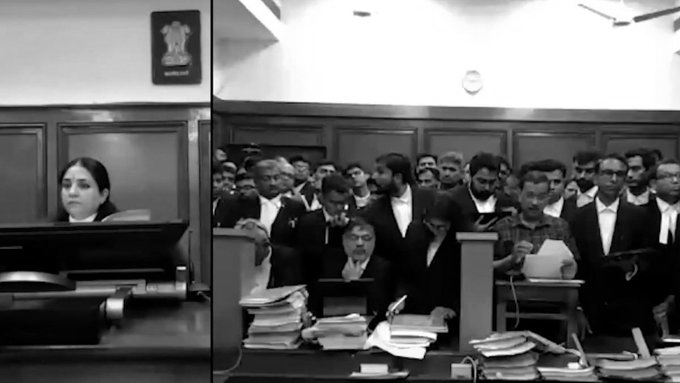
The Delhi excise policy case took a combustible turn on April 13 when Arvind Kejriwal appeared in person before the Delhi High Court to demand the recusal of Justice Swarana Kanta Sharma , citing what he called a "real, grave, and reasonable apprehension of bias" , a phrase carefully chosen to invoke established legal doctrine rather than personal accusation. What unfolded over four hours was less a routine procedural hearing and more a reckoning with a question India's judiciary has long deferred: can justice be seen to be done when everything around a case suggests it cannot?
Kejriwal pointed out that Justice Sharma had attended four events organised by the Akhil Bharatiya Adhivakta Parishad , widely regarded as the RSS's legal wing and that since his party stood in open ideological opposition to that worldview, her repeated participation created a reasonable perception of alignment. "You attending their programme four times gives me the impression that, since I believe in the opposite ideology, will I get justice? " he asked, directly and without flinching. He further alleged a clear pattern: that every single averment of the CBI and ED had been endorsed in her orders, and that on March 9, in a five-minute ex parte hearing attended only by the CBI's lawyer, the court had declared a trial court order, passed after three months of day-to-day hearings across 40,000 pages, as prima facie erroneous .
Kejriwal argued that earlier judicial language had effectively "declared him corrupt" before any conviction, a charge that stings especially given that the trial court ultimately discharged him and 22 others, finding the CBI's case too weak to proceed. The pattern he laid out was damning in its specificity: Justice Sharma had rejected bail for Kejriwal, Manish Sisodia, Sanjay Singh, and K. Kavitha , while also staying the conviction of BJP leader and former Union minister Dilip Ray in a coal scam case just days before the Lok Sabha elections, conveniently allowing him to contest.
Justice Sharma's son Ishaan Sharma and daughter Shambhavi Sharma were both empanelled as Union Government panel counsels , at the Delhi High Court and the Supreme Court respectively,in September and November 2025. The very same Central Government, represented before Justice Sharma by Solicitor General Tushar Mehta , is now arguing against Kejriwal. In plain terms: the careers of the presiding judge's children are in the hands of the party appearing before her.
India's legal tradition carries within it a principle older than any statute, justice must not only be done, it must be seen to be done. The convergence of ideological association, a one-sided order record, a politically convenient bail for a BJP candidate, and direct patronage links to the opposing party's counsel is not merely uncomfortable. It is, by any honest measure, a textbook conflict of interest . Justice Sharma has reserved her order on the recusal plea. Whether she steps aside or soldiers on, the question Kejriwal raised in that courtroom will not be so easily dismissed.