
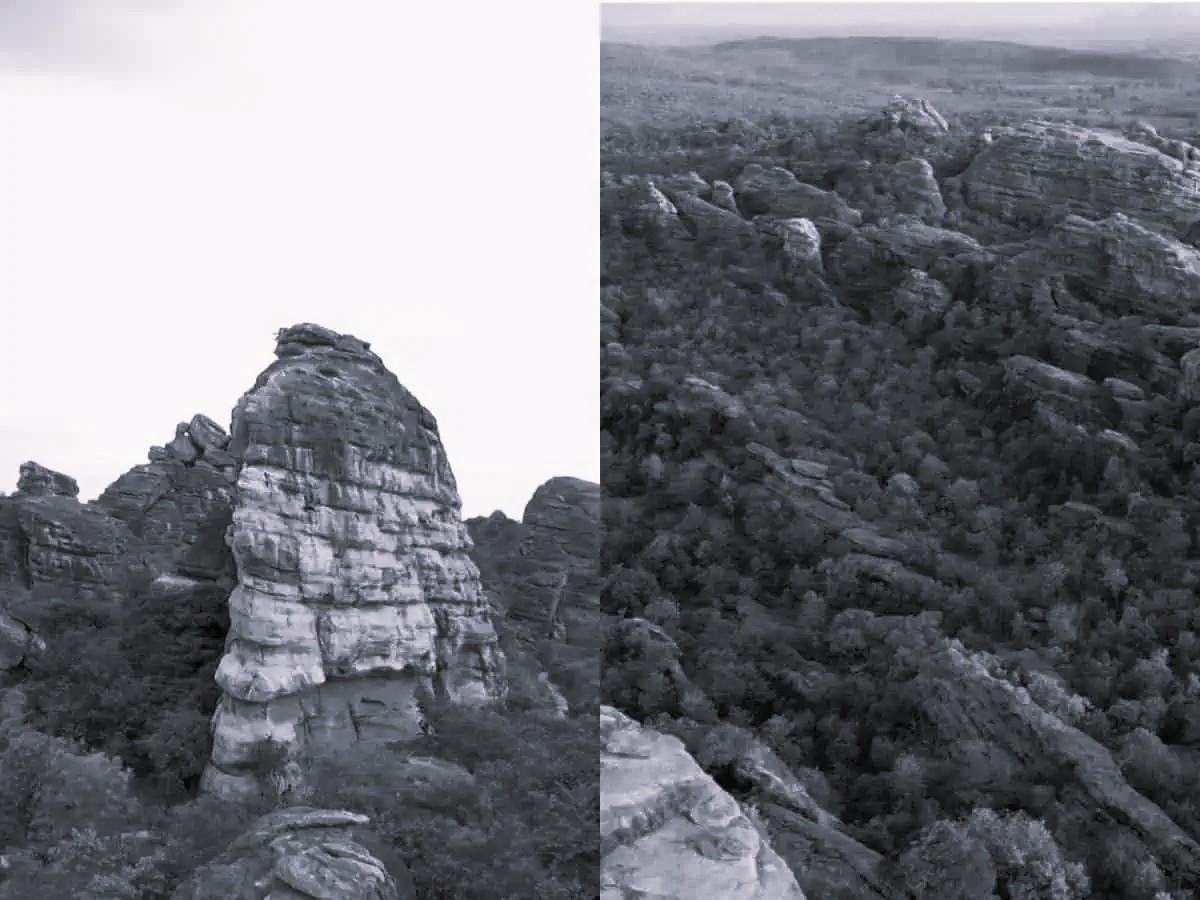
A Natural Masterpiece Hidden in the Forests of Telangana: Pandavula Gutta
The landscape of Telangana is adorned with numerous historical monuments, formidable forts, and ancient temples. However, there exists a unique destination sculpted not by human hands, but by Nature herself over millions of years of patient labor. This is Pandavula Gutta . Located in the Jayashankar Bhupalpally district, within close proximity to the historic city of Warangal, this 'Geo-Heritage Treasure' is a paradise for nature enthusiasts. Resembling the world-famous sandstone arches of Utah, USA, this site serves as an extraordinary stage for those who seek a blend of ancient history and raw adventure.
Geological Antiquity: Rocks Older Than the Himalayas
The distinction of Pandavula Gutta lies in its staggering antiquity. According to geologists, these sandstone hillocks in the Deccan Plateau are far older than the Himalayan mountain range. Over eons, the relentless friction of wind and the steady flow of rainwater have eroded these rocks, molding them into bizarre and fascinating shapes. Consequently, this site has been recognized as the only Geo-Heritage Site in Telangana. When the red sandstone cliffs shimmer under the golden rays of the evening sun, the landscape transforms into a mystical world, offering an experience that feels almost otherworldly.
The Natural Arch: Nature’s Version of the 'Delicate Arch'
Upon entering this domain, the first marvel to greet a traveler’s eye is the unique natural rock arch. Known locally as the 'Natural Arch,' its specialty lies in its shifting persona; its form changes remarkably depending on the angle of observation:
From the Front:
It resembles a crane with a long, elegant neck.
From the Rear:
It creates the illusion of a giant platypus head.
From the Side:
It bears a striking resemblance to the famous 'Delicate Arch' in Utah, USA. Lying beneath this arch and gazing upward, the ceiling appears at times like the hood of a giant cobra, at other times like a pensive human face, and occasionally like the alien protagonist from a classic Hollywood sci-fi film. This serves as a testament to Nature’s unparalleled sculptural prowess.
Vestiges of the Mesolithic Era
From a historical perspective, Pandavula Gutta marks the cradle of human civilization. The significance of these caves came to light in 1990 when officials from the Archaeological Survey of India, K. Ramakrishna Rao and S.S. Rangacharyulu, discovered the site. Evidence suggests that human habitation here dates back to the Mesolithic period, roughly between 4,000 to 20,500 years ago . These rock walls act as a time machine, transporting us back to the era of primitive humans who utilized these caves as shelters and etched their lifestyles onto the stone surfaces. It is not merely a hill; it is an ancient library preserving the evolution of mankind.
The Primitive Art Gallery
The rock paintings (petroglyphs) found within these caves remain astonishingly vivid to this day. Depictions of wildlife such as tigers, wild bison, antelopes, lizards, frogs, fish, and peacocks indicate the rich biodiversity that once thrived in this region. Furthermore, the presence of Swastika symbols and various geometric patterns—circles and squares—demonstrates the sophisticated thought processes and cultural foundations of early humans.
Particularly intriguing are the 'Boomerang' shaped paintings. These hunting tools serve as a profound metaphor: a reminder of the spiritual truth that whatever we cast out into the world inevitably returns to us. These artworks are not just colors on stone; they are historical signatures of a civilization's worldview.
The Slot Canyon: Telangana’s Nevada
For trekking enthusiasts, the 'Slot Canyon' at Pandavula Gutta is a breath-taking experience. Moving through the narrow passage between towering rocks, one feels as though they are traversing the 'Fire Canyon' of Nevada. As sunlight filters through these narrow crevices, the rocks shift through hues of red, brown, and yellow, offering a spectacular visual feast. During the monsoon, when water gushes through these narrows, the sight and sound are beyond description.
Mythological Lore: The Exile of the Pandavas
The name of this site is steeped in legend. Local tradition firmly believes that the Pandavas, from the epic Mahabharata, resided in these caves during their twelve-year exile (Vana Parva). The 'Kunti Devi Cave' is a major attraction here. The interior of this deep cave features formidable and majestic rock formations. The snake-hood-like structure crowning the cave adds an aura of sanctity and gravity to the location.
Enigmatic Rocks: Nandi, Alligator, and Face Rock
Nature has experimented with various forms here, creating a pantheon of rock shapes:
Nandi Rock:
A rock resembling Nandi, the sacred bull and vehicle of Lord Shiva, attracts many devotees.
Face Rock:
From a distance, this formation looks like a human profile, reminiscent of the Crazy Horse Memorial in South Dakota.
Alligator Rock:
A massive formation that looks like a giant alligator crawling through the forest, startling unsuspecting tourists.
Balanced Rock:
A single rock precariously balanced between two others, representing the pinnacle of nature's mysterious equilibrium.
Sunset: A Symphony of Colors
A journey to Pandavula Gutta is incomplete without witnessing the sunset. As the sun dips below the horizon, the western sky becomes a canvas of crimson, purple, and orange. Looking down from the hilltops, the lush green paddy fields reflect these radiant colors, making it seem as though the sky has descended to earth. The tranquil atmosphere, punctuated by the chirping of birds, provides a meditative escape from modern-day stress.
Rashtrakuta Inscriptions: Witnesses to Medieval History
In addition to prehistoric art, the site hosts several inscriptions from the medieval Rashtrakuta period, proving that this area remained a hub of human activity for millennia. These "Label Inscriptions" are vital historical markers.
Sri Utpatti Pidugu:
Found on the ceiling of the 'Eduru Pandavulu' rock shelter, this 8th or 9th-century inscription refers to a prestigious guild of architects or a specific title of that era.
Srimathu:
A recently discovered 7th-century inscription in the early Telugu-Kannada script.
Gonthemma Guha Inscription:
Discovered in 1990, further solidifying the site's Rashtrakuta connection.
These inscriptions, written in the ancient Telugu-Kannada script, reflect the social and religious dynamics of the time, including references to Buddhism and Jainism. They bridge the gap between the Mesolithic era and the medieval age, making Pandavula Gutta a continuous thread in the tapestry of Indian heritage.
Transport and Accommodation
Located 55 km from Warangal near Kothapally village, the site is easily accessible by road.
From Hyderabad:
It is approximately 200 km. Travelers should reach Warangal/Hanamkonda and proceed via Parkal towards Bhupalpally.
By Bus:
Take a bus from Hanamkonda towards Bhupalpally, alight at Regonda, and take an auto-rickshaw (15-minute ride) to the hills.
By Train:
The nearest major stations are Kazipet and Warangal.
Stay:
While there are no luxury hotels at the site, Hanamkonda offers excellent stay options, including the Telangana Tourism 'Haritha Kakatiya' hotel. Basic lodges are also available in Bhupalpally.
Essential Guidelines for Tourists
The Telangana Tourism and Forest Departments have developed this as an international-standard eco-tourism hub. While photography is currently permitted, visitors must adhere to strict conservation ethics.
Do not deface or paint over the ancient rock art. It is an irreplaceable ancestral heritage. The sandstone can be slippery; wear high-grip sports shoes for trekking. The site is remote; carry sufficient water, snacks, and food. Visit between 8:00 AM and 4:00 PM. Avoid staying after dark due to the forested terrain. Engaging a local forest department guide is highly recommended to accurately locate the hidden petroglyphs.
An Experience of a New World
Pandavula Gutta is not merely a collection of rocks; it is a living witness to millions of years of geological evolution and thousands of years of human civilization. Visiting this hidden gem in Jayashankar Bhupalpally is akin to exploring a different realm. Away from modern luxuries, nestled in the lap of nature amidst the echoes of ancient history, every moment spent here leaves an indelible mark on the soul. Whether you are a nature lover, a history buff, or a photography enthusiast, Pandavula Gutta awaits with secrets buried deep within its heart. Explore this 'Telangana Treasure' and immerse yourself in the wonders of the natural world!